Quick Answer
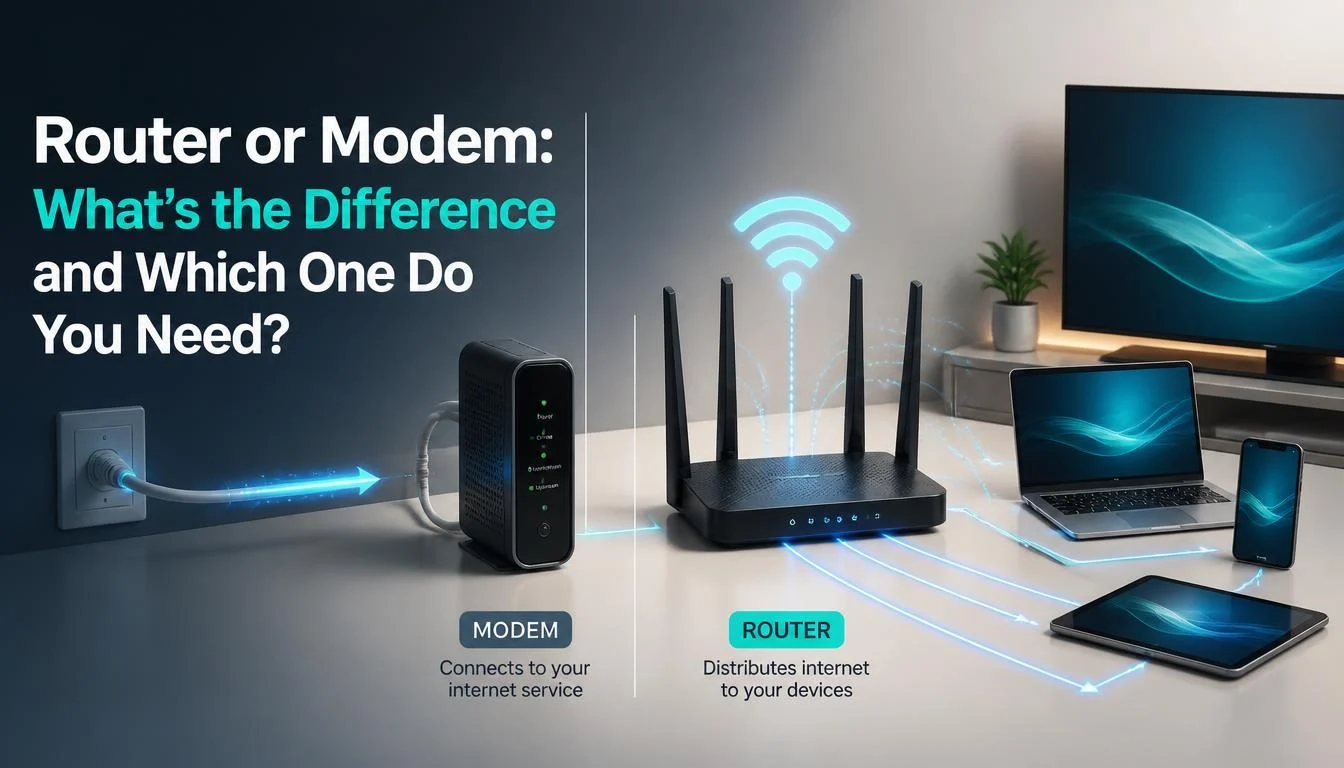
Both router and modem are correct words, but they describe different networking devices. A modem connects your home to your internet provider, while a router shares that connection with your devices.
When setting up home internet, it is easy to confuse a router with a modem. Although these devices often work together, they perform different jobs. A modem connects your home network to your internet service provider, while a router distributes that internet connection to multiple devices and helps them communicate with each other. Understanding the difference can make it much easier to set up, troubleshoot, or upgrade your network.
The terms router or modem often come up when people are buying networking equipment or trying to fix an internet problem. Knowing what each device does can help you choose the right equipment and avoid unnecessary purchases. In this guide, we’ll explain how routers and modems differ, how they work together, and when you may need one device, the other, or a combination of both.
Which One Is Correct?
Both router and modem are standard English words. Neither is an incorrect spelling or a grammatical alternative to the other.
The important difference is meaning. A modem communicates with your internet provider, while a router manages traffic between devices on your local network and the internet.
So, the right word depends on what you are describing.
For example:
- “I need to replace my modem because my ISP connection keeps dropping.”
- “My router is not sending Wi-Fi to the upstairs rooms.”
- “The technician installed a new modem and router.”
Calling a router a modem is technically inaccurate, even though many people do it in everyday conversation.
Meaning of the Correct Word
Definition
A router is a networking device that directs data between different networks. In a typical home, it manages communication between your local devices and the internet.
A modem is a device that connects your home or business network to an internet service provider. It translates and manages signals so your network can communicate through the provider’s connection.
In simple terms, the modem brings the internet connection into your home, while the router distributes and manages it.
Explanation
Think of your internet connection as a road entering your house.
The modem is like the entrance point connecting your property to the main road. It establishes communication with your internet provider.
The router is like a traffic controller inside your property. It decides where network traffic should go.
Suppose your home has a laptop, smartphone, smart TV, gaming console, and printer. They all need to communicate with the network. The router helps manage those connections.
A modem alone usually does not provide the same local-network management that a router does. Likewise, a router generally cannot replace a modem when your ISP requires a separate modem connection.
Usage
The word router commonly appears in conversations about:
- Wi-Fi networks
- Home networks
- Ethernet connections
- Network traffic
- Wireless connectivity
- Network security
- Port forwarding
- Connected devices
The word modem commonly appears when discussing:
- Internet service
- ISP connections
- Cable internet
- DSL internet
- Fiber equipment
- Connection problems
- Internet activation
- Signal conversion
Pronunciation also differs slightly.
Router is commonly pronounced “ROW-ter” in American English. You may also hear “ROOT-er,” especially in other English varieties.
Modem is pronounced “MOH-dem.”
Real-World Examples
Here are several natural examples:
“I restarted the router because my laptop could not connect to Wi-Fi.”
“The modem shows that the internet signal is active.”
“We bought a faster router to improve wireless coverage.”
“Our ISP replaced the old modem after the connection became unstable.”
“The router connects all the devices in my apartment.”
These examples show why substituting one term for the other can change the technical meaning.
Meaning of the Incorrect or Alternative Word
Incorrect
Neither router nor modem is inherently incorrect. The mistake happens when someone uses one word to describe the function of the other.
For example, saying “My modem controls my Wi-Fi network” may be inaccurate if the device performing that function is actually the router.
The confusion is understandable because many internet providers supply a single device that combines both functions.
Typo
Neither term is a common spelling mistake for the other.
Some people may type “rouder” instead of “router” or “modem” with accidental letter changes. Those are simply spelling errors.
The standard spellings are:
- router
- modem
Slang
Neither word is slang. Both are established technical terms that have become common in everyday English.
People sometimes use informal expressions such as “Wi-Fi box” or “internet box,” but these descriptions are less precise.
Regional Variation
There is no major American-versus-British spelling difference between router and modem.
The spelling remains the same across major varieties of English. Pronunciation can vary, particularly for router.
In American English, “ROW-ter” is very common. “ROOT-er” is also heard and is not automatically a pronunciation error.
Rare but Valid Usage
In technical contexts, router can refer to different types of networking equipment, including edge routers, core routers, wireless routers, and virtual routers.
Likewise, modem can refer to equipment designed for different connection technologies, such as cable, DSL, cellular, or other communication systems.
The exact function can therefore vary by technology, but the basic distinction remains useful: the modem handles the provider-side connection, while the router handles network traffic between connected networks.
Key Differences Between the Two Words
| Feature | Router | Modem |
|---|---|---|
| Spelling | Router | Modem |
| Meaning | Directs network traffic | Connects to the internet service |
| Pronunciation | “ROW-ter” or “ROOT-er” | “MOH-dem” |
| Grammar | Noun | Noun |
| Main role | Manages local network traffic | Establishes the ISP connection |
| Typical connection | Connects to modem and devices | Connects to ISP line and router |
| Wi-Fi | Often provides Wi-Fi | Usually does not by itself |
| Network management | Yes | Limited |
| Common setting | Home or office network | Internet connection |
| Recognition | Widely recognized | Widely recognized |
The clearest distinction is function rather than spelling.
A router creates and manages a local network. It can assign local addresses, direct traffic, provide wireless access, and apply network rules.
A modem communicates with the infrastructure operated by your internet provider. Depending on the service, it may use a cable line, telephone line, fiber connection, or another technology.
Router vs. Modem in a Home Network
A traditional setup might look like this:
Internet provider → Modem → Router → Your devices
The modem receives the connection from the provider. The router then manages the devices inside your home.
For example, when you open a website on your phone, the request travels through your router and modem before reaching the wider internet. The response then travels back through the same general chain.
Modern equipment can simplify this arrangement.
What Is a Modem-Router Combo?
A modem-router combo combines the two functions in one physical device.
That means one box may:
- Connect to your ISP.
- Establish the internet connection.
- Create your local network.
- Provide Wi-Fi.
- Connect wired devices.
This is one major reason people confuse router or modem. If the same box performs both jobs, it may be casually called either one.
However, technically, the device is performing two separate networking roles.
Common Mistakes People Make
Mistake 1: Calling Every Wi-Fi Device a Modem
Wi-Fi comes from a wireless access point, which is often built into a router.
Therefore, a device providing Wi-Fi is not necessarily functioning as a modem.
Mistake 2: Assuming a Modem Creates Wi-Fi
A traditional modem’s primary job is to connect your network to your ISP.
If you have a separate modem and router, the router is normally responsible for your home’s Wi-Fi network.
Mistake 3: Treating Router and Modem as Synonyms
These terms describe related but different networking functions.
They can work together, but they are not synonyms.
Mistake 4: Blaming the Router for Every Internet Problem
A failed internet connection does not always mean the router is faulty.
The problem could involve the modem, ISP, cables, service outage, or another part of the network.
Mistake 5: Using “Wi-Fi” and “Internet” as Exact Synonyms
Wi-Fi is a method of connecting devices to a local network wirelessly.
The internet is a global network of interconnected systems.
You can have strong Wi-Fi without having an active internet connection. For example, your phone may remain connected to your router while the ISP connection is down.
Correct Usage Examples
Casual Examples
These examples sound natural in everyday conversation:
- “Can you restart the router?”
- “The modem is showing a red light.”
- “Our router has a better range now.”
- “I think the modem needs to be replaced.”
- “The Wi-Fi works downstairs but not upstairs.”
These sentences use each term according to its normal function.
Professional Examples
Technical and workplace writing benefits from greater precision:
- “The router manages traffic between the office network and the internet connection.”
- “The modem establishes communication with the service provider.”
- “The network administrator replaced the router after identifying a hardware fault.”
- “The modem is operating normally, but the router is failing to distribute network traffic.”
In professional communication, precise terminology helps prevent troubleshooting mistakes.
Educational Examples
Teachers and technical writers often explain the distinction with a simple sequence:
“The modem connects your network to the ISP, while the router distributes that connection among your devices.”
Another useful example is:
“A home network may contain a modem, router, wireless access point, and several connected devices.”
This wording makes the separate roles easier to understand.
Literary/Metaphorical Examples
Technical terms can also work metaphorically, although this use is less common.
For example:
“The router acted like a traffic director, sending each request toward its destination.”
Or:
“The modem became the doorway between the household and the wider digital world.”
These descriptions are not technical definitions. They simply make the concepts easier to visualize.
Word Origin / Etymology
The two words have different histories.
Router comes from route, meaning a path or way from one place to another. The noun describes a device that routes or directs data along appropriate paths.
The underlying idea is straightforward: information travels through a network, and routing determines where that information should go.
Modem is a shortened technical formation from modulator-demodulator.
The word combines the ideas of modulation and demodulation. A modem converts signals for communication and interprets incoming signals in the reverse direction.
The term became especially familiar as computers began communicating through telephone networks. Older dial-up modems famously converted computer data into signals that could travel across telephone lines.
Modern internet connections use more advanced technologies, but the word modem remains part of everyday technical vocabulary.
Why the Incorrect Version Became Popular
There is no truly “incorrect version” of router or modem. The confusion comes from overlapping functions and changing consumer technology.
Older home setups often made the distinction easier to see because users had separate boxes. One device was the modem, and another was the router.
Today, internet providers frequently offer integrated equipment. A single gateway device may include modem, router, Wi-Fi, firewall, and other networking functions.
Consumers naturally refer to the entire box as a “modem” or “router,” even when it technically performs several roles.
Another source of confusion is the phrase “Wi-Fi modem.” Internet providers and retailers sometimes use simplified product language aimed at ordinary customers. That language can blur the technical distinction.
The result is a common everyday habit: people use modem, router, Wi-Fi router, and internet box somewhat interchangeably.
For casual conversation, that may cause little trouble. During technical support or troubleshooting, however, identifying the correct device can make a big difference.
Easy Memory Tricks
Here are simple ways to remember the difference.
Think “Modem = Main Internet Connection”
Remember:
Modem → ISP
The modem connects your network to the service supplied by your internet provider.
Think “Router = Routes Traffic”
The word router contains the idea of a route.
A router decides where network traffic should go.
So:
Router → Routes
That connection makes the word easier to remember.
Use the House Analogy
Imagine your home is a building.
The modem is the doorway connecting your building to the outside road.
The router is the person directing visitors to different rooms.
This is not a literal technical description, but it provides a useful mental shortcut.
Remember the Basic Chain
When in doubt, picture:
ISP → Modem → Router → Devices
This simple sequence captures the typical relationship between the two devices.
FAQs
Is a router the same as a modem?
No. A modem connects to your internet provider, while a router manages traffic between your devices and networks.
Do I need both a modem and a router?
Often, yes, when they are separate devices. Some modern gateway devices combine both functions into one unit.
Does a modem provide Wi-Fi?
A traditional modem usually does not provide Wi-Fi. A router or combined modem-router gateway normally handles wireless access.
Which is better, a router or modem?
Neither is “better” because they perform different jobs. Your network may need both functions.
Why do people call a router a modem?
Many internet providers use combination devices that contain both a modem and router, causing the terms to overlap in everyday speech.
How do you pronounce router?
In American English, router is commonly pronounced “ROW-ter,” although “ROOT-er” is also used.
How do you pronounce modem?
Modem is pronounced “MOH-dem.”
Can a router work without a modem?
A router can create and manage a local network without a modem, but a separate modem or equivalent connection equipment may be needed for traditional internet service.
Conclusion
Both router and modem are correct terms, but they describe different networking functions.A modem connects your home to the ISP, while a router directs traffic among connected devices and networks.Modern gateway devices can combine both roles, which explains much of the everyday confusion.Remember it simply: the modem connects, and the router routes.
Read More Articles
- Let’s or Lets | Common Grammar Mistakes Explained In 2026
- Fien or Fein | Common Spelling Mistake Explained In 2026

Jessica Morgan is a blogger and writer at GramScript.com, where she turns everyday ideas into engaging, relatable stories. Her writing blends a natural voice with fresh perspectives that keep readers coming back.
1 thought on “Router or Modem | Comparing Their Roles, Features and Functions In 2026”