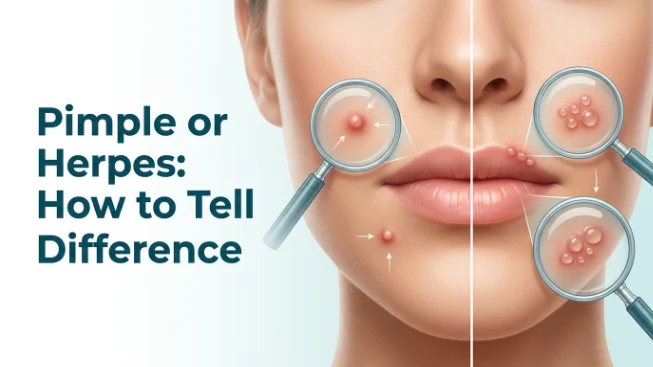
Quick answer:
A pimple is usually a clogged or inflamed pore, while herpes commonly causes painful, fluid filled blisters that may appear in clusters. A healthcare professional is the safest person to confirm what an unfamiliar sore actually is.
A small bump around your lips, face, or skin can sometimes leave you wondering whether it is a pimple or herpes. At first glance, the two may look similar, especially when a sore is just beginning to appear. However, they have different causes and can develop in noticeably different ways. Knowing the common signs can help you understand what you may be looking at without jumping to conclusions.
Pimples are usually linked to clogged or inflamed pores, while herpes sores are caused by the herpes simplex virus. A pimple may appear as a red bump or whitehead, whereas a cold sore often begins with tingling, burning, or itching before small fluid-filled blisters develop. In this guide, we’ll compare their appearance, symptoms, location, progression, and other important differences so you can better understand whether you may be dealing with a pimple or herpes.
Pimple or Herpes: What Is the Difference?
The biggest difference is the cause.
A pimple is commonly related to clogged pores and inflammation. Pimples are a common feature of acne, although a single pimple can occur without widespread acne. They may appear as red bumps, whiteheads, blackheads, or pus-filled spots.
Herpes, on the other hand, is an infection caused by herpes simplex virus. When herpes affects the mouth and lips, it is commonly called oral herpes or a cold sore. These sores often begin with tingling, burning, itching, or discomfort before small fluid-filled blisters appear.
There is an important point to remember: appearance alone cannot always confirm the cause. Some herpes sores can initially resemble pimples, especially during their earliest stage. Likewise, a pimple near the lip can be mistaken for a cold sore.
Quick Comparison Table
| Feature | Pimple | Herpes / Cold Sore |
|---|---|---|
| Main cause | Clogged or inflamed pore | Herpes simplex virus |
| Typical appearance | Red bump, whitehead, blackhead, or pus-filled spot | Small fluid filled blister or group of blisters |
| Common location | Face, chest, shoulders, back, and other skin | Lips and skin around the mouth for oral herpes |
| Sensation | Tenderness or localized pain | Tingling, burning, itching, pain |
| Fluid | May contain pus | Usually clear or slightly yellow fluid |
| Pattern | Often appears as an individual blemish | Often appears in a cluster |
| Contagious? | No | Yes |
| Can recur in the same place? | Pimples can recur in the same general area | Cold sores often return to a similar location |
| Typical progression | Bump may develop a head and gradually settle | Tingling → blisters → oozing → crusting → healing |
| Main concern | Skin inflammation | Viral infection and transmission |
These are general patterns, not a way to diagnose yourself. A healthcare professional can examine the area and recommend testing when needed.
Which One Is Correct?
If you are asking whether “pimple” or “herpes” is the correct word, both are correct English words. They do not mean the same thing, however.
Pimple is the correct word when you mean a small inflamed or clogged skin bump.
Herpes is the correct medical term for an infection caused by herpes simplex viruses. Depending on the location and type of infection, healthcare professionals may refer to oral herpes, genital herpes, or a cold sore.
So this is not a spelling question in which one word is right and the other is wrong. The important question is which condition does the bump actually represent?
For example:
- “I have a pimple on my cheek.”
- “She developed a cold sore on her lip.”
- “The doctor tested for herpes.”
- “The bump looked like a pimple at first.”
Using the words correctly means matching the word to the condition rather than treating them as interchangeable terms.
What Is a Pimple?
A pimple is a small skin growth or blemish that can become red, swollen, inflamed, or discolored. Pimples commonly occur as part of acne, but individual pimples can also develop for other reasons.
Your skin contains pores and hair follicles. Oil, dead skin cells, and other material can build up inside these openings. When a pore becomes blocked and inflamed, a pimple may form.
Pimples can have several appearances.
Common types of pimples
A whitehead occurs when a clogged pore remains closed at the surface.
A blackhead forms when the contents of an open pore react with air and become dark. The dark color is not simply dirt.
A papule is a small raised, inflamed bump without visible pus.
A pustule is an inflamed bump that contains pus.
Larger and deeper acne lesions, such as nodules and cysts, can be more painful and may require professional treatment.
Where do pimples appear?
Pimples can appear almost anywhere there are pores and hair follicles. Common areas include:
- Face
- Forehead
- Nose
- Chin
- Cheeks
- Chest
- Shoulders
- Upper back
A pimple can also occur close to the mouth. That is one reason people sometimes confuse it with a cold sore.
However, a typical pimple does not suddenly become a contagious cluster of fluid-filled blisters. Its development is usually connected to the skin and the affected pore.
What Is Herpes?
Herpes refers to infection with a herpes simplex virus. Two main types are HSV-1 and HSV-2. HSV-1 commonly causes oral herpes and cold sores, although either type can affect the mouth or genital area.
When people see a sore around the lips, they may use terms such as:
- Cold sore
- Fever blister
- Oral herpes
- Herpes labialis
Cold sores are usually small, fluid-filled blisters that develop on or around the lips. They can occur elsewhere on the face, including around the nose or chin.
One characteristic feature is the sensation that may happen before the visible sore appears. Some people notice tingling, burning, itching, pain, or numbness in the area first. Within a short period, small bumps can develop and become fluid-filled blisters.
The blisters may later break open, release fluid, form a crust, and gradually heal.
Pimple or Herpes on the Lip: How Can You Tell?
The lip area is where confusion is especially common.
A lip pimple may appear as a raised red bump with a whitehead or blackhead. A cold sore tends to develop as a small fluid filled blister or a group of blisters.
1. Look at the location
A pimple can develop on the skin near the lips. It may appear along the lip line or on the surrounding skin.
Cold sores can appear on the lips or nearby skin. They also have a tendency to return to a similar location during future outbreaks.
Still, location by itself is not enough to tell the difference.
2. Notice how it feels
A pimple may feel tender, swollen, or sore when touched.
A cold sore often has a different beginning. You may notice tingling, itching, burning, or unusual sensitivity before the blister becomes visible.
This early warning sensation is one of the more useful clues, although not everyone experiences it.
3. Examine the appearance
A typical pimple is a raised skin bump. It may develop a white or yellow center if pus is present.
A cold sore usually develops as a group of small, fluid-filled blisters. The blisters can break, ooze, and later crust over.
4. Watch how it changes
A pimple generally stays associated with a localized skin blemish.
A cold sore often follows a recognizable sequence:
Tingling or burning → small bumps → fluid-filled blisters → oozing → crusting → healing.
A typical cold sore outbreak often heals within about two to three weeks, although the exact duration varies.
Pimple or Herpes on the Genital Area
Genital bumps deserve extra care because several different conditions can look similar.
A pimple can develop on ordinary skin in the genital region. Friction, sweat, blocked follicles, shaving, and irritation can contribute to bumps in this area.
Genital herpes can also initially look like a pimple. As the lesion develops, however, herpes may become a painful blister or ulcer. Multiple lesions can occur together.
One general clue is that a typical pimple is often a single bump and may contain pus, whereas a herpes lesion may contain clear or yellowish fluid and can develop into a blister or ulcer. However, these differences are not reliable enough to rule herpes in or out by appearance alone.
If a new genital bump appears after sexual contact, especially if it is painful, blistering, recurring, or accompanied by sores or other symptoms, it is sensible to speak with a healthcare professional rather than trying to identify it from photographs or descriptions alone.
Are Pimples Contagious?
Ordinary pimples are not contagious.
You cannot catch acne from another person by kissing them, touching their face, sharing a towel, or being physically close to them. Pimples are related to processes in the skin rather than a contagious virus.
This is very different from herpes. Herpes simplex can spread through close contact, including kissing when oral herpes is involved. The virus can sometimes spread even when visible sores are not present.
That difference matters because assuming a cold sore is “just a pimple” can lead to accidental transmission.
What Causes a Pimple?
Pimples generally form when pores become blocked and inflamed. Oil, dead skin cells, and other material can contribute to the blockage. Bacteria naturally present on the skin can also become involved in inflammation.
Several everyday factors can make skin more prone to breakouts, including:
- Excess oil
- Dead skin cell buildup
- Hormonal changes
- Friction
- Sweat
- Certain skin or cosmetic products
- Picking or squeezing existing blemishes
Squeezing a pimple is especially unhelpful when the skin becomes broken. Picking can create an opening that allows bacteria to enter and may lead to infection, increased inflammation, or scarring.
What Causes Herpes?
Herpes sores are caused by the herpes simplex virus.
HSV can remain in the body after the initial infection and later become active again. For people who experience recurrent cold sores, outbreaks may be associated with triggers such as illness, stress, sun exposure, hormonal changes, or irritation around the mouth.
Transmission can happen through close contact. Kissing is a well-known route for oral HSV transmission, and sharing items that contact the mouth may also create a risk. HSV can also spread through oral sexual contact.
Importantly, having herpes does not automatically mean someone recently acquired it. HSV infections can remain unnoticed for a long time, and many infected people do not develop obvious symptoms.
Common Mistakes People Make
Mistake 1: Assuming every lip bump is a pimple
Not every bump near the mouth is acne.
A cold sore can resemble a pimple during its early stage, so its progression matters.
Mistake 2: Assuming every painful bump is herpes
Pain does not automatically mean herpes.
Pimples can become tender, particularly in sensitive areas such as the lips. Infected pimples can also become significantly painful and swollen.
Mistake 3: Popping a suspicious blister
If you are unsure what a bump is, avoid squeezing or popping it.
Opening a lesion can irritate the skin and may increase the risk of spreading infectious material if the lesion is caused by HSV.
Mistake 4: Treating herpes like ordinary acne
Acne products are designed for skin conditions involving clogged pores and inflammation. They do not eliminate the herpes virus.
Cold sores may be treated with antiviral medicines, and treatment can be more helpful when started early in an outbreak.
Mistake 5: Trying to diagnose herpes from appearance alone
Pictures and descriptions can provide clues, but they cannot reliably confirm every case.
If a lesion is unusual, recurrent, painful, spreading, or associated with sexual exposure, professional medical advice is a better option than guessing.
Pimple or Herpes: Correct Usage Examples
The words pimple and herpes belong to different categories, so the sentence should make their meanings clear.
Casual examples
- “I think I have a pimple near my lip.”
- “That bump looks different from my usual pimples.”
- “She gets cold sores on her lip from time to time.”
- “I wasn’t sure whether the spot was a pimple or a cold sore.”
Professional examples
- “The clinician examined the lesion to determine whether it was acne or a viral sore.”
- “The patient reported tingling before the blisters appeared.”
- “The healthcare provider discussed possible causes of the skin lesion.”
Educational examples
- “Pimples usually develop from clogged or inflamed pores.”
- “Cold sores are associated with herpes simplex virus.”
- “A cluster of fluid-filled blisters is more characteristic of a cold sore than a typical pimple.”
Simple comparison sentences
- “A pimple is not the same as herpes.”
- “Herpes can initially resemble a pimple.”
- “A pimple is not contagious, while herpes can spread through close contact.”
- “The appearance of a sore can change over time, so the first stage may not tell the whole story.”
Pronunciation: Pimple vs. Herpes
The words also sound very different.
Pimple is commonly pronounced approximately:
PIM-puhl
It has two syllables.
Herpes is commonly pronounced:
HER-peez
It also has two syllables.
The spelling and pronunciation are not commonly confused because of sound. The confusion usually comes from the fact that a herpes lesion can sometimes resemble a pimple.
Grammar: How to Use Pimple and Herpes Correctly
The word pimple is a countable noun.
You can say:
- “I have a pimple.”
- “She has two pimples.”
- “That pimple is painful.”
- “These pimples appeared yesterday.”
The plural is pimples.
The word herpes is normally treated as the name of a medical infection or condition rather than a countable individual object.
You would say:
- “He has herpes.”
- “The doctor tested for herpes.”
- “Herpes can cause blisters.”
- “The patient has oral herpes.”
You would not normally say “a herpes” to refer to the infection.
If you mean an individual lesion, words such as sore, blister, lesion, or cold sore are more appropriate depending on the situation.
For example:
- “She has a cold sore.”
- “There is a painful blister on the lip.”
- “The doctor examined the lesion.”
Word Origin and Etymology
The word pimple has a long history in English. It comes from Middle English forms related to a small swelling or skin eruption and is associated with older Germanic roots describing a swelling or blemish.
The word herpes has a very different origin. It comes from the Greek word herpēs, associated with the idea of creeping or spreading. The term entered medical language through Latin and Greek traditions and became associated with certain skin eruptions.
The medical term herpes simplex comes from Latin. Simplex means “simple” or “single,” and the phrase became established in medical terminology for infections caused by herpes simplex viruses.
Understanding these origins helps explain why pimple describes a type of skin blemish, while herpes names a viral infection.
Why Do People Confuse Pimples and Herpes?
The main reason is visual similarity.
A new herpes lesion can begin as a small bump. Before it becomes a recognizable blister, it may look like an ordinary spot on the skin. A pimple near the mouth can also be red, swollen, and painful.
The location adds to the confusion. Both conditions can occur around the face and mouth.
Another reason is that people often use “pimple” as a general word for almost any small bump. Medically, however, different bumps can have very different causes.
That is why it is useful to consider several clues together:
- Where did the bump appear?
- Did you feel tingling or burning before seeing it?
- Is it one bump or several?
- Does it contain pus or clear fluid?
- Has it become a blister?
- Does it usually return in the same place?
- Is the area unusually painful?
- Are there other symptoms?
- Could there have been exposure to HSV?
- Is the lesion changing rapidly?
No single question provides a definite diagnosis, but the overall pattern can help a healthcare professional understand what may be happening.
Easy Memory Trick
A simple way to remember the basic distinction is:
Pimple = pore problem.
Herpes = viral infection.
You can also remember the visual difference:
Pimple → bump or pus
Cold sore → blister or cluster
And for sensation:
Pimple → tender
Cold sore → tingling, burning, or itching may come first
These are memory aids, not diagnostic rules. Real skin conditions can overlap in appearance.
When Should You See a Healthcare Professional?
Consider getting medical advice when you are uncertain about a new sore, especially if it does not behave like your usual pimples.
Professional evaluation is particularly important when:
- The lesion is on or near the eye.
- You have severe pain.
- The sore is spreading.
- You have repeated unexplained outbreaks.
- You have a weakened immune system.
- The lesion does not heal as expected.
- You develop significant fever or other systemic symptoms.
- You have a new genital blister or ulcer.
- You are concerned about possible exposure to herpes.
- The sore keeps returning in the same location.
Mayo Clinic advises medical evaluation for cold sores that are severe, recur frequently, fail to heal within about two weeks, or occur alongside eye symptoms.
A healthcare professional can determine whether testing is appropriate. This is especially important for genital sores because several conditions can resemble one another.
Can a Pimple Turn Into Herpes?
No.
A pimple does not transform into herpes, and herpes does not develop because you squeezed a pimple.
They have different causes.
A pimple develops through processes involving the skin and pores. Herpes is caused by infection with herpes simplex virus.
However, squeezing a pimple can make it more inflamed or infected. Breaking the skin can allow bacteria to enter and may result in increased redness, swelling, pain, or pus.
So if a pimple suddenly looks worse after being squeezed, that does not mean it has become herpes.
Can Herpes Look Like a Pimple?
Yes.
This is one of the most important reasons people search for pimple or herpes.
Early herpes lesions may resemble small pimples. As the outbreak develops, the lesion may become a fluid-filled blister, break open, and form a crust.
A pimple, by comparison, may develop a whitehead, blackhead, or pus-filled center.
If you cannot confidently identify the lesion, do not rely on appearance alone.
Can You Have a Pimple and Herpes at the Same Time?
Yes.
Having acne does not protect someone from herpes, and having herpes does not prevent someone from developing ordinary pimples.
The two conditions have different causes and can occur independently.
For example, someone may have acne on the face and also experience a cold sore around the lip. In that situation, identifying each lesion correctly is important because their causes and management are different.
Is Every Cold Sore Herpes?
A true cold sore is associated with a herpes simplex infection. Cleveland Clinic notes that cold sores are a sign of herpes simplex infection, although not every bump or irritation around the lips is a cold sore.
This distinction is useful.
People sometimes call any sore near the mouth a cold sore, but a pimple, irritation, canker sore, or another skin condition can occur in the same general area.
That is why the phrase “cold sore” should not simply be used for every lip bump.
Is a Canker Sore the Same as Herpes?
No.
Canker sores and cold sores are different.
Canker sores usually occur inside the mouth and are not caused by herpes simplex virus. They are also not contagious. Cold sores commonly appear on or around the lips and are caused by HSV.
A canker sore often looks like a small round or oval ulcer with a pale center and red border.
A cold sore more commonly begins as small fluid-filled blisters that may later break and crust.
This is another reason not to use “herpes” as a general word for every mouth sore.
FAQs
1. Is it a pimple or herpes if there is one bump?
One bump can be either, so the number of bumps alone cannot tell you. A pimple is often a single raised blemish, while herpes can begin with a small number of bumps before developing into fluid-filled blisters.
2. Does herpes always look like a cluster?
Not necessarily at the very beginning. Cold sores commonly develop as groups of small fluid-filled blisters, but the earliest lesion may be difficult to distinguish from an ordinary bump.
3. Does a pimple have pus while herpes has clear fluid?
That is a useful general distinction. Pimples can contain pus, while cold sores typically contain clear or slightly yellow fluid. However, fluid alone cannot provide a definite diagnosis.
4. Is a painful lip bump always herpes?
No. Pimples can be painful, especially around the lips, where the skin contains many nerve endings. Cold sores are also often painful and may cause burning or tingling.
5. Can herpes appear as one small pimple?
It can initially resemble one. As the lesion develops, herpes may become a blister or group of blisters. If you are unsure, especially after possible exposure, professional evaluation is appropriate.
6. Can you pop a herpes sore like a pimple?
It is better not to squeeze or pop a suspicious blister. Doing so can irritate the area and expose fluid from the lesion. If the sore is herpes-related, close contact with the lesion can also create opportunities for transmission.
7. How long does a cold sore usually last?
Cold sores commonly heal within about two to three weeks, although the course varies from person to person. The blister may break, ooze, crust, and gradually heal during that period.
8. Can a pimple occur on the lip?
A pimple can occur on the skin near the lip. However, people sometimes use “lip pimple” for any bump around the mouth, so location alone does not establish what caused it.
Conclusion
When comparing pimple or herpes, remember that they are different conditions with different causes. A pimple usually involves a clogged or inflamed pore, while herpes is caused by the herpes simplex virus. A blistering cluster, tingling, burning, or repeated sores in the same area may point toward a cold sore, but appearance alone cannot confirm the cause. If you are unsure about a new or unusual sore, getting professional medical advice is the safest way to know what you are dealing with.

Jessica Morgan is a blogger and writer at GramScript.com, where she turns everyday ideas into engaging, relatable stories. Her writing blends a natural voice with fresh perspectives that keep readers coming back.