Quick Answer
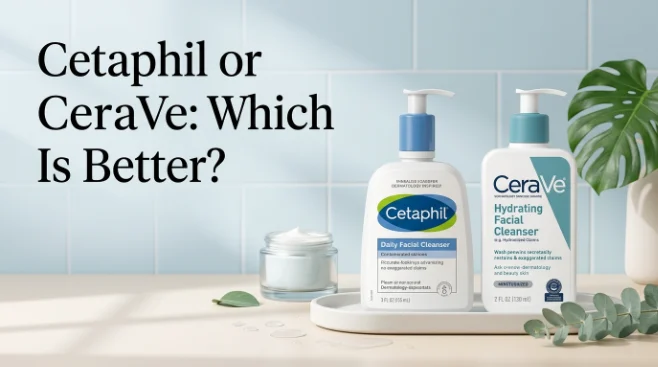
Neither Cetaphil nor CeraVe is universally better. Cetaphil is often a strong choice for simple, gentle care, while CeraVe stands out for ceramide focused hydration and skin barrier support.
Choosing between Cetaphil or CeraVe can be confusing, especially when both brands offer gentle cleansers, moisturizers, and products for different skin types. While they may seem similar at first glance, their formulas, ingredients, textures, and product ranges can differ. The better choice depends less on the brand name and more on what your skin actually needs.
In this guide, we’ll compare Cetaphil and CeraVe in simple terms so you can understand their key differences. Whether you have dry, oily, combination, or sensitive skin, you’ll learn what each brand is known for, which products may suit different needs, and how to choose between them without making your skincare routine unnecessarily complicated.
Which One Is Correct?
If you are asking whether Cetaphil or CeraVe is the correct name, both are correct. They are two different skincare brands, not two spellings of the same word.
| Point | Cetaphil | CeraVe |
|---|---|---|
| Brand name | Cetaphil | CeraVe |
| What it is | Skincare brand | Skincare brand |
| Best known for | Sensitive-skin care and gentle formulas | Ceramides and barrier-focused care |
| Established | 1947 | 2005 |
| Common products | Cleansers, moisturizers, sunscreens | Cleansers, moisturizers, serums, sunscreens |
| Main strength | Gentle daily skincare | Barrier support and hydration |
| Typical audience | Especially sensitive skin | Dry, normal, sensitive, oily, and combination skin depending on product |
Cetaphil began in 1947 when a pharmacist in Texas developed its first cleansing lotion, now known as Cetaphil Gentle Skin Cleanser. CeraVe was developed with dermatologists beginning in 2005 and launched with three core products built around ceramides and its MVE delivery technology.
So there is no “incorrect” version here. Cetaphil is correct, and CeraVe is correct.
What Does Cetaphil Mean?
Cetaphil is a brand name rather than an ordinary English word.
The name has an interesting connection to the brand’s original purpose. According to Galderma, the “Cet” refers to cetyl alcohol, while “phil” means “love.” The name was intended to express the idea of caring for and soothing the skin.
Today, Cetaphil is particularly associated with sensitive-skin care. The company says its products are specifically formulated for different types of sensitive skin and that it works with dermatologists and healthcare professionals during product development.
What Is Cetaphil Used For?
Cetaphil makes products for several everyday needs, including:
- Facial cleansing
- Body cleansing
- Moisturizing
- Sun protection
- Dry skin
- Sensitive skin
- Combination and oily skin
- Uneven skin texture
- Some acne-prone routines
Its current range is much broader than its original cleanser. The brand now offers cleansers, moisturizers, sunscreens, baby products, and products aimed at specific skin concerns.
Cetaphil Gentle Skin Cleanser
One of the best-known Cetaphil products is Gentle Skin Cleanser. Its current formula contains glycerin, panthenol, and niacinamide, and the brand describes it as a creamy cleanser designed for normal-to-dry skin. It is also fragrance-free and soap-free.
That ingredient combination is useful to understand because it shows why people often associate Cetaphil with gentle cleansing.
- Glycerin helps attract and retain moisture.
- Panthenol is a form of provitamin B5 associated with moisturizing and soothing properties.
- Niacinamide, or vitamin B3, can support the skin barrier and help maintain moisture.
The exact formula can change, so checking the ingredient list on the product you actually have is always sensible.
What Does CeraVe Mean?
CeraVe is also a brand name, but its construction has a more direct connection to its formulation philosophy.
The brand explains that “Cera” refers to its essential ceramides, while “Ve” comes from its MultiVesicular Emulsion, or MVE, delivery technology.
CeraVe was developed with dermatologists around 2005 and launched with three core products: a moisturizing cream, moisturizing lotion, and hydrating cleanser. Its formulas were designed around three essential ceramides, fatty acids, and other lipids associated with the skin barrier.
What Is CeraVe Used For?
Depending on the product, CeraVe can be used for:
- Dry skin
- Normal skin
- Sensitive skin
- Oily skin
- Combination skin
- Skin barrier support
- Facial cleansing
- Body moisturizing
- Hydration
- Acne prone routines
- Sun protection
The brand now has a much wider range than its original three products. Its current lineup includes facial and body cleansers, moisturizers, serums, sunscreens, and baby care products.
CeraVe Hydrating Facial Cleanser
CeraVe’s Hydrating Facial Cleanser is designed for normal to dry skin. It contains three essential ceramides and hyaluronic acid and is intended to cleanse without leaving the skin feeling tight or stripped.
Its formula illustrates the brand’s familiar approach:
- Ceramides support the skin’s protective barrier.
- Hyaluronic acid helps maintain moisture.
- Glycerin contributes to hydration.
- The cleanser is designed to remove dirt and impurities while maintaining moisture.
CeraVe also uses MVE technology in many of its products. The technology is designed to release moisturizing ingredients gradually rather than all at once.
Cetaphil vs. CeraVe: The Key Differences
The most useful way to compare the two is to look beyond the brand names.
1. Their Main Focus Is Slightly Different
Cetaphil has a particularly strong identity around sensitive skin. Its current materials emphasize skin sensitivity, gentle formulas, clinical testing, and collaboration with dermatologists and healthcare professionals.
CeraVe places especially strong emphasis on ceramides, hydration, and the skin barrier. Its products are developed with dermatologists and many formulas contain three essential ceramides.
This does not mean Cetaphil cannot support the skin barrier or CeraVe cannot work for sensitive skin. Both brands offer products for those needs.
2. Ingredients Can Be Very Different
A brand name alone does not tell you how a product will behave.
For example, Cetaphil Gentle Skin Cleanser features glycerin, panthenol, and niacinamide.
CeraVe Hydrating Facial Cleanser features ceramides, hyaluronic acid, glycerin, and other supporting ingredients.
Therefore, comparing Cetaphil cleanser vs. CeraVe cleanser without naming the exact products can be misleading.
3. Texture Matters
Texture can make a major difference in whether you enjoy using a product.
Cetaphil Gentle Skin Cleanser has a creamy, non foaming texture.
CeraVe offers several textures, including creamy hydrating cleansers and cream to foam formulas. Its Hydrating Cream to Foam Cleanser, for example, starts as a cream and turns into a foam during use.
If you dislike foam, one product may feel better. If you prefer a fresh foaming cleanse, another may be more appealing.
4. Both Offer Products for Different Skin Types
It would be inaccurate to say that all Cetaphil products are for dry skin or that all CeraVe products are for dry skin.
Cetaphil has a Daily Facial Cleanser designed for normal to oily skin, with a gel-to-foam texture and ingredients including niacinamide, panthenol, and glycerin.
CeraVe also has cleansers designed for different needs, including hydrating and foaming options.
The individual formula matters more than the logo.
Cetaphil or CeraVe for Dry Skin?
Both can be suitable for dry skin, but the better choice depends on the exact formula.
If your main concern is tightness and dehydration, look for a gentle cleanser followed by a moisturizer designed for dry skin.
CeraVe Moisturizing Cream contains three essential ceramides, hyaluronic acid, dimethicone, and petrolatum. The brand describes it as a rich moisturizer for normal-to-dry skin that helps maintain the skin’s protective barrier.
Cetaphil also offers rich moisturizers. Its current range includes products intended to provide intensive hydration for dry and sensitive skin.
A simple rule
If your skin feels:
- Tight after washing
- Rough or flaky
- Uncomfortable in cold or dry weather
- Easily dehydrated
choose a gentle cleanser and a richer moisturizer rather than relying on cleanser alone.
Cetaphil or CeraVe for Sensitive Skin?
This is where both brands can be reasonable choices.
Cetaphil has a particularly long history in this area. The brand was created in 1947, and its current product range remains heavily focused on sensitive skin. Cetaphil says it has conducted more than 1,100 clinical studies involving more than 49,000 patients or subjects across its product development and testing work.
CeraVe also makes products intended for sensitive skin and says its products are developed with dermatologists. Its range includes fragrance-free and no comedogenic options, although these features vary by product.
For sensitive skin, the safest approach is not simply choosing the “sensitive skin brand.” Instead:
- Check the ingredient list.
- Avoid ingredients you already know irritate you.
- Introduce one new product at a time.
- Patch test when appropriate.
- Stop using a product if it causes persistent burning, swelling, or a worsening reaction.
If you have a diagnosed skin condition or frequent reactions, a dermatologist can help identify suitable ingredients.
Cetaphil or CeraVe for Oily Skin?
Oily skin does not automatically mean you need a harsh cleanser.
The goal is to remove excess oil without leaving the skin uncomfortably dry. Over cleansing can make a routine harder to tolerate.
Cetaphil Daily Facial Cleanser is specifically made for normal to oily skin and uses a gel to foam texture. The brand says it removes dirt, excess oil, and makeup while avoiding a dry or tight after feel.
CeraVe also offers foaming cleansers for people who prefer that type of finish.
For oily skin, look for a cleanser that leaves your face clean but comfortable, rather than extremely squeaky or tight.
Cetaphil or CeraVe for Acne-Prone Skin?
Neither brand should be treated as a single acne treatment because both sell many different products.
The better question is: Which exact formula fits an acne-prone routine?
Some products from both brands contain ingredients chosen for particular concerns. For example, Cetaphil has an exfoliating cleanser containing salicylic acid, mandelic acid, and gluconolactone.
CeraVe also offers products designed for acne-prone skin and different cleansing needs.
If you have frequent, painful, deep, or persistent breakouts, a basic cleanser and moisturizer may not be enough. In that situation, professional medical advice is more useful than switching repeatedly between brands.
Cetaphil or CeraVe Moisturizer: Which Is Better?
There is no universal winner.
CeraVe Moisturizing Cream is especially notable for its combination of ceramides, hyaluronic acid, dimethicone, and petrolatum. It is intended for normal-to-dry skin and can be used on both the face and body.
Cetaphil also has moisturizers designed for sensitive and dry skin, including rich formulas intended for stronger hydration.
Your choice should depend on:
- Skin type
- Desired texture
- Climate
- Whether you prefer a cream or lotion
- Ingredients you tolerate well
- Whether your skin feels dry, oily, or balanced
- Whether you need a basic moisturizer or a targeted treatment
In other words, compare formulas, not just brands.
Common Mistakes People Make
Mistake 1: Assuming One Brand Is Always Better
There is no reliable rule that says every CeraVe product beats every Cetaphil product, or vice versa.
A cleanser, serum, sunscreen, and moisturizer have different jobs. Even within the same brand, formulas can behave very differently.
Mistake 2: Choosing Based Only on the Word “Sensitive”
A product labeled for sensitive skin can still contain an ingredient that does not agree with your individual skin.
Always check the full ingredient list.
Mistake 3: Thinking More Foam Means Better Cleaning
Foam is mainly a sensory and formulation characteristic. A cleanser does not have to leave your face extremely tight to be effective.
Mistake 4: Changing Several Products at Once
If you introduce a cleanser, moisturizer, serum, and sunscreen together, it becomes difficult to know which product caused a reaction.
Change one major product at a time when possible.
Mistake 5: Ignoring the Product’s Intended Skin Type
A moisturizer designed for very dry skin may feel heavy on someone with oily skin. Likewise, a lightweight lotion may not provide enough comfort for very dry skin.
Mistake 6: Treating “Non-Comedogenic” as a Guarantee
Non-comedogenic means a product is formulated or tested with the goal of minimizing pore-clogging potential. It does not guarantee that every person will have the same experience.
Correct Usage Examples
Because Cetaphil and CeraVe are proper brand names, they should normally be capitalized exactly as the brands use them.
Casual Examples
- “Should I buy Cetaphil or CeraVe?”
- “I use CeraVe moisturizer at night.”
- “My sister prefers Cetaphil cleanser.”
- “Which one feels lighter on your skin?”
Professional Examples
- “The patient reported better comfort after switching to a fragrance-free moisturizer.”
- “The product contains ceramides that support the skin barrier.”
- “The cleanser was selected according to the patient’s skin type and tolerance.”
Educational Examples
- “Ceramides are lipids naturally found in the skin barrier.”
- “Glycerin is a humectant that helps attract water.”
- “A gentle cleanser can remove impurities without leaving the skin feeling excessively dry.”
Everyday Comparison Examples
- “Cetaphil and CeraVe are both established skincare brands.”
- “CeraVe is well known for ceramide-focused formulas.”
- “Cetaphil has a long history of products designed for sensitive skin.”
- “The best choice depends on the individual product rather than the brand alone.”
How Do You Pronounce Cetaphil and CeraVe?
Brand names can be confusing because their spelling does not always tell you exactly how to say them.
Cetaphil is commonly pronounced approximately like:
SEH-tuh-fil
CeraVe is commonly pronounced approximately like:
SEH-ruh-vee
The pronunciation of brand names can vary slightly across accents, but these forms are widely understandable.
A useful way to remember CeraVe is to think of its name as being connected to ceramides and MVE, the technology associated with its original formulation approach.
Word Origin and Brand History
Cetaphil
Cetaphil has roots going back to 1947, when a pharmacist in Texas developed its original cleansing lotion. That product later became known as Cetaphil Gentle Skin Cleanser.
The name combines a reference to cetyl alcohol with “phil,” meaning love, according to Galderma’s historical explanation of the brand name.
Over the decades, the brand expanded from its original cleanser into a broad range of products for sensitive skin and everyday skincare.
CeraVe
CeraVe is considerably newer. Its story began in 2005, when researchers worked with dermatologists to develop products focused on the skin barrier. The original line was built around three essential ceramides and MVE technology.
CeraVe launched in the United States with three core products in 2006, according to the brand’s historical account: Moisturizing Cream, Moisturizing Lotion, and Hydrating Cleanser.
The name itself reflects the formulation concept: “Cera” connects to ceramides, while “Ve” refers to the MVE delivery technology.
Why Do People Confuse Cetaphil and CeraVe?
The confusion is understandable.
Both names:
- Begin with a “Ce” sound.
- Appear frequently in skincare routines.
- Offer cleansers and moisturizers.
- Have products for sensitive skin.
- Are associated with dermatology.
- Use relatively clinical-looking packaging.
- Are widely available.
Their product categories also overlap. Someone shopping for a gentle cleanser may see a Cetaphil cleanser next to a CeraVe cleanser and assume the products are nearly identical.
They are not.
The two brands have different product histories, ingredient combinations, textures, and formulation approaches.
Easy Memory Tricks
If you regularly mix up the two names, try these simple associations.
Remember Cetaphil With “Sensitive”
Think:
Cetaphil → gentle → sensitive skin
This is not a rule for every product, but it reflects the brand’s long-standing focus.
Remember CeraVe With “Ceramides”
Think:
CeraVe → Cera → ceramides
The brand itself connects “Cera” with its essential ceramides.
Remember the History
- Cetaphil: 1947
- CeraVe: 2005/2006
Cetaphil is the older brand by several decades.
Remember the Main Formulation Ideas
- Cetaphil: sensitive-skin care, gentle cleansing, hydration
- CeraVe: ceramides, hydration, skin-barrier support
Again, these are helpful shortcuts rather than strict rules.
Which One Should You Choose?
A simple comparison can make the decision easier.
| If you want… | A reasonable place to start |
|---|---|
| Gentle sensitive skin care | Cetaphil |
| A cleanser for normal to dry skin | Either, depending on formula |
| Ceramide focused hydration | CeraVe |
| A rich barrier focused moisturizer | CeraVe |
| A long established sensitive skin range | Cetaphil |
| Normal to oily cleansing | Compare the specific foaming formulas |
| Simple daily cleansing | Either brand can work |
| Acne focused care | Choose a product based on its active ingredients |
| Very dry skin | Compare richer moisturizers from both |
| Easily irritated skin | Check fragrance, actives, and your personal triggers |
The table is only a starting point. Your skin may respond differently from someone else’s, even when you have similar skin types.
Can You Use Cetaphil and CeraVe Together?
Yes. There is no general reason you must choose only one brand.
For example, someone could use a Cetaphil cleanser and a CeraVe moisturizer. Another person might prefer the opposite combination.
Skincare routines do not need to follow brand boundaries.
A simple routine might look like:
Morning:
Gentle cleanser → moisturizer → sunscreen
Evening:
Cleanser → treatment if needed → moisturizer
The important thing is that the products work well together and your skin tolerates them.
Should You Switch From Cetaphil to CeraVe?
Not necessarily.
If your current product cleanses comfortably, does not cause irritation, and fits your needs, there may be no reason to change simply because another brand is popular.
Consider switching when:
- Your skin remains excessively dry.
- Your cleanser feels too harsh.
- Your moisturizer feels too heavy.
- You need a different texture.
- You want a specific active ingredient.
- Your skin needs have changed.
- Your current product causes irritation.
If a product works well for you, consistency can be more valuable than constantly searching for something “better.”
FAQs
1. Is Cetaphil or CeraVe better?
Neither brand is automatically better for everyone. Cetaphil has a strong focus on sensitive-skin care, while CeraVe is especially known for ceramide-based formulas and barrier support. The best choice depends on your skin and the exact product.
2. Can I use Cetaphil and CeraVe together?
Yes. You can use products from both brands in the same routine. For example, you might prefer a Cetaphil cleanser and a CeraVe moisturizer. There is no need to use only one brand.
3. Is Cetaphil good for sensitive skin?
Yes. Cetaphil has been developed around sensitive-skin care for decades and offers products specifically formulated for sensitive skin. However, individual ingredients can still affect different people differently.
4. Is CeraVe good for dry skin?
Yes. CeraVe offers several products for normal-to-dry and dry-to-very-dry skin. Its Moisturizing Cream, for example, contains ceramides, hyaluronic acid, dimethicone, and petrolatum.
5. Which is better for oily skin, Cetaphil or CeraVe?
Both brands have products for oily skin. Cetaphil Daily Facial Cleanser is specifically made for normal-to-oily skin, while CeraVe also offers foaming formulas. Compare the individual cleanser rather than judging the entire brand.
6. Are Cetaphil and CeraVe the same company?
No. They are separate skincare brands with different histories and product-development approaches. Cetaphil originated in 1947, while CeraVe was developed beginning in 2005.
7. Which one is better for acne-prone skin?
There is no single winner. Look at the specific product and its active ingredients. Both brands offer products intended for different skin concerns, including acne-prone routines.
8. What is the main difference between Cetaphil and CeraVe?
The simplest distinction is that Cetaphil has a particularly strong heritage in sensitive-skin care, while CeraVe is strongly associated with ceramides, hydration, and skin-barrier support. Both offer products beyond these core strengths.
Conclusion
When choosing between Cetaphil or CeraVe, there is no single winner because the right option depends on your skin type and specific needs. Cetaphil is known for gentle, sensitive-skin care, while CeraVe is recognized for ceramides and skin-barrier support. Instead of choosing based on the brand alone, consider the ingredients, texture, and purpose of each product. Ultimately, the best choice is the one your skin feels comfortable with and that works well in your daily routine.

Jessica Morgan is a blogger and writer at GramScript.com, where she turns everyday ideas into engaging, relatable stories. Her writing blends a natural voice with fresh perspectives that keep readers coming back.
2 thoughts on “Cetaphil vs CeraVe | An Easy Comparison for Everyday Skincare In 2026”