Quick Answer
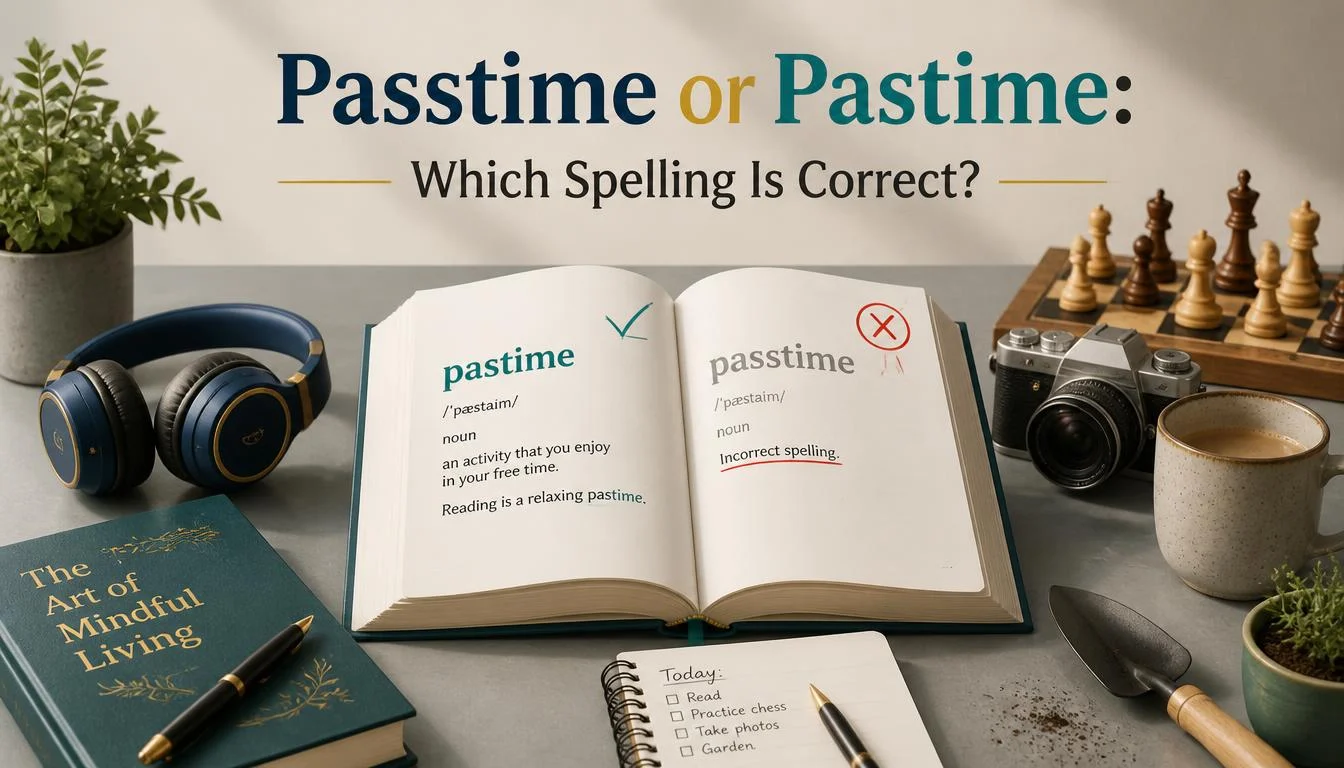
Pastime is the correct standard spelling for a hobby or activity enjoyed during free time.Passtime is generally a misspelling caused by confusing the noun with the phrase “pass time.”
If you have ever wondered whether the correct spelling is passtime or pastime, you are not alone. The two forms look almost identical, but only one is the standard spelling in modern English. Pastime is the correct word, and it refers to an activity someone enjoys doing during their free time. Reading, gardening, playing sports, painting, and listening to music can all be examples of a pastime.
The confusion usually comes from the natural way the word sounds when spoken. Since “pastime” contains the word “time,” some writers may add an extra s and write “passtime.” However, passtime is generally considered a misspelling, while pastime is the accepted form. In this guide, you will learn the correct spelling, meaning, pronunciation, usage, and examples so you can use pastime confidently in both everyday and formal English.
Which One Is Correct?
Pastime is the correct spelling when you mean a hobby, recreational activity, or enjoyable way to spend free time.
For example:
Reading is my favorite pastime.
Here, pastime functions as a noun. It refers to an activity someone enjoys during leisure hours.
Passtime is not the standard spelling of this noun. In most modern English writing, it should be treated as a spelling error.
There is, however, a related expression that explains the confusion:
We played cards to pass the time.
In this sentence, pass is a verb and time is a noun. They remain separate words.
Compare the two:
| Correct form | Meaning |
|---|---|
| pastime | A hobby or leisure activity |
| pass the time | To spend time doing something while waiting or occupying yourself |
| passtime | Generally a misspelling of pastime |
The distinction becomes much easier once you remember that pastime is a single noun.
Meaning of the Correct Word
Definition
Pastime means an activity that someone regularly enjoys during free time.
It can refer to a hobby, recreation, or another pleasant way to occupy yourself when you are not working or handling responsibilities.
Common pastimes include:
- Reading
- Gardening
- Fishing
- Painting
- Cooking
- Hiking
- Playing music
- Watching movies
- Collecting items
- Solving puzzles
A pastime does not have to be productive or educational. Its main purpose is enjoyment or relaxation.
Explanation
The word pastime combines the ideas of “past” and “time.” Historically, it developed around the idea of an activity that helps someone spend or occupy time.
In modern English, the word has a clear noun meaning. It describes something a person likes to do for pleasure, especially during leisure time.
For example:
Photography became her favorite pastime after retirement.
The sentence does not mean that photography simply helped her wait for something. It means photography became a regular recreational activity she enjoyed.
A pastime can also be occasional rather than deeply habitual:
Crossword puzzles are a relaxing pastime on rainy afternoons.
The activity provides entertainment without necessarily being a person’s main hobby.
Usage
Pastime is normally used as a countable noun.
You can say:
- a favorite pastime
- my favorite pastime
- a popular pastime
- outdoor pastimes
- traditional pastimes
- childhood pastimes
- a relaxing pastime
It often appears with possessive words:
Gardening is her favorite pastime.
Fishing was his favorite pastime.
You can also use it in broader descriptions:
Chess has long been a popular pastime.
The plural form is pastimes.
Different cultures have their own traditional pastimes.
Real-World Examples
Here are several natural examples:
Reading mystery novels is my favorite pastime.
Gardening became a peaceful pastime for her.
Many families consider board games a fun weekend pastime.
Fishing is a popular pastime in many rural communities.
His favorite pastimes include hiking and photography.
The museum explores traditional pastimes from different periods.
Playing the guitar started as a pastime and later became a profession.
Notice that pastime always functions as a noun in these examples.
Meaning of the Incorrect or Alternative Word
Incorrect
Passtime is generally incorrect when you intend to write the noun meaning “hobby” or “leisure activity.”
The standard spelling is:
pastime
Not:
passtime
For formal writing, schoolwork, professional communication, and published content, use pastime.
Typo
Passtime commonly appears as a simple spelling mistake.
The error makes sense because English contains the phrase pass time, and writers may naturally combine the two words when thinking about an activity that helps them spend time.
For example, someone may write:
Reading is a great passtime.
The intended word is clearly pastime.
This type of mistake can happen even when the writer knows the meaning. The pronunciation and meaning remain familiar, but the spelling gets influenced by the separate verb pass.
Slang
Passtime is not normally recognized as a standard slang form of pastime.
You should not use it as an informal alternative in ordinary American English. If you mean a hobby or recreational activity, pastime remains the appropriate choice.
Regional Variation
Passtime is not a standard American English regional spelling.
It should not be treated like genuine spelling differences such as color and colour. Those forms represent established regional conventions. Pastime and passtime do not have the same relationship.
The standard noun remains pastime.
Rare but Valid Usage
The form passtime does not normally function as an accepted alternative spelling of the noun in contemporary standard English.
You may encounter it in old texts, informal writing, user-generated content, or spelling-error databases. Such appearances do not make it the standard modern spelling.
If your goal is clear and correct English, choose pastime.
Key Differences Between the Two Words
The difference between passtime or pastime becomes straightforward when you compare their spelling, grammar, and meaning.
| Feature | Pastime | Passtime |
|---|---|---|
| Spelling | Correct | Generally incorrect |
| Meaning | A hobby or leisure activity | Usually intended to mean “pastime” |
| Pronunciation | PASS-time | Usually pronounced like “pastime” |
| Grammar | Noun | Not standard as this noun |
| Usage | Standard modern English | Usually a spelling error |
| Recognition | Widely recognized | Not standard |
| Example | Reading is my favorite pastime. | Reading is my favorite passtime. |
| Recommended in formal writing | Yes | No |
Pronunciation Difference
Pastime is pronounced approximately PASS-time.
The first part sounds like “pass,” followed by “time.”
Interestingly, this pronunciation can make the spelling confusing. The spoken word does not strongly reveal whether the middle sound should be represented as pass or past.
That is why visual memory matters when learning the word.
Grammar Difference
Pastime is a noun.
Hiking is a relaxing pastime.
The word names an activity.
By contrast, pass time is a verb phrase:
We played games to pass the time.
Here, pass describes an action, while time receives that action.
The grammatical difference is important:
pastime = noun
pass time = verb + noun
Usage Difference
Use pastime when talking about a hobby or recreational activity.
Painting is her favorite pastime.
Use pass the time when talking about occupying yourself while waiting or during an otherwise empty period.
She read a magazine to pass the time.
These meanings overlap slightly, but the grammatical structures remain different.
Common Mistakes People Make
Mistake 1: Writing “passtime” as a noun
Incorrect:
Swimming is my favorite passtime.
Correct:
Swimming is my favorite pastime.
The noun has only one s before the t.
Mistake 2: Confusing “pastime” with “pass time”
Incorrect:
I read books as a way to pass-time.
Correct:
I read books as a way to pass the time.
The verb phrase normally appears as separate words.
Mistake 3: Assuming “passtime” is a spelling variant
Some writers assume passtime might be an acceptable alternative because it seems logical.
However, spelling does not always follow modern intuition. Established English words often preserve forms that differ from phrases with similar meanings.
Mistake 4: Using “past time” when you mean “pastime”
These forms have different functions.
Gardening is a pleasant pastime.
But:
That difficult period is now past.
The phrase past time can occur when “past” functions as an adjective or preposition, but it does not replace the noun pastime.
Mistake 5: Treating every hobby as a “pass time”
A hobby can certainly help you pass the time, but the noun for the hobby itself is pastime.
For example:
Chess is a popular pastime.
You could also say:
People play chess to pass the time.
Both sentences are grammatical, but they use different constructions.
Correct Usage Examples
Casual Examples
Reading comics is one of my favorite pastimes.
Playing video games is a popular pastime among many people.
Watching old movies is a relaxing pastime.
I enjoy gardening as a weekend pastime.
Baking became her favorite pastime during the holidays.
These examples use pastime naturally in everyday conversation.
Professional Examples
The report examines how recreational pastimes affect community life.
Gardening can provide employees with a relaxing pastime outside working hours.
The center offers several pastimes for older adults.
Traditional crafts remain an important pastime in some communities.
In professional writing, pastime can sound more polished than simply saying “something to do.”
Educational Examples
The students discussed how pastimes have changed over time.
Reading was a common pastime among educated families in earlier periods.
The lesson compares traditional pastimes with modern forms of entertainment.
Students can describe a favorite pastime using descriptive adjectives.
The word works well in educational contexts because it connects hobbies with culture, history, and leisure.
Literary/Metaphorical Examples
Music became his quiet pastime after long days of work.
The garden offered her a peaceful pastime away from the noise of the city.
Collecting old maps was more than a pastime; it became a lifelong passion.
What began as a simple pastime eventually shaped his career.
These examples show that a pastime can be casual, meaningful, or even connected to a person’s identity.
Word Origin / Etymology
The word pastime developed from the older idea of passing time.
Its components are closely connected to the concept of spending or occupying time. Over the history of English, expressions involving “pass” and “time” developed into the noun pastime.
The modern noun does not simply function as a shortened version of the phrase “pass time.” It became an established lexical item with its own spelling and grammatical role.
That history also helps explain today’s confusion.
English contains both the noun pastime and the verb phrase pass time. Their meanings overlap because both involve spending time. Yet their grammatical structures differ.
The noun eventually settled into the spelling pastime, while the verb phrase retained its separate words.
The word has also developed a broad cultural meaning. A pastime can describe anything from a quiet individual hobby to a widely shared recreational activity.
For example, sports can be described as national or community pastimes when large groups regularly enjoy them.
Why the Incorrect Version Became Popular
The spelling passtime is easy to understand as a modern spelling mistake.
First, the pronunciation begins with a sound that strongly resembles pass. When people hear pastime, they may naturally connect the first syllable with the verb pass.
Second, the phrase pass the time is extremely familiar. People often use it when describing ways to occupy themselves while waiting.
For example:
I played a game to pass the time.
Because pass time and pastime are semantically related, the brain can blend their spelling patterns.
There is also a visual reason for the mistake. Pastime contains the letters “pass” only partially. A writer who focuses on the meaning rather than the established spelling may automatically produce passtime.
Digital writing makes this error easier to notice because informal messages often rely on quick typing. Spell-checkers can catch some instances, but not every writing environment flags unusual forms immediately.
The key point is that frequent appearance does not make passtime a standard spelling. Online mistakes can repeat thousands of times without becoming accepted English.
Easy Memory Tricks
Think “PAST + TIME”
The easiest trick is to remember the word as:
PAST + TIME = PASTIME
When you mean a hobby, write the word with past:
My favorite pastime is reading.
Remember the Noun
Think:
Pastime = a pastime is a thing.
Because it names an activity, it works as a noun.
Hiking is a pastime.
Keep “Pass Time” Separate
When you are talking about spending time while waiting, remember:
Pass the time
For example:
I listened to music to pass the time.
Do not turn that phrase into passtime.
Use a Simple Pair
Memorize these two sentences together:
Reading is my pastime.
I read to pass the time.
The first sentence names the activity. The second describes what the activity helps you do.
Picture the Spelling
Imagine the word divided visually:
PAST | TIME
That makes it easier to remember the t before time.
FAQs
Is “passtime” a correct word?
No. Pastime is the standard spelling for a hobby or leisure activity.
Is it “pastime” or “passtime”?
The correct form is pastime. Passtime is generally a misspelling.
What does pastime mean?
A pastime is an activity someone enjoys during free time, such as reading, gardening, or fishing.
How do you pronounce pastime?
Pastime is pronounced approximately PASS-time.
Is “pass time” the same as “pastime”?
They are related but grammatically different. Pastime is a noun, while pass the time is a verb phrase.
Can I say “my favorite pastime”?
Yes. My favorite pastime is a common and completely correct expression.
What is the plural of pastime?
The plural is pastimes.
Reading and gardening are my favorite pastimes.
Why do people spell pastime as passtime?
The mistake likely comes from the related phrase pass the time and the pronunciation of pastime, which sounds similar.
Conclusion
When choosing between passtime or pastime, use pastime for a hobby or enjoyable leisure activity.Keep pass the time as separate words when describing how you occupy yourself while waiting.Although passtime may appear in informal writing, it is not the standard spelling of the noun.Remember PAST + TIME = PASTIME, and you will have the correct form every time.
Read More Articles
- Friend or Foe | Understanding the Meaning and Proper Usage In 2026
- Loses or Losses | How to Choose the Right Word In 2026

Andrew Cooper is a blogger and writer at Gramscript.com, turning everyday ideas into clear, engaging stories. His writing blends curiosity, insight and a genuinely human perspective.
2 thoughts on “Passtime or Pastime | How to Spell It Correctly In 2026”