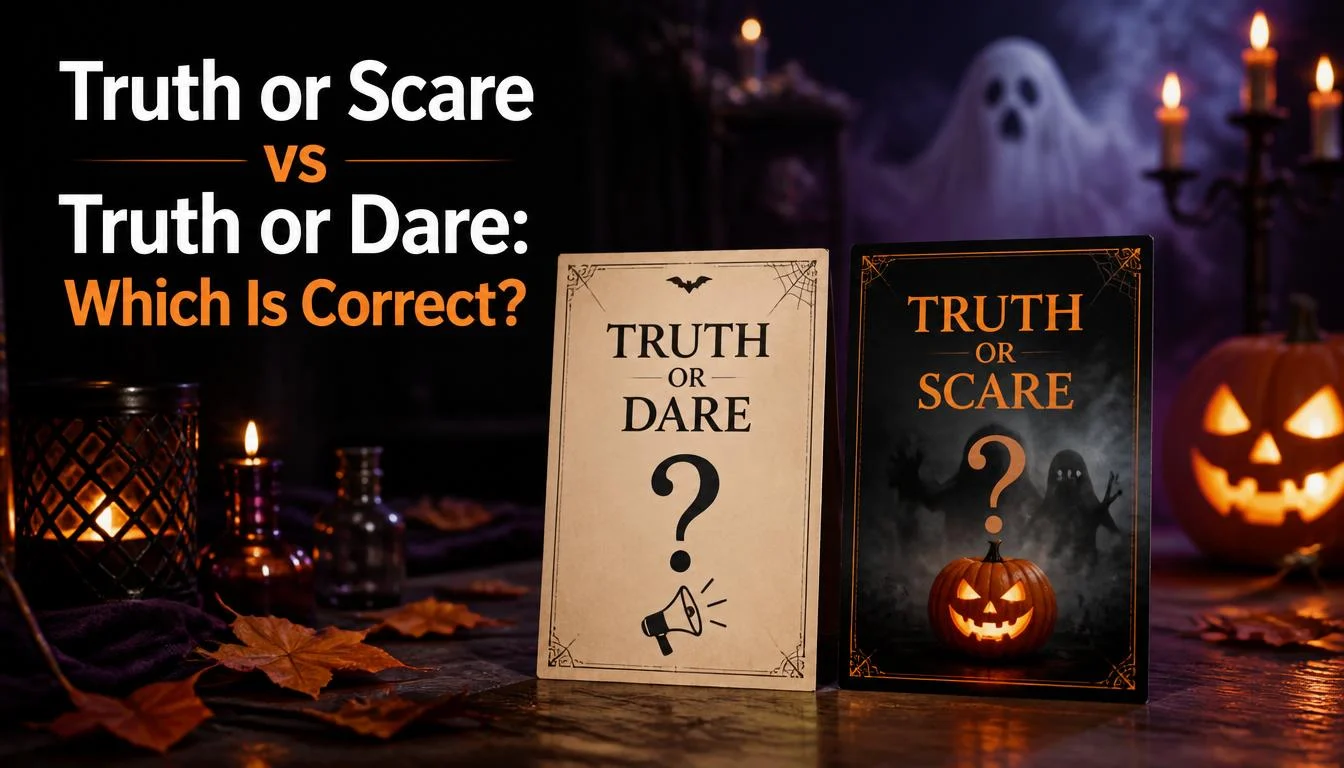
Quick Answer
“Truth or Dare” is the standard name of the classic party game, while “Truth or Scare” is a creative Halloween themed variation.“Truth or Scare” is not a spelling mistake when it refers to a spooky game, title, or themed activity.
If you have come across the phrase “truth or scare” and wondered whether it is the correct expression, you are not alone. The wording can be confusing because English has several familiar expressions built around words such as truth, scare, and dare. Understanding what “truth or scare” means requires looking at the context in which the phrase appears and determining whether the writer intends a standard expression, a playful variation, or a creative phrase.
In this guide, we’ll examine truth or scare, explain its meaning and usage, and look at how it differs from more established expressions. You’ll also see clear examples that show how the phrase works in everyday English. By the end, you’ll have a better idea of whether “truth or scare” fits the context you want to use it in and which wording sounds most natural to English readers.
Which One Is Correct?
Both expressions can be correct, but they are used differently.
“Truth or Dare” is the standard expression for the traditional game. It is the natural choice when you are talking about the familiar party activity without a special theme.
“Truth or Scare” is a creative variation. It is especially associated with Halloween, horror-themed parties, spooky classroom activities, and similar events. In this version, “scare” replaces “dare” to give the game a Halloween feel.
So, neither phrase should automatically be called incorrect.
| Expression | Standard use |
|---|---|
| Truth or Dare | Traditional party game |
| Truth or Scare | Halloween or spooky variation |
| Truth or scare | Same phrase in lowercase when used within a sentence |
If you are writing about the classic game, use Truth or Dare. If you are naming a Halloween adaptation, Truth or Scare works naturally.
Meaning of the Correct Word
Definition
The word dare is a verb and a noun. As a verb, it means to challenge someone to do something that may be difficult, embarrassing, risky, or frightening.
As a noun, a dare is the challenge itself.
In “Truth or Dare,” the player chooses between telling the truth and accepting a challenge. The challenge can be silly, embarrassing, physical, or dramatic.
Explanation
The word dare is pronounced DAIR.
For example:
She dared me to sing in front of everyone.
Here, “dared” means challenged.
As a noun, you might say:
That was a difficult dare.
The noun refers to the challenge.
In the game Truth or Dare, the word works because players traditionally choose between revealing something honestly and completing a challenge.
The exact rules can vary between groups. Some versions use personal questions, while others include funny or embarrassing tasks.
Usage
Use Truth or Dare when you mean the established party game.
Examples include:
- We played Truth or Dare at the sleepover.
- Do you want to play Truth or Dare?
- She chose truth instead of dare.
- His dare was to sing a song.
- They created a list of Truth or Dare questions.
The phrase is usually capitalized when it refers to the named game.
When used as a general description rather than a title, lowercase styling can also appear:
They spent the evening playing truth or dare.
Real-World Examples
The phrase appears naturally in casual conversation, party planning, and entertainment contexts.
“Who wants to play Truth or Dare?”
“I always choose truth because the dares are embarrassing.”
“We prepared some funny Truth or Dare questions for the party.”
“He accepted the dare and danced in the middle of the room.”
These examples show why dare is the expected word in the traditional version of the game.
Meaning of the Incorrect or Alternative Word
Incorrect
Scare is not incorrect English. The word itself is completely standard.
The confusion comes from treating Truth or Scare as though it were the traditional name of the game. In that context, Truth or Dare is the established expression.
However, “Truth or Scare” can be correct when someone intentionally changes the game for a spooky theme.
Typo
“Scare” can be a typo if someone intended to write the traditional expression Truth or Dare.
For example:
We played Truth or Scare at the birthday party.
If the writer meant the ordinary party game, “scare” may simply be an accidental substitution.
Context determines whether it is a mistake.
Slang
“Truth or Scare” is not generally classified as standard slang.
Instead, it functions as a playful, informal name for a themed version of the game. Halloween activity websites commonly use the expression in this way.
Regional Variation
“Truth or Scare” is not a standard American-versus-British spelling difference.
It is better understood as a thematic variation, not a regional variant.
American, British, and other English-speaking audiences can understand both expressions when the context is clear. The traditional phrase remains Truth or Dare.
Rare but Valid Usage
“Truth or Scare” can also appear as a proper title.
For example, Truth or Scare was the name of a Discovery Kids television series that aired from 2001 to 2003. The program explored spooky stories and paranormal subjects for younger audiences.
That means the phrase has uses beyond a Halloween party game.
It can also work as the name of a classroom activity, printable game, party event, or Halloween challenge.
Key Differences Between the Two Words
The main difference is not spelling accuracy. It is meaning and context.
| Feature | Truth or Dare | Truth or Scare |
|---|---|---|
| Spelling | Standard expression | Creative themed expression |
| Meaning | Truth or a challenge | Truth or a spooky challenge |
| Pronunciation | “trooth or dair” | “trooth or skair” |
| Grammar | Fixed game name | Themed game name or phrase |
| Usage | General party game | Halloween and horror themes |
| Recognition | Widely recognized | Recognized mainly from themed contexts |
| Tone | Casual and playful | Spooky, playful, or seasonal |
| Typical setting | Parties and sleepovers | Halloween parties and spooky events |
The difference becomes clearer when you consider the individual words.
Dare focuses on a challenge.
Scare focuses on fear or something frightening.
A Halloween game can replace “dare” with “scare” to create a pun and establish a spooky mood.
Why the Substitution Works
The two words sound different, but they share a similar rhythm.
Truth or Dare
becomes:
Truth or Scare
The change is small, but the meaning shifts toward Halloween.
A “scare” might involve pretending to be a ghost, telling a frightening story, making a spooky sound, or completing another themed challenge. Some versions still function almost exactly like Truth or Dare, with only the name and prompts changed.
Common Mistakes People Make
One common mistake is assuming that Truth or Scare is always wrong.
That is too broad.
If someone writes about a normal sleepover game, they probably mean Truth or Dare. But if the activity is specifically Halloween-themed, Truth or Scare may be intentional.
Another mistake is using the two phrases interchangeably in formal writing.
For example:
We played Truth or Scare during our ordinary birthday party.
This may confuse readers if there is no spooky theme.
A clearer sentence would be:
We played Truth or Dare during our birthday party.
If the party is Halloween-themed, the original sentence could make sense:
We played Truth or Scare during our Halloween party.
Another common mistake involves capitalization. When the expression refers to the name of a game, title case is appropriate:
We played Truth or Scare.
When you are discussing the words as ordinary language, lowercase may be more natural:
The phrase “truth or scare” is often used for Halloween activities.
Writers should also avoid assuming that “scare” is a grammatical replacement for “dare” in every sentence. The words have different meanings.
Compare:
I dare you to open the door.
with:
The movie scared me.
Dare describes a challenge, while scare describes causing or experiencing fear.
Correct Usage Examples
Casual Examples
“Truth or Dare or Truth or Scare?”
“Let’s play Truth or Dare after dinner.”
“We made our own Truth or Scare cards for Halloween.”
“She picked scare instead of truth.”
“That was the funniest dare of the night.”
“The Halloween version is called Truth or Scare.”
These examples reflect the way people might use the expressions in everyday conversation.
Professional Examples
In professional or informational writing, context should make the distinction clear.
The event will include a Halloween-themed Truth or Scare activity.
Guests can participate in a traditional Truth or Dare game.
The organizer renamed the activity Truth or Scare for the Halloween celebration.
The worksheet adapts the familiar Truth or Dare format for younger students.
These sentences avoid presenting the themed expression as the standard name of the traditional game.
Educational Examples
Teachers can also use “Truth or Scare” as a creative classroom title.
The students completed a Halloween Truth or Scare activity.
Each student selected a truth question or a spooky challenge.
The teacher prepared age-appropriate Truth or Scare cards.
The activity helped students practice speaking while enjoying a Halloween theme.
In educational settings, the title can be adapted to suit the lesson.
Literary/Metaphorical Examples
The two words can also be used creatively outside an actual game.
The story became a choice between truth or scare as the mystery unfolded.
Halloween turned the ordinary party into a night of truth or scare.
Behind every costume was a secret, and every question felt like truth or scare.
These examples use the phrase creatively rather than as the formal name of a game.
Word Origin / Etymology
The words truth, dare, and scare have separate histories.
Truth comes from Old English trēowth, related to the idea of faithfulness, loyalty, or being true. Over time, it developed into the modern meaning of something that agrees with fact or reality.
Dare also has Old English roots. The Old English verb durran expressed the idea of having the courage or confidence to do something. Its modern uses developed around courage, challenge, and willingness.
Scare has Germanic roots and is related to words connected with fright or sudden fear. Modern English uses it as both a verb and a noun.
The phrase Truth or Dare combines the ideas of honesty and challenge. “Truth or Scare” later works as a playful alteration because “scare” fits Halloween and horror themes.
The expression is therefore not formed by a spelling rule. It is a creative word substitution.
Why the Incorrect Version Became Popular
Calling Truth or Scare simply “the incorrect version” can be misleading.
It became popular in certain contexts because it is an easy Halloween adaptation of a familiar phrase. Changing only one word makes the activity instantly sound spooky.
Modern Halloween activity sources use “Truth or Scare” for games involving truth questions and frightening or silly challenges.
The phrase also benefits from wordplay. Dare and scare both fit naturally after “truth or,” so the substitution is easy for readers to understand.
There is another reason the expression can look familiar. Truth or Scare has been used as a title for Halloween activities, online games, party resources, and other entertainment. It is therefore more than a random spelling mistake.
Still, that does not make it the standard replacement for Truth or Dare.
The safest rule is simple: use Truth or Dare for the traditional game and Truth or Scare when you deliberately want a spooky or Halloween-themed version.
Easy Memory Tricks
Remember the difference with this simple rule:
Dare = Do something.
Scare = Something spooky.
If the game involves ordinary challenges, think:
Truth or Dare = Tell or Do
If the activity has a Halloween theme, think:
Truth or Scare = Tell or Spook
You can also remember the first letters:
- Dare → Do a challenge
- Scare → Spooky theme
Another useful trick is to imagine the setting.
At a normal sleepover:
Truth or Dare
At a Halloween party:
Truth or Scare
This memory trick works because the difference is mainly contextual rather than grammatical.
FAQs
Is “Truth or Scare” correct English?
Yes. “Truth or Scare” can be correct as a creative Halloween phrase or game title.
Is “Truth or Dare” the standard phrase?
Yes. “Truth or Dare” is the established name of the traditional party game.
Is “Truth or Scare” a typo?
It can be a typo if the writer intended the traditional game, but it is not automatically a mistake.
What does “Truth or Scare” mean?
It usually describes a Halloween-themed version of Truth or Dare with spooky questions or challenges.
How do you pronounce “Truth or Dare”?
It can be written phonetically as “trooth or dair.”
How do you pronounce “Truth or Scare”?
It can be written phonetically as “trooth or skair.”
Is “Truth or Scare” a Halloween game?
Yes. Several party and activity sources use it as a Halloween adaptation of Truth or Dare.
Should I write “Truth or Dare” or “Truth or Scare”?
Use Truth or Dare for the traditional game and Truth or Scare when you intentionally mean a spooky or Halloween-themed version.
Conclusion
Truth or Dare is the standard phrase for the classic party game, while Truth or Scare works as a creative Halloween variation.
“Scare” is not an incorrect English word, but it changes the ton`e and meaning of the expression.Use “Truth or Dare” for the traditional game and “Truth or Scare” for a spooky adaptation.When choosing between truth or scare, let the context tell you whether the phrase is a mistake or a deliberate Halloween twist.
Read More Articles
- Nails or Never | Meaning, Usage and Common Interpretations In 2026
- Arial or Aerial |How to Choose the Right Word In 2026

Christopher Parker is a writer and blogger at GramScript.com, sharing thoughtful insights and engaging stories across a range of topics. His writing blends clarity, curiosity, and a distinctly human perspective.