Quick Answer
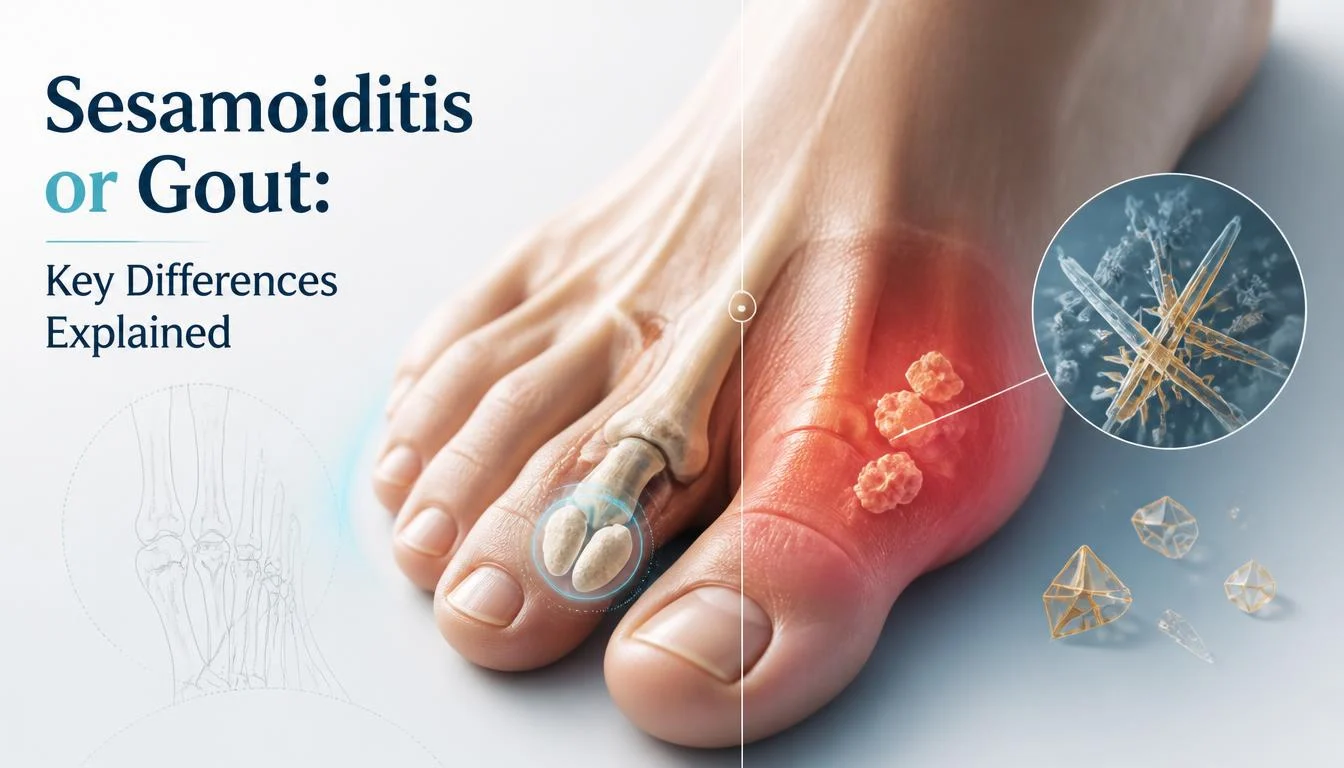
Sesamoiditis and gout are both correct medical terms, but they describe different conditions. Sesamoiditis affects the small sesamoid bones beneath the big toe, while gout is a crystal related form of arthritis that often affects the big toe joint.
Pain around the big toe can make simple activities like walking, standing, or exercising surprisingly uncomfortable. Two conditions that can cause pain in this area are sesamoiditis or gout, but they develop for very different reasons. Sesamoiditis typically involves irritation or inflammation of the small sesamoid bones and surrounding tissues beneath the big toe joint, often after repeated pressure or overuse. Gout, on the other hand, is a form of inflammatory arthritis caused by urate crystal buildup in a joint.
Knowing the difference between sesamoiditis or gout can help you understand what may be behind your symptoms and when professional evaluation may be appropriate. The location and timing of pain, swelling, redness, tenderness, recent activity, and other symptoms can provide useful clues, although they cannot replace a proper diagnosis. In this guide, we’ll compare the two conditions, explain their common symptoms and causes, and look at how doctors distinguish and treat them.
Which One Is Correct?
Both sesamoiditis and gout are correct words.
The key difference is meaning. Sesamoiditis refers to pain involving the sesamoid bones beneath the head of the first metatarsal. Gout is an inflammatory form of arthritis caused by urate crystal deposits in a joint.
So, asking which word is “correct” depends on what condition you mean.
If the problem involves the small bones beneath the big toe and is linked to pressure, repetitive activity, or mechanical irritation, sesamoiditis may be the appropriate term. If sudden joint inflammation results from urate crystals, gout is the appropriate term.
Neither word is a misspelling of the other.
Meaning of the Correct Word
Definition
Sesamoiditis is a term used for pain involving the sesamoid bones beneath the head of the first metatarsal. These are two small bones located beneath the big-toe area and embedded within a tendon.
The term is commonly associated with inflammation, irritation, or injury around these bones. Merck Manual notes that the condition can involve pain even when obvious inflammation is not present.
Pronunciation: ses-uh-MOY-dih-tis
Gout is pronounced gowt.
Explanation
The foot contains two small sesamoid bones beneath the first metatarsal head. They help protect the tendon and contribute to the mechanics of the big toe during movement.
Repeated pressure can irritate this area. Activities such as dancing and jogging can increase stress on the sesamoids. High arches, high-heeled shoes, and some foot structures can also contribute to symptoms.
Gout works differently. Extra uric acid can lead to urate crystals forming in a joint. The immune response to these crystals can cause sudden and severe inflammation. The big toe is a classic location for a gout flare.
That difference in cause is one of the most useful ways to separate the two terms.
Usage
Use sesamoiditis when discussing a condition involving pain around the sesamoids beneath the big toe.
For example:
The runner was diagnosed with sesamoiditis after repeated pain beneath the big toe.
Use gout when referring to crystal-induced arthritis.
For example:
The patient experienced a sudden gout flare in the big toe.
Medical writing may mention both terms when discussing possible causes of pain in the same region. Sesamoiditis can sometimes be confused with gout, especially when redness or swelling is present.
Real-World Examples
- A dancer develops gradual pain beneath the big toe after repeated rehearsals. Sesamoiditis may be considered.
- A runner notices pain beneath the first metatarsal that worsens while walking. Sesamoiditis is one possible cause.
- A person wakes with sudden, severe pain, redness, warmth, and swelling around the big-toe joint. Gout may be suspected.
- A doctor evaluating swollen big-toe pain may consider both conditions before reaching a diagnosis.
These examples show why location alone cannot always identify the condition.
Meaning of the Incorrect or Alternative Word
Incorrect
Neither word is inherently incorrect.
Sesamoiditis is a legitimate medical term. Gout is also a legitimate medical term. They should not be treated as competing spellings of the same word.
The more accurate comparison is sesamoiditis vs. gout, meaning two different diagnoses that can produce similar foot symptoms.
Typo
Neither word is normally considered a typo when spelled correctly.
Common spelling errors may happen because sesamoiditis is long and unfamiliar. People may accidentally omit letters or rearrange the middle of the word. The standard spelling is sesamoiditis.
Gout is much shorter, so spelling mistakes are less common.
Slang
Neither term is slang.
Both are established medical vocabulary. Gout is a common medical and everyday term, while sesamoiditis is more specialized and often appears in podiatry, orthopedics, sports medicine, and foot-care discussions.
Regional Variation
There is no meaningful America versus British spelling difference between sesamoiditis and gout.
The terms retain the same basic spellings in standard English.
Rare but Valid Usage
Sesamoiditis can be used in a broader clinical sense for pain involving the sesamoid region, even when the exact underlying problem is not simply inflammation. Merck Manual explains that sesamoiditis can describe pain at the sesamoid bones with or without inflammation or fracture.
Gout can also affect locations other than the big toe. Although the first metatarsophalangeal joint is a classic site, gout may affect the ankle, knee, wrist, elbow, or other joints.
Key Differences Between the Two Words
The easiest way to understand sesamoiditis or gout is to compare what each term actually describes.
| Feature | Sesamoiditis | Gout |
|---|---|---|
| Spelling | Sesamoiditis | Gout |
| Meaning | Pain or irritation involving the sesamoid region | Crystal-induced inflammatory arthritis |
| Pronunciation | ses-uh-MOY-dih-tis | gowt |
| Grammar | Noun | Noun |
| Typical location | Beneath the big-toe joint | Often the big-toe joint |
| Main mechanism | Repetitive pressure, injury, or mechanical irritation | Urate crystal deposition |
| Typical pattern | Often linked to activity or pressure | Often sudden and intensely inflammatory |
| Common symptoms | Localized pain, tenderness, possible warmth or swelling | Severe pain, swelling, redness, warmth, tenderness |
| Common triggers or risks | Repetitive activity, certain footwear, foot structure | Factors that increase uric acid or reduce urate removal |
| Recognition | Commonly used in foot and orthopedic medicine | Widely recognized arthritis term |
The table also explains why these conditions can be confused. Both can involve the big-toe region, but the underlying mechanisms differ.
Why Location Can Be Misleading
Pain beneath the big toe does not automatically mean gout.
Sesamoiditis usually produces tenderness directly over a sesamoid. Pain can become worse during walking or when wearing shoes that put pressure on the area.
Gout more typically involves the first metatarsophalangeal joint itself. A flare may cause rapid onset of severe pain, redness, warmth, and swelling.
Because these structures are close together, people may describe both conditions simply as “big-toe pain.”
Why Diagnosis Matters
A medical professional may use a physical examination, imaging, laboratory testing, or joint-fluid analysis depending on the suspected cause.
For suspected sesamoid problems, X-rays may help identify a fracture or structural issue. MRI may be used when X-rays do not provide enough information.
When gout is suspected, identifying urate crystals in joint fluid can confirm the diagnosis. A high blood uric acid level alone does not prove that someone has gout.
Common Mistakes People Make
Mistake 1: Treating the Words as Spelling Variants
The biggest mistake is assuming that sesamoiditis and gout are alternative spellings.
They are not.
They are separate medical terms describing different conditions.
Mistake 2: Assuming Every Big-Toe Problem Is Gout
Gout is strongly associated with the big toe, but other conditions can cause pain there.
Sesamoiditis is one example. A fracture, arthritis, tendon problems, or other foot disorders may also produce similar symptoms.
Mistake 3: Using High Uric Acid as the Entire Diagnosis
A person can have elevated uric acid without having symptomatic gout.
Merck Manual notes that hyperuricemia alone is not enough to confirm gout. Doctors may need additional evidence, such as urate crystals or appropriate imaging findings.
Mistake 4: Ignoring the Pain Pattern
The way pain develops can provide useful information.
Sesamoiditis often relates to pressure, movement, footwear, or repeated activity. Gout often causes a sudden flare with marked inflammation.
However, symptom patterns are clues rather than a substitute for professional diagnosis.
Mistake 5: Assuming Redness Automatically Means Gout
Redness can occur with gout, but it does not belong exclusively to gout.
Sesamoid problems can sometimes cause warmth, swelling, or redness around the big-toe area.
That overlap is one reason a careful examination matters.
Correct Usage Examples
Casual Examples
- “My doctor mentioned sesamoiditis as a possible reason for the pain under my big toe.”
- “She thought her sudden big-toe pain might be gout.”
- “Sesamoiditis can make walking uncomfortable.”
- “His gout flare made his big toe swollen and extremely tender.”
Professional Examples
- “The patient reported localized tenderness over the tibial sesamoid.”
- “The clinical findings raised concern for an acute gout flare.”
- “Imaging was ordered to evaluate possible sesamoid injury.”
- “Joint-fluid analysis may help distinguish gout from other inflammatory conditions.”
Educational Examples
- “Sesamoiditis involves the structures beneath the first metatarsal head.”
- “Gout results from inflammation associated with urate crystal deposition.”
- “The big toe is a common location for gout.”
- “Repeated pressure can contribute to sesamoid pain.”
Literary/Metaphorical Examples
These terms are medical rather than metaphorical, so they are rarely used figuratively.
Still, a health article might use them in descriptive writing:
“The dancer learned that persistent pain beneath the big toe was more than ordinary soreness; it was consistent with sesamoiditis.”
Or:
“The sudden gout attack turned an ordinary morning walk into a painful struggle.”
In formal medical writing, however, direct and literal usage is best.
Word Origin / Etymology
Sesamoiditis
The word sesamoiditis is built from sesamoid plus the medical suffix -itis.
“Sesamoid” refers to a bone that develops within a tendon or similar soft tissue. The name is linked to the resemblance of these small bones to sesame seeds.
The suffix itis is commonly used in medical terminology to indicate inflammation or an inflammatory condition. Examples include terms such as arthritis and tendonitis.
In modern clinical use, however, sesamoiditis can refer to pain around the sesamoid region even when inflammation is not clearly demonstrated.
Gout
Gout has a much older linguistic history.
The English word comes through Old French and ultimately traces back to Latin gutta, meaning “drop.” Historical medical thinking once associated disease with harmful “drops” or fluids affecting the body.
Modern medicine explains gout very differently. It is a form of inflammatory arthritis associated with monosodium urate crystal deposition.
So, while the words have different histories, both now have precise meanings in medical English.
Why the Incorrect Version Became Popular
There is no true “incorrect version” in sesamoiditis or gout.
The confusion comes from overlapping symptoms rather than from a spelling mistake.
- Both conditions can cause pain around the big toe.
- Both may involve tenderness.
- Both can sometimes involve swelling, warmth, and redness.
That visual similarity can lead people to use “gout” as a general label for painful big-toe symptoms.
The reverse can also happen. Someone with pain beneath the big toe may search for conditions involving the sesamoids without realizing that gout can affect the nearby first metatarsophalangeal joint.
The location is therefore only part of the story.
A clinician may consider the onset, exact location, physical findings, activity history, medical history, and appropriate tests before identifying the cause. When significant joint swelling is present, joint-fluid analysis may help rule out gout or infectious arthritis.
Easy Memory Tricks
Try these simple associations:
Sesamoiditis = Sesamoid bones
The first part of sesamoiditis points directly to the sesamoids. Think:
Sesa-moid → small bones beneath the big toe
Gout = crystals in a joint
Think:
Gout → urate crystals → sudden joint inflammation
Another useful distinction is:
Pressure and movement → think about sesamoid problems.
Sudden severe joint inflammation → think about gout.
These are memory aids, not diagnostic rules. A healthcare professional should determine the actual cause of persistent or severe pain.
FAQs
Is sesamoiditis the same as gout?
No. Sesamoiditis involves pain around the sesamoid bones beneath the big toe, while gout is a crystal-induced form of arthritis.
Which is more likely to cause sudden severe big-toe pain?
Gout commonly causes sudden, severe pain with redness, warmth, swelling, and tenderness in the big-toe joint.
Can sesamoiditis cause redness and swelling?
Yes. Sesamoiditis may cause warmth, swelling, and sometimes redness around the big-toe area.
Can gout affect the sesamoid bones?
Gout primarily causes inflammation from urate crystals in joints, but symptoms can occur close to the sesamoid region. A clinician may need to distinguish the conditions when the location overlaps.
Is high uric acid enough to diagnose gout?
No. High uric acid alone does not confirm gout because some people have elevated levels without gout symptoms.
How is sesamoiditis diagnosed?
Doctors typically assess the foot and may use X-rays or MRI when a fracture, displacement, or another structural problem is suspected.
How is gout confirmed?
Gout can be confirmed by identifying urate crystals in joint fluid or a tophus. Ultrasound and specialized CT imaging can also help in selected cases.
Should persistent big-toe pain be checked by a doctor?
Yes. Persistent, severe, suddenly swollen, hot, or red joint pain deserves medical evaluation because gout, infection, fracture, and other conditions can look similar.
Conclusion
Sesamoiditis or gout is not a choice between two spellings, but a comparison between two distinct medical conditions. Sesamoiditis involves painful structures beneath the big toe, while gout commonly causes sudden inflammation inside the big-toe joint. Their symptoms can overlap, so location alone cannot provide a reliable diagnosis. The easiest takeaway is simple: sesamoiditis involves the sesamoids, while gout involves urate crystals and inflammatory arthritis.
Read More Articles
- Vanguard or Fidelity | Comparing Features, Costs and Investment Choices In 2026
- Combating or Combatting | Meaning, Spelling and Usage In 2026

Andrew Cooper is a blogger and writer at Gramscript.com, turning everyday ideas into clear, engaging stories. His writing blends curiosity, insight and a genuinely human perspective.