Quick Answer
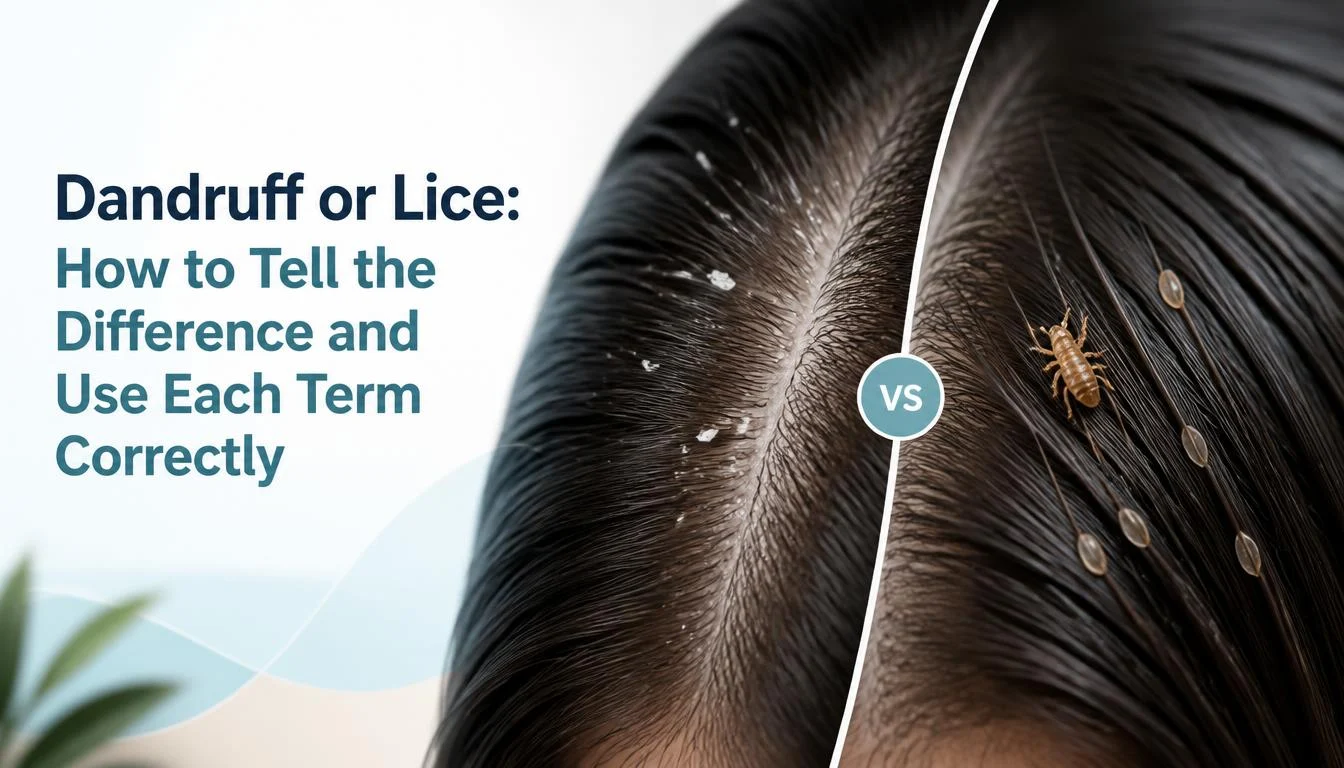
Both dandruff and lice are correct words, but they describe different scalp problems. Dandruff causes flaky, shedding skin, while lice are tiny insects that live on the scalp and lay eggs called nits.
An itchy scalp can be frustrating, especially when you notice white flakes or tiny particles in your hair. But is it dandruff or lice? Although these two conditions can cause scalp discomfort and may look similar at first glance, they are very different. Dandruff is a common scalp condition that causes flakes and irritation, while head lice are tiny parasites that live on the scalp and feed on blood.
Knowing the difference between dandruff or lice can help you avoid treating the wrong problem. Dandruff flakes usually shed easily from the scalp and hair, whereas lice eggs, called nits, tend to stick firmly to individual hair strands close to the scalp. In this guide, you’ll learn how to recognize the symptoms of each condition, understand their key differences, and discover the appropriate ways to deal with them.
Which One Is Correct?
Both dandruff and lice are correct English words. The key difference is meaning, not spelling.
Dandruff is the term for visible flakes of dead skin that shed from the scalp. It is often associated with scalp irritation, dryness, or seborrheic dermatitis.
Lice is the plural form of louse. In the context of the scalp, head lice are small insects that feed on blood and live close to the scalp. Their eggs are called nits.
So, there is no single “correct” choice between dandruff and lice. The right word depends on what you are describing.
For example:
- “I have dandruff in my hair.”
- “My child has head lice.”
- “These white flakes look like dandruff.”
- “The doctor found lice near the scalp.”
The words should not be used interchangeably.
Meaning of the Correct Word
Definition
Dandruff is a common scalp condition that produces visible flakes of shed skin. The flakes may appear white, grayish, or yellowish, depending on the person’s scalp and the amount of oil present.
Dandruff is generally discussed as a scalp condition rather than an infectious organism. It does not mean that insects are present in the hair.
Lice, meanwhile, are tiny parasitic insects. When people say “lice” in this context, they usually mean head lice, which infest the scalp and hair.
Explanation
Dandruff is related to the scalp’s skin. The flakes come from skin cells that shed more noticeably than usual.
An itchy scalp can occur with dandruff. Some people also experience irritation or oily, scaly patches. The severity can vary from mild flaking to more persistent scalp scaling.
Lice work differently. A live louse is an insect, not a piece of skin. Adult lice crawl through the hair and remain close to the scalp. Female lice lay eggs that attach firmly to individual hair shafts.
This distinction provides a useful clue: dandruff is loose skin, while lice and nits are associated with insects and their eggs.
Usage
The word dandruff is normally used as an uncountable noun.
You would usually say:
- “I have dandruff.”
- “She has severe dandruff.”
- “This shampoo helps control dandruff.”
You would not normally say “one dandruff” or “three dandruffs.”
Lice has a different grammatical pattern. It is already plural.
- Singular: louse
- Plural: lice
For example:
- “I found a louse.”
- “I found several lice.”
- “The school notified parents about head lice.”
The word nit refers to a louse egg, while nits refers to more than one.
Real-World Examples
Consider these examples:
“Small white flakes fell onto his shoulders, so he checked for dandruff.”
Here, the person is describing shedding skin.
“The nurse noticed several nits attached to the child’s hair.”
Here, the concern is related to head lice.
“She thought the itching was dandruff, but a closer inspection revealed head lice.”
This sentence shows why the distinction matters. Similar symptoms can have different causes.
Meaning of the Incorrect or Alternative Word
Incorrect
Neither word is inherently incorrect. Dandruff and lice are both standard English terms.
The mistake occurs when someone uses one word to describe the other condition.
Calling lice “dandruff” changes the meaning. Calling dandruff “lice” does the same.
For example, “I have dandruff” means you are describing scalp flakes. “I have lice” means you are describing an infestation involving insects.
Typo
Neither dandruff nor lice is a common typo-based variant of the other.
People may misspell either word because of unfamiliar spelling patterns. However, replacing one term with the other is not a spelling error. It is a vocabulary or meaning error.
A common spelling point is that lice is pronounced differently from how some beginners might expect it to be spelled.
Slang
Neither dandruff nor lice is slang. Both are established dictionary words used in everyday conversation and professional contexts.
Medical professionals, teachers, parents, pharmacists, and other speakers can use these terms naturally.
Regional Variation
There is no major American-versus-British spelling difference between dandruff and lice.
American English uses dandruff, just as British English does. Likewise, lice remains the plural of louse in both varieties.
The vocabulary may vary slightly in everyday descriptions, but the core terms remain the same.
Rare but Valid Usage
The singular word louse is less frequently heard in ordinary conversation about an infestation because people commonly encounter multiple insects. Still, it is completely valid.
For example:
“A single louse was found during the inspection.”
The plural lice is appropriate when referring to more than one.
The word dandruff does not normally have a plural form in everyday English because it refers to a condition or substance rather than individual objects.
Key Differences Between the Two Words
| Feature | Dandruff | Lice |
|---|---|---|
| Spelling | Dandruff | Lice |
| Meaning | Flaking or shedding scalp skin | Small parasitic insects |
| Pronunciation | DAN-druff | LYSE |
| Grammar | Usually an uncountable noun | Plural noun |
| Singular form | No usual singular count form | Louse |
| Related term | Scalp flakes | Nits |
| Physical nature | Skin flakes | Living insects |
| Typical clue | Loose flakes | Crawling insects or firmly attached nits |
| Usage | “I have dandruff.” | “I have lice.” |
| Recognition | Common scalp condition | Head infestation |
The pronunciation of dandruff is commonly written as DAN-druff. Lice is pronounced LYSE, rhyming with “rice.”
The grammar difference is especially useful. Dandruff behaves like an uncountable noun, while lice is a plural noun.
Common Mistakes People Make
One common mistake is assuming that every white particle in the hair is dandruff. White material can have several causes, including loose skin, hair products, or attached nits.
Another mistake is assuming that an itchy scalp automatically means lice. Itching can occur with dandruff and several other scalp conditions.
People also sometimes use lice as if it were singular. The correct singular form is louse.
Incorrect:
“I found a lice.”
Correct:
“I found a louse.”
Or, when referring to several:
“I found lice.”
Another frequent mistake involves nits. A nit is a louse egg. It is not simply another word for dandruff.
Dandruff flakes often separate from the scalp and hair easily. Nits tend to be firmly attached to individual hairs. Still, visual identification can be difficult, so appearance alone should not always be treated as a diagnosis.
People may also confuse dandruff with head lice because both can involve itching. That similarity does not make the terms interchangeable.
Mistake: Using “Dandruff” for an Infestation
“My daughter has dandruff, and I found insects in her hair.”
If actual insects are present, head lice is the more precise term.
Mistake: Using “Lice” for Loose Flakes
“I have lice falling onto my shirt.”
If the material is simply loose scalp skin, dandruff is the appropriate term.
Mistake: Treating “Lice” as Singular
“There is one lice on the hair.”
Use louse for one insect.
“There is one louse on the hair.”
For multiple insects:
“There are lice in the hair.”
Mistake: Assuming Itching Proves Lice
An itchy scalp does not automatically mean someone has lice. Dandruff, irritation, allergies, and other scalp issues can also cause itching.
Correct Usage Examples
Casual Examples
Here are some natural everyday examples:
- “I think I have dandruff because my scalp is really flaky.”
- “Can you check my hair for lice?”
- “He uses a dandruff shampoo twice a week.”
- “The kids were checked for head lice.”
- “Those flakes look more like dandruff than nits.”
- “She discovered lice after noticing persistent itching.”
These sentences use each word according to its actual meaning.
Professional Examples
In a professional setting, precise vocabulary can prevent misunderstandings.
- “The patient reports persistent dandruff and scalp irritation.”
- “The examination confirmed the presence of head lice.”
- “The clinician distinguished loose dandruff flakes from attached nits.”
- “The family received information about preventing the spread of head lice.”
- “Persistent dandruff may require evaluation if standard care does not improve symptoms.”
Notice how the language stays specific. The condition is described separately from the organism.
Educational Examples
Teachers and students can use the terms in simple explanatory sentences:
- “Dandruff consists of flakes from the scalp.”
- “Lice are small insects that can live in human hair.”
- “A louse is singular, while lice is plural.”
- “Nits are eggs laid by lice.”
- “Dandruff and head lice can both cause an itchy scalp.”
These examples are useful for vocabulary lessons because they show both meaning and grammar.
Literary/Metaphorical Examples
Dandruff is sometimes used descriptively in informal writing to create a vivid image of white flakes on dark clothing or hair.
For example:
“Snow-like flakes of dandruff dusted the shoulders of his black jacket.”
Lice can also appear in literary or historical descriptions of poor hygiene, crowded living conditions, or difficult circumstances.
However, these metaphorical uses should not blur the literal meaning. In normal health-related writing, the terms should remain precise.
Word Origin / Etymology
The history of dandruff is surprisingly old. The word comes from Middle English forms related to scalp flaking and developed into the modern English dandruff.
Its exact historical development is less straightforward than many everyday English words. The modern term has been used for centuries to describe flakes or scales associated with the scalp.
Lice has an older and clearer linguistic history. It is the irregular plural of louse, a word inherited from Old English lus. The same ancient Germanic root is related to words for the insect in several other Germanic languages.
The singular-to-plural change is irregular:
louse → lice
This pattern is similar to other older English vowel changes, such as:
mouse → mice
The word nit also has Old English roots and has long referred to the egg of a louse.
Understanding these origins explains why lice does not follow a simple plural pattern such as “louses” when referring to the insects.
Why the Incorrect Version Became Popular
There is no incorrect spelling variant that directly competes with dandruff and lice. The confusion comes mainly from their overlapping everyday context.
Both words can appear in conversations about hair, scalp itching, children, grooming, and visible particles in the hair. That shared context can lead people to assume they describe similar things.
Visual confusion also plays a role. A person who notices tiny white particles may immediately think of dandruff. Another person may suspect nits. Without closer inspection, the two can be difficult to distinguish.
Online conversations can add to the confusion because people often use broad descriptions such as “white stuff in my hair” or “itchy scalp.” Those descriptions do not identify the underlying cause.
The best approach is to keep the vocabulary precise. Use dandruff for scalp flaking and lice for the insects. Use nits when specifically referring to louse eggs.
Easy Memory Tricks
A simple memory trick is:
Dandruff = flakes.
Think of dandruff as loose flakes coming from the scalp.
For lice, remember:
Lice = live insects.
The word lice also rhymes with rice, which makes its pronunciation easy to remember.
For the grammar:
One louse, two or more lice.
You can also remember the relationship this way:
Dandruff flakes → scalp skin
Lice → insects
Nits → eggs
- If something is a loose flake, think dandruff.
- If you are talking about the insects, think lice.
- If you mean their eggs, think nits.
FAQs
Is dandruff the same as lice?
No. Dandruff involves scalp flakes, while lice are tiny parasitic insects that live on the scalp and hair.
Is “lice” singular or plural?
Lice is plural. The singular form is louse.
How do you pronounce dandruff?
Dandruff is commonly pronounced DAN-druff.
How do you pronounce lice?
Lice is pronounced LYSE, which rhymes with “rice.”
Are nits the same as dandruff?
No. Nits are lice eggs attached to hair shafts, while dandruff consists of loose flakes of scalp skin.
Can dandruff cause an itchy scalp?
Yes. Dandruff can be associated with scalp itching, flaking, and irritation.
Does an itchy scalp always mean lice?
No. Itching can have many causes, including dandruff, irritation, allergies, and other scalp conditions.
Which is correct: “a lice” or “a louse”?
Use a louse for one insect. Use lice when referring to more than one.
Conclusion
Understanding dandruff or lice becomes simple once you separate scalp flakes from living insects. Dandruff describes a flaky scalp condition, while lice are parasitic insects and nits are their eggs. Both terms are correct, but they cannot be used interchangeably. Remember the simple rule: dandruff flakes, lice crawl, and nits cling.
Read More Articles
- Presentor or Presenter | Clear Up This Common Spelling Confusion In 2026
- Behaviour or Behavior | Everything You Need to Know About the Spelling In 2026

Christopher Parker is a writer and blogger at GramScript.com, sharing thoughtful insights and engaging stories across a range of topics. His writing blends clarity, curiosity, and a distinctly human perspective.
1 thought on “Dandruff or Lice | How to Check Your Scalp and Choose the Right Treatment In 2026”