Quick Answer
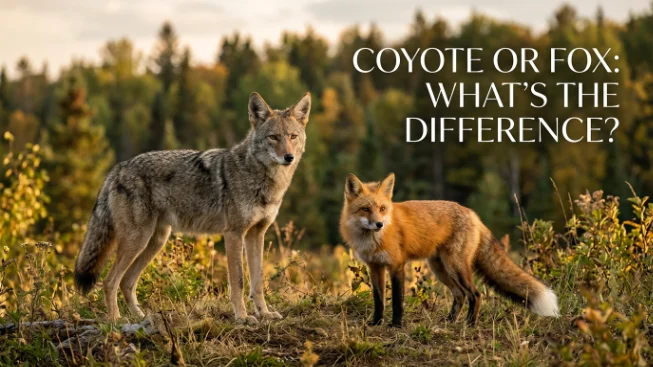
A coyote and a fox are both members of the dog family, but they are different animals. A coyote is generally larger, taller, and longer legged, while a fox is smaller and more compact with a fuller tail.
At first glance, a coyote or fox can be easy to confuse, especially when you spot one briefly in the wild or from a distance. Both belong to the dog family and have pointed ears, furry coats, bushy tails, and similar body shapes. However, they are noticeably different in size, proportions, behavior, habitat, and appearance. Coyotes are generally taller and more slender with longer legs and a larger overall build, while foxes are usually smaller, more compact, and have a fuller-looking tail.
Knowing the differences between a coyote and a fox can make identification much easier. Features such as body size, muzzle shape, ear position, tail appearance, coat color, and the way the animal moves can provide useful clues. This guide breaks down the most important differences in simple language, helping you recognize whether you are looking at a coyote or a fox and understand how these two fascinating wild animals differ.
Which One Is Correct?
Both “Coyote” and “Fox” Are Correct
There is no incorrect word in coyote or fox. Both coyote and fox are correct English nouns, but they refer to different animals.
Use coyote when you mean a member of the genus Canis, especially the species Canis latrans, which is native to North America and has expanded its range considerably.
Use fox when referring to members of several genera in the dog family. The word is especially associated with animals such as the red fox, Vulpes vulpes, although “fox” can describe several related species.
The important point is simple:
A coyote is not a type of fox, and a fox is not a small coyote.
They are related because both belong to the family Canidae, but they have different evolutionary histories and physical characteristics.
Singular and Plural Forms
Both words follow normal English noun patterns.
| Singular | Plural |
|---|---|
| coyote | coyotes |
| fox | foxes |
Examples:
- “A coyote crossed the road.”
- “Several coyotes were heard nearby.”
- “A fox was hiding behind the fence.”
- “Two foxes ran across the field.”
Notice that the plural of fox is foxes, not foxs. The ending es is used because of the final sound in fox.
Meaning of “Coyote”
What Is a Coyote?
A coyote is a wild canine native to North America. Its scientific name is Canis latrans. It is closely related to wolves and domestic dogs.
Coyotes are usually medium-sized animals with:
- Long, narrow legs
- A relatively slender body
- Pointed ears
- A narrow muzzle
- A bushy tail
- Gray, brown, tan, or reddish fur
- A generally lean appearance
An adult coyote is normally larger and taller than most foxes. Its long legs give it a somewhat rangy appearance.
Coyotes are highly adaptable. They can live in deserts, grasslands, forests, mountains, farmland, and even urban and suburban areas.
How Coyotes Behave
Coyotes are intelligent and opportunistic animals. They can hunt small mammals, eat birds and insects, and consume fruit or other available food.
Their diet can change according to location and season.
A coyote may eat:
- Rabbits
- Rodents
- Birds
- Insects
- Reptiles
- Fruit
- Carrion
- Other available food sources
Coyotes are often associated with nighttime activity, but they can also be active during the day. In places where they experience little disturbance, daytime sightings are possible.
Coyote Calls
One of the easiest ways to identify a coyote is its distinctive vocal behavior.
Coyotes can produce:
- Howls
- Yips
- Whines
- Barks
- High-pitched calls
A group of coyotes calling together can sound much larger than the actual number of animals present. Their calls can carry over long distances, particularly at night.
This is one reason coyotes have become strongly connected with wilderness and nighttime landscapes in North American culture.
Meaning of “Fox”
What Is a Fox?
A fox is a small-to-medium-sized member of the dog family. Unlike “coyote,” which commonly refers to one particular species, the word fox can refer to several different species.
The red fox is one of the best-known examples. Its scientific name is Vulpes vulpes.
Foxes are generally recognized by their:
- Small to medium size
- Pointed face
- Large ears
- Slender body
- Long, bushy tail
- Quick movements
- Thick fur
The red fox is often reddish orange, but fox coloration varies widely. Some individuals may appear brown, gray, black, silver, or mixed in color.
How Foxes Behave
Foxes are usually solitary hunters, although their social behavior can vary by species and circumstances.
They are highly adaptable and can live in:
- Forests
- Grasslands
- Farmland
- Mountains
- Deserts
- Suburban areas
- Some urban environments
A fox may hunt small mammals, birds, insects, and other small prey. It may also eat fruit and other available foods.
Like coyotes, foxes are opportunistic. They can adjust their behavior according to the environment around them.
Why Foxes Have Bushy Tails
A fox’s tail is more than a visual feature.
The large tail can help with balance while running and turning. In cold weather, a fox may also use its tail for warmth by curling it around its body.
The tail is one of the most useful visual clues when distinguishing a fox from a coyote. Foxes often appear to have a proportionally larger and fuller tail.
Key Differences Between a Coyote and a Fox
Size and Body Shape
Size is one of the easiest ways to tell them apart.
Coyotes are generally larger than foxes. They have longer legs and a taller, more athletic frame.
Foxes usually have a shorter, more compact body. Their legs are shorter in proportion to their body, and their large tail can make them appear bigger than they actually are.
| Feature | Coyote | Fox |
|---|---|---|
| General size | Medium-sized canine | Small-to-medium canine |
| Legs | Long | Shorter |
| Body | Lean and rangy | Compact and slender |
| Face | Long, narrow muzzle | Narrow, pointed face |
| Ears | Upright | Large and pointed |
| Tail | Bushy but usually less oversized | Often very full and prominent |
| Common example | Canis latrans | Red fox, Vulpes vulpes |
These are general characteristics. Different fox species and individual animals can vary considerably.
Color
Color can help, but it should not be your only clue.
Coyotes often have a mixture of gray, brown, tan, and reddish tones. Their fur may look somewhat grizzled because several colors can be present at once.
Red foxes commonly have reddish-orange fur, darker legs, and a pale underside. However, red foxes can also have darker or unusual color forms.
This means that seeing a reddish animal does not automatically mean you are looking at a fox.
Tail Shape
The tail can provide another useful clue.
A fox usually has a very full, bushy tail that appears large compared with its body. A red fox’s tail often has a distinctive white tip, although markings can vary.
A coyote’s tail is also bushy, but it generally looks less oversized in relation to the animal’s body.
When watching an animal from a distance, compare the tail with the overall body rather than looking at the tail alone.
Face and Ears
Coyotes usually have a longer, narrower muzzle and a more dog-like face.
Foxes tend to have a sharper, more pointed face and relatively large ears.
The difference becomes easier to see when the animals are standing side by side, but distance and lighting can make identification difficult.
Legs
Long legs are a strong clue for a coyote.
A coyote often looks tall and lightly built because its legs are long compared with its body.
A fox usually looks lower to the ground. Its shorter legs give it a more compact appearance.
If the animal seems unusually tall and narrow, a coyote becomes more likely.
Coyote or Fox: Behavior Differences
Hunting Style
Both animals are capable hunters, but their hunting strategies can differ.
Coyotes are versatile predators. Depending on the situation, they may hunt alone or cooperate with other coyotes, especially when pursuing larger prey.
Foxes are often solitary hunters. Their smaller size makes them particularly suited to catching small prey such as rodents and other small animals.
Foxes are also famous for their ability to locate prey beneath vegetation or snow. A fox may pause, listen carefully, and then leap toward the ground to catch hidden prey.
Social Behavior
Coyotes can have more complex social structures than many people expect.
They may live alone, as pairs, or in family groups. Their social behavior can change depending on food availability, territory, and breeding conditions.
Foxes are often more solitary, especially while hunting.
This does not mean that every fox lives alone all the time. Family groups can form, particularly when adults are raising young.
Activity
Both coyotes and foxes can be active at night.
However, neither animal should automatically be described as strictly nocturnal.
Their activity patterns can change because of:
- Human activity
- Food availability
- Season
- Weather
- Breeding
- Habitat
An animal seen during daylight is not necessarily sick, lost, or abnormal simply because it is active during the day.
Coyote or Fox in Different Habitats
Where Coyotes Live
Coyotes are famous for their ability to adapt.
They can survive in a wide variety of environments, including:
- Open plains
- Deserts
- Forest edges
- Mountains
- Agricultural land
- Suburbs
- Urban areas
Their adaptability has helped them expand beyond many areas where people once expected them to live.
Where Foxes Live
Foxes also occupy a wide range of environments.
Depending on the species, foxes can be found in:
- Forests
- Grasslands
- Mountains
- Deserts
- Farmland
- Suburban areas
- Urban environments
The term “fox” covers several species, so habitat varies considerably.
For this reason, saying “a fox lives in forests” is less precise than identifying the particular fox species.
Common Mistakes People Make
Mistake 1: Calling Every Small Wild Canine a Fox
A small-looking wild canine is not automatically a fox.
Young coyotes can look surprisingly small and may be mistaken for foxes.
Look at the animal’s proportions. Long legs, a narrow body, and a larger overall frame can point toward a coyote.
Mistake 2: Assuming Every Gray Animal Is a Coyote
Color alone is unreliable.
Foxes can have gray, black, silver, or mixed coats. A gray animal may be a fox, coyote, or another species.
Use several characteristics together.
Mistake 3: Thinking Coyotes Are Always Larger
Coyotes are generally larger than foxes, but size can be difficult to judge in the field.
Distance, perspective, thick fur, and the animal’s posture can all make an animal appear larger or smaller.
Mistake 4: Using “Fox” and “Coyote” as Synonyms
These words cannot normally replace each other.
For example:
- “A fox crossed the trail.”
- “A coyote crossed the trail.”
The sentences describe different animals.
Mistake 5: Assuming Fox Means Only Red Fox
“Fox” is a broader term.
There are multiple fox species, including red foxes, Arctic foxes, gray foxes, and several other species found in different parts of the world.
Mistake 6: Assuming Coyotes Are Just Wild Dogs
Coyotes belong to the dog family, but a coyote is a distinct wild species.
It is not simply a domestic dog that has become wild.
Correct Usage Examples
Casual Examples
- “Was that a coyote or a fox?”
- “I saw a fox near the garden.”
- “A coyote was walking along the road.”
- “That animal looked too tall to be a fox.”
- “The fox disappeared into the bushes.”
Professional Examples
- “The wildlife team identified the animal as a coyote.”
- “The researcher recorded several fox sightings in the area.”
- “The animal’s long legs and narrow body were consistent with a coyote.”
- “The camera captured a red fox moving through the woodland.”
Educational Examples
- “Coyotes and foxes are both members of the Canidae family.”
- “Coyotes are generally larger and longer-legged than foxes.”
- “Foxes often have a noticeably bushy tail.”
- “The red fox is one of the most widely recognized fox species.”
Literary and Metaphorical Examples
The word fox has also developed metaphorical meanings in English.
A person may be called a fox in older or literary usage to suggest cleverness or cunning.
For example:
- “The old fox knew exactly what the villagers were planning.”
- “He was a clever fox who rarely revealed his intentions.”
The word coyote has fewer common metaphorical uses in everyday English, although it appears frequently in stories, folklore, poetry, songs, and descriptions of the American West.
Pronunciation Differences
How to Pronounce “Coyote”
Coyote has more than one accepted pronunciation in English.
Common pronunciations include:
- kai-OH-tee
- kai-OHT
The shorter pronunciation is particularly common in some varieties of American English.
How to Pronounce “Fox”
Fox is much simpler:
foks
It rhymes with words such as:
- box
- locks
- rocks
- socks
The pronunciation is the same whether you mean the animal or use fox metaphorically.
Grammar Differences
“Coyote” as a Noun
Coyote is normally used as a countable noun.
Examples:
- “I saw a coyote.”
- “Three coyotes were nearby.”
- “The coyote moved through the grass.”
“Fox” as a Noun
Fox is also a countable noun.
Examples:
- “I saw a fox.”
- “Two foxes crossed the road.”
- “The fox disappeared into the forest.”
Common Determiners
Use a or an according to pronunciation, not spelling.
Because coyote begins with a consonant sound, we say:
- “a coyote”
Because fox also begins with a consonant sound, we say:
- “a fox”
Examples:
- “We spotted a coyote.”
- “We spotted a fox.”
Word Origin and Etymology
The Origin of “Coyote”
The English word coyote comes from Spanish coyote, which was borrowed from Nahuatl, an Indigenous language of central Mexico. The Nahuatl form is commonly given as coyōtl.
The word entered English as European writers and speakers encountered the animal and its name in the Americas.
This history explains why the spelling may look unusual to English learners. It is not built from familiar English word parts.
The Origin of “Fox”
The English word fox is much older within the Germanic language family.
It comes from Old English fox and has related forms in other Germanic languages.
For example, German has Fuchs, Dutch has vos, and related forms appear across the Germanic family.
Because fox is an ancient English word, its spelling is short and familiar.
Why Do People Mix Up Coyote and Fox?
Similar Appearance
The biggest reason is physical resemblance.
Both animals have:
- Four legs
- Pointed ears
- Long tails
- Narrow faces
- Fur
- Similar canine body shapes
If you see one quickly, especially at dusk, the differences can be hard to notice.
Similar Environments
Both species can live close to people.
A person who sees a wild canine in a neighborhood may not immediately know which species it is.
Similar Diets
Both animals can eat small mammals, birds, insects, fruit, and other available food.
This overlap makes their lifestyles appear similar even though the animals are distinct.
Similar Reputation
Both coyotes and foxes are often described as clever, adaptable, and difficult to observe.
Stories and popular culture have also given both animals strong personalities, which can blur the distinction for people who are learning about them.
Easy Memory Tricks
Think “Long Legs” for Coyote
When you see a wild canine that looks tall and lean, think:
Coyote = longer legs.
It is not a perfect rule, but it is a useful first clue.
Think “Full Tail” for Fox
When the animal looks smaller and has a very prominent, fluffy tail, think:
Fox = fuller tail.
Again, use this clue together with body shape and face structure.
Remember the Plurals
This simple language trick can help:
Coyote → coyotes
Fox → foxes
The second form adds -es, just like box → boxes.
Remember the Family
Both animals belong to Canidae, the dog family.
So you can remember:
Related does not mean identical.
A coyote and a fox share a family, but they remain different animals.
Coyote or Fox: A Simple Comparison
| Characteristic | Coyote | Fox |
|---|---|---|
| Animal group | Canid | Canid |
| Typical body size | Larger | Smaller |
| Body shape | Tall and lean | Compact and slender |
| Legs | Relatively long | Relatively short |
| Muzzle | Long and narrow | Pointed and narrow |
| Tail | Bushy | Very bushy and often prominent |
| Common example | Canis latrans | Red fox, Vulpes vulpes |
| Social behavior | Can form family groups | Often more solitary |
| Diet | Highly varied | Highly varied |
| Habitat | Highly adaptable | Highly adaptable |
| Common English plural | Coyotes | Foxes |
FAQs
Is a coyote a fox?
No. A coyote and a fox are different animals. Both belong to the dog family, but a coyote belongs to the genus Canis, while many foxes belong to other genera, including Vulpes.
Which is bigger, a coyote or a fox?
A coyote is generally bigger. It usually has longer legs, a taller body, and a more rangy appearance. Most foxes are smaller and more compact.
Can a fox and a coyote look alike?
Yes. Both have pointed ears, narrow faces, fur-covered bodies, and bushy tails. Young coyotes can be especially easy to mistake for foxes.
Are coyotes and foxes related?
Yes. Both are members of the Canidae family, which also includes domestic dogs, wolves, jackals, and other canids.
What is the plural of coyote?
The plural of coyote is coyotes. For example: “Several coyotes were heard after dark.”
What is the plural of fox?
The plural of fox is foxes. For example: “Two foxes crossed the field.”
Is coyote pronounced “kai-oh-tee”?
Yes. Kai-OH-tee is a common pronunciation, although kai-OHT is also used in some varieties of English.
Is a red fox the same as a fox?
A red fox is one particular kind of fox. The word fox can refer to several species, while red fox specifically refers to Vulpes vulpes.
Conclusion
When comparing coyote or fox, remember that both are related canids but represent different animals. A coyote is generally larger, taller, and longer legged, while a fox is usually smaller with a fuller tail. Their names are both correct, but they should not be used interchangeably. When in doubt, look at the animal’s size, legs, face, tail, and overall body shape before deciding which one you are seeing.

Jessica Morgan is a blogger and writer at GramScript.com, where she turns everyday ideas into engaging, relatable stories. Her writing blends a natural voice with fresh perspectives that keep readers coming back.
1 thought on “Coyote or Fox | How Their Features and Habits Differ In 2026”