Quick Answer
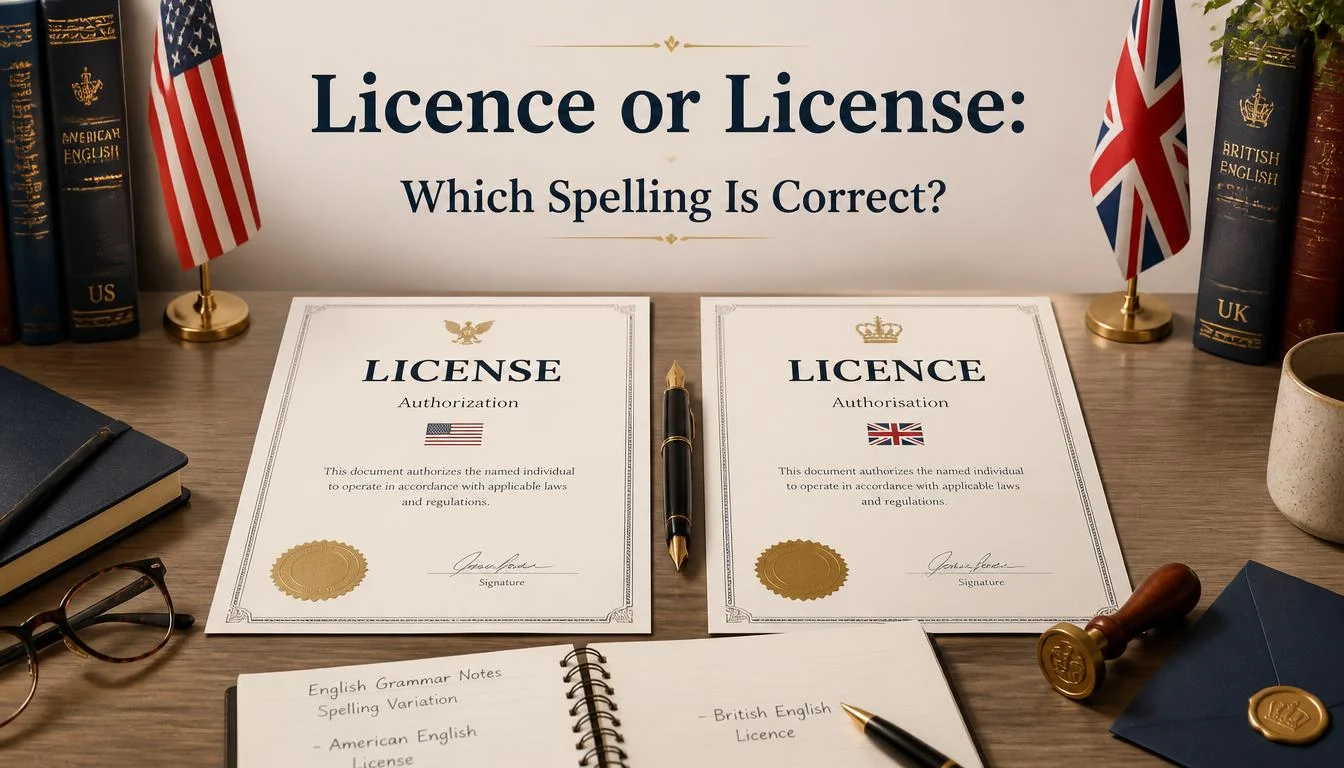
“License” is the standard American spelling for both the noun and verb; “licence” is the British spelling for the noun.
If you are writing in American English, choose license every time.
If you have ever wondered whether licence or license is the correct spelling, you are not alone. Both forms are correct, but the one you should use depends largely on which variety of English you are writing. Licence is commonly used as a noun in British English, while license is the standard spelling in American English. The difference becomes especially important in formal writing, professional documents, applications, and other situations where consistent spelling matters.
The confusion does not stop at spelling because British English also uses license as a verb, while licence is generally the noun. American English simplifies the distinction by using license for both the noun and the verb. In this guide, we’ll explain the difference between licence and license, show you how each word works in a sentence, and give you an easy way to remember which spelling to choose.
Which One Is Correct?
Both licence and license are correct spellings, but their use depends on the English variety.
In American English, license is used for both the noun and the verb:
- I renewed my driver’s license.
- The city may license the business.
- She has a professional license.
- The company is licensed to operate.
In British English, the usual distinction is:
- licence = noun
- license = verb
For example:
- He applied for a driving licence.
- The government may license the company.
So, neither spelling is simply “wrong.” The important question is which English convention you are following.
If your audience expects American English, use license. If you are following British English, use licence when the word functions as a noun.
Meaning of the Correct Word
Definition
A license is an official permission, document, or authorization that allows someone to do something legally or under specific rules.
As a verb, license means to give someone official permission to do something.
The word can refer to many situations, including driving, business operations, professional work, software use, broadcasting, and commercial activities.
Explanation
When license is used as a noun in American English, it usually refers to an official document or legal authorization.
For example, a driver’s license gives a person legal permission to drive. A business license allows a company to conduct certain activities under government regulations.
When license is used as a verb, it describes the act of granting that permission.
Consider the difference:
She received a license to operate the restaurant.
Here, license is a noun because it names the authorization.
The city will license the restaurant next month.
Here, license is a verb because it describes the action of granting authorization.
This noun-versus-verb distinction becomes especially important in British English, where the spelling changes.
Usage
In American English, license is used in several common expressions:
- driver’s license
- business license
- professional license
- hunting license
- fishing license
- marriage license
- operating license
- software license
- liquor license
The word can also appear in professional and legal contexts:
- license agreement
- license holder
- license renewal
- license number
- licensed professional
- licensed contractor
In British English, many of these noun phrases use licence instead.
For example:
- driving licence
- business licence
- professional licence
- software licence
Real-World Examples
Here are some natural examples using license in American English:
- You need a valid driver’s license to rent the car.
- The restaurant applied for a new business license.
- She renewed her professional license online.
- The company has a license to sell the product.
- The state may license qualified contractors.
- The publisher licensed the character for a new product line.
- His fishing license expires next month.
- The software requires a paid license for commercial use.
These examples show why license is the safest choice for American English writing.
Meaning of the Incorrect or Alternative Word
Incorrect
Licence is not inherently incorrect. It is the standard British spelling when the word is used as a noun.
However, licence is considered incorrect in standard American English.
For example:
I renewed my driver’s licence.
This spelling would look unusual in an American context.
The American form is:
I renewed my driver’s license.
So, whether licence is “incorrect” depends on the English variety.
Typo
If you normally write American English, typing licence may simply be a spelling mistake caused by familiarity with British English.
It is easy to make because many other English words have different American and British spellings. Writers may also encounter licence frequently in international articles, books, websites, and official documents.
Slang
Licence is not slang.
It is a legitimate standard spelling used in British English and several other varieties influenced by British usage.
Using licence does not make your writing informal or incorrect. It simply signals a particular spelling convention when the word is a noun.
Regional Variation
The biggest distinction is regional.
| English variety | Noun | Verb |
|---|---|---|
| American English | license | license |
| British English | licence | license |
This pattern is similar to other British-American spelling differences, although the noun/verb distinction makes licence/license particularly easy to confuse.
Rare but Valid Usage
In British English, licence is widely accepted and is not a rare form. It is the normal noun spelling.
You may also encounter licence in official documents, signs, newspapers, academic writing, and business communication in countries that follow British spelling conventions.
By contrast, license is the normal American form for both grammatical roles.
Key Differences Between the Two Words
The central difference between licence and license is spelling convention and grammatical function.
| Feature | License | Licence |
|---|---|---|
| American noun | Correct | Incorrect |
| American verb | Correct | Incorrect |
| British noun | Less standard for the noun | Correct |
| British verb | Correct | Incorrect |
| Meaning | Official permission or to authorize | Official permission |
| Pronunciation | LY-sens | LY-sens |
| Grammar | Noun and verb in American English | Usually noun in British English |
| Usage | Standard American spelling | Standard British noun spelling |
| Recognition | Common worldwide | Common in British English contexts |
Spelling
The difference is only one letter:
- license → ends in -se
- licence → ends in -ce
That small difference carries a regional grammar convention.
Meaning
The basic meaning remains the same. Both forms relate to official permission or authorization.
The difference is not comparable to two unrelated words such as affect and effect. Instead, licence/license represent regional spelling and grammatical conventions.
Pronunciation
Both words are generally pronounced LY-sens.
The spelling changes, but the pronunciation normally does not.
The verb license has the same basic pronunciation as the noun in standard usage.
Grammar
American English simplifies the spelling by using license for both noun and verb.
British English commonly keeps the distinction:
- licence as a noun
- license as a verb
For example:
British noun:
She showed her driving licence.
British verb:
The authority will license the operator.
Usage
Use license if your writing follows American English.
Use licence for a British English noun, but use license for the British verb.
This distinction is especially useful when writing for international readers because spelling can reveal which variety of English a document follows.
Recognition
Both spellings are widely recognizable.
An American reader will understand licence, and a British reader will understand license. However, readers may notice that the spelling does not match their local convention.
For formal writing, consistency matters more than trying to make one spelling universal.
Common Mistakes People Make
Using “licence” in American English
One of the most common mistakes is writing:
I need a driver’s licence.
For standard American English, write:
I need a driver’s license.
Assuming “licence” Is Always Wrong
The opposite mistake is also common.
Some writers learn American spelling and conclude that licence is always incorrect. That is not true.
In British English, licence is the standard noun spelling.
For example:
My driving licence expires next year.
That sentence is perfectly correct in British English.
Using “licence” as a British Verb
British English distinguishes the noun from the verb.
Incorrect:
The agency will licence the new facility.
Standard British usage:
The agency will license the new facility.
The noun takes -ce, while the verb takes -se.
Mixing American and British Forms
Another problem is inconsistency.
A document might use:
driver’s license
in one section and:
driver’s licence
in another.
If the entire document is written in American English, license should be used consistently. If it follows British English, use licence for nouns and license for verbs.
Confusing License With Permit
A license and a permit can be similar, but they are not always interchangeable.
A license often represents formal authorization, qualification, or an ongoing legal status. A permit may authorize a particular activity, event, construction project, or temporary action.
The exact distinction depends on the legal system and context.
Forgetting Related Forms
Once you know the basic spelling, related words become easier:
- licensed
- licensing
- licensee
- licensure
American English commonly uses licensed and licensing.
For example:
She is a licensed therapist.
The state handles professional licensing.
These forms can appear in both American and British contexts, although specific institutional terminology can vary.
Correct Usage Examples
Casual Examples
Everyday conversations often involve licenses for driving, fishing, or other activities.
- Did you renew your driver’s license?
- I forgot my license at home.
- You need a fishing license here.
- My license expires in June.
- Do they check your license at the counter?
These examples follow standard American English.
Professional Examples
The word is also common in workplaces and regulated professions.
- The contractor must hold a valid license.
- Our company has a state business license.
- She renewed her professional license last week.
- The agency is responsible for licensing healthcare providers.
- The business was licensed by the state.
In professional writing, precise spelling is especially important because licensing can have legal consequences.
Educational Examples
Teachers and students may encounter the word in grammar lessons or discussions about law and public policy.
- A driver’s license proves that the holder is legally authorized to drive.
- The state requires a license for certain occupations.
- Students should learn the difference between American and British spelling.
- The university licensed the software for classroom use.
- A professional license may require education and examination.
These examples also show how the word extends beyond driving.
Literary/Metaphorical Examples
License can sometimes have a broader, non-legal meaning.
It may describe freedom to act, especially when that freedom goes beyond normal limits.
For example:
The artist took creative license with the historical details.
Here, license does not refer to a government document. It means freedom or permission to depart from strict accuracy for artistic effect.
Another example is:
His position seemed to give him a license to criticize everyone else.
In this context, the word suggests freedom or perceived permission.
Word Origin / Etymology
The history of license reaches back to Latin.
The English word developed from the Latin licentia, meaning freedom, permission, or liberty. It is related to the Latin verb licere, meaning “to be permitted” or “to be allowed.”
The word entered English through French and developed over centuries into the modern forms license and licence.
The spelling difference emerged as English developed different conventions across regions.
British English eventually established a useful distinction between the noun licence and the verb license. American English largely standardized on license for both functions.
The underlying word remains the same. The spelling reflects the conventions of different English-speaking communities.
This history explains why neither form is an invented variation. Both belong to the long development of English vocabulary.
Why the Incorrect Version Became Popular
If you primarily use American English, you may wonder why licence appears so often online and in published material.
The answer is simple: British English is widely used around the world.
Countries and institutions that follow British spelling may use licence as the noun. This includes many English-speaking regions outside the United States.
Readers may therefore encounter:
driving licence
alongside the American:
driver’s license
Both expressions communicate the same basic idea.
International communication has also made these forms increasingly visible to one another. Websites, books, educational materials, government documents, and news sources cross national boundaries every day.
As a result, an American writer may accidentally adopt licence, while a British writer may encounter American license.
The spelling is therefore best understood as a regional convention, not as a battle between a “correct” word and a meaningless mistake.
Easy Memory Tricks
Think “American = License”
If you are writing American English, remember:
American English → license
Use it for both the noun and verb.
- driver’s license
- business license
- to license a company
British Noun = Licence
For British English, remember the simple pair:
Noun → licence
Verb → license
You can think of the C in licence as the “certificate” form because a licence is often a document.
Then remember that the action uses S:
The authority licenses the business.
Use the Context Test
Ask yourself two questions:
- Am I writing American or British English?
- Is the word a noun or a verb?
For American English, the answer is always license.
For British English:
- noun → licence
- verb → license
This quick test solves most spelling problems.
Remember the Pronunciation
Both forms are generally pronounced LY-sens.
So pronunciation will not help you decide which spelling to use. You must rely on the regional convention and grammatical role.
FAQs
Is “licence” correct in American English?
No. Standard American English uses license for both the noun and verb.
Is “license” correct in British English?
Yes. British English uses license as the verb, while licence is normally the noun.
What is the American spelling of licence?
The American spelling is license.
What is the British spelling of license?
For the noun, British English normally uses licence. The verb remains license.
Is a driver’s license or driver’s licence correct?
Driver’s license is standard American English. Driving licence is standard British English.
Are licence and license pronounced differently?
Usually, no. Both are generally pronounced LY-sens.
Is “licence” a typo?
Not necessarily. It is the standard British spelling of the noun, but it is not standard American spelling.
Which spelling should I use in American writing?
Use license for both nouns and verbs. Consistency is the key.
Conclusion
When choosing between licence or license, first identify the English variety you are using.American English uses license for both the noun and verb, while British English uses licence for the noun.The two forms share the same core meaning and are usually pronounced the same way.Remember: American English = license; British noun = licence, British verb = license.
Read More Articles
- Indexes or Indices | Meaning, Usage and Grammar Explained In 2026
- Argentine or Argentinian | A Simple Guide to Correct Usage In 2026

Jessica Morgan is a blogger and writer at GramScript.com, where she turns everyday ideas into engaging, relatable stories. Her writing blends a natural voice with fresh perspectives that keep readers coming back.
2 thoughts on “Licence or License | British and American Usage Made Simple In 2026”