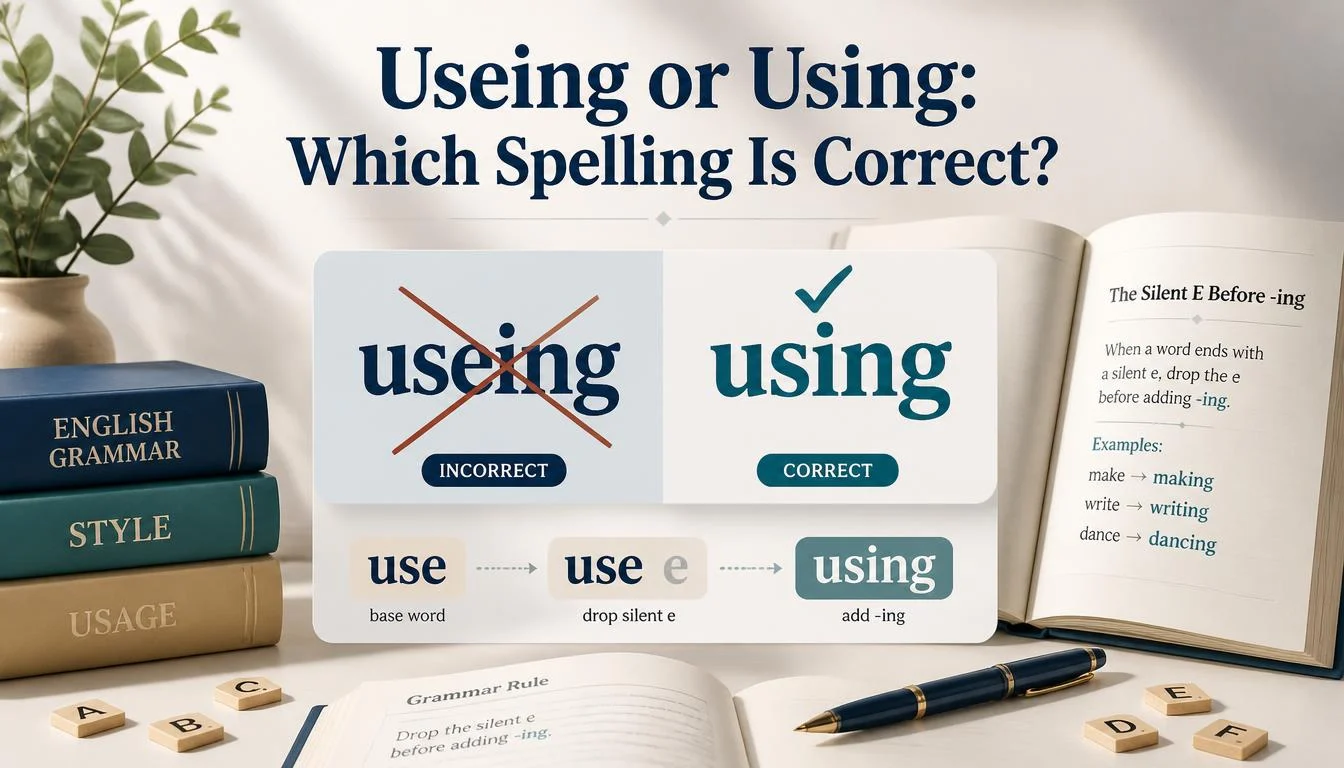
Quick Answer
Using is the correct spelling; useing is an incorrect spelling and should be avoided in standard American English.
The final e in use is dropped before adding ing, giving us using.
When writing quickly, it is easy to type “useing” instead of “using.” Although the two forms look similar, only one is considered the correct standard English spelling. Using is the present participle and gerund form of the verb use, and it appears frequently in everyday conversations, academic writing, professional communication, and online content. The spelling “useing” is incorrect and should be avoided in standard English.
The confusion usually comes from how English words change when -ing is added to a verb ending in a silent e. In the case of use, the final e is dropped before adding -ing, producing using, not useing. Understanding this simple spelling rule can help you avoid a common mistake and write with greater accuracy. In this guide, we’ll explain useing or using, show why using is correct, and provide clear examples to make the difference easy to remember.
Which One Is Correct?
Using is the only standard spelling used in modern American English. It is formed from the verb use by removing the final silent e before adding -ing.
The spelling process looks like this:
use + ing → using
The final e is dropped because English commonly removes a silent e when a suffix beginning with a vowel is added.
For example:
- make → making
- write → writing
- take → taking
- drive → driving
- use → using
Therefore, useing does not follow the standard spelling pattern.
It may still appear in informal writing, online posts, messages, or spelling errors. However, dictionaries and standard edited English recognize using, not useing, as the correct form.
Meaning of the Correct Word
Definition
Using is the present participle and gerund form of use. The verb use means to employ something for a particular purpose, function, or result.
Depending on the sentence, using can describe an action happening now or can function like a noun.
For example:
She is using my laptop.
Here, using describes an action in progress.
It can also appear as a gerund:
Using a dictionary can improve your vocabulary.
In this sentence, using refers to the activity itself.
Explanation
The word using has several common grammatical functions. Most often, it appears with a form of be to create the present progressive tense.
Examples include:
- I am using the computer.
- He is using the wrong password.
- They are using a new method.
- We were using an older version.
It can also introduce a method or tool:
She solved the problem using a calculator.
In that structure, using tells the reader how the action was performed.
The meaning depends on context, but the spelling remains the same.
Usage
Use using whenever you need the -ing form of the verb use.
Common patterns include:
am/is/are + using
I am using this notebook.
was/were + using
They were using the conference room.
using + noun
He improved the photo using special software.
using + gerund phrase
Using public transportation can save money.
The word is extremely common in everyday and formal English. It works naturally in conversation, academic writing, business communication, technical instructions, and creative writing.
Real-World Examples
Here are some natural examples of using:
- I am using a new phone this week.
- She is using her experience to solve the problem.
- We were using the wrong address.
- He learned English by using simple books.
- You can save time by using this shortcut.
- The teacher demonstrated the experiment using basic materials.
- They are using data from several reliable sources.
- Using clear examples makes difficult ideas easier to understand.
Notice that none of these sentences requires useing. The correct form is always using.
Meaning of the Incorrect or Alternative Word
Incorrect
Useing is incorrect in standard English.
It is usually created by adding -ing to use without removing the final e. Although the logic seems understandable, English spelling rules require the silent e to be dropped.
So:
Incorrect: useing
Correct: using
The same pattern occurs with many other verbs ending in a silent e.
Typo
Useing is best understood as a spelling error or typographical mistake rather than a separate English word.
Someone may type it because they remember the general rule “add -ing” but forget the spelling change. Fast typing can also produce the mistake.
A spell checker may flag useing because it is not the accepted standard form.
Slang
Useing is not recognized as a standard slang form of using. You may occasionally see it online, but that does not make it an accepted alternative spelling.
Internet writing often contains accidental misspellings, especially in quick messages and comments. These forms should not be copied into formal writing.
Regional Variation
Useing is not a standard American-versus-British spelling difference.
Both American and British English use:
using
The difference between American and British spelling appears in some words, such as color/colour and center/centre. Useing/using is not one of those cases.
Rare but Valid Usage
There is no ordinary modern English context in which useing is accepted as the standard spelling of the -ing form of use.
If you encounter it in an old document, a username, a quotation, or an intentionally misspelled text, the context may explain it. In normal modern writing, however, use using.
Key Differences Between the Two Words
| Feature | Using | Useing |
|---|---|---|
| Spelling | Correct | Incorrect |
| Meaning | The -ing form of use | No standard separate meaning |
| Pronunciation | YOO-zing | Usually intended as YOO zing |
| Grammar | Present participle or gerund | Not a standard grammatical form |
| Usage | Standard in all varieties of modern English | Usually a spelling mistake |
| Recognition | Recognized by standard dictionaries | Not recognized as the standard form |
The most important difference is simple: using is the correct word, while useing is a misspelling.
The pronunciation does not create a useful distinction. Both spellings would normally be intended to represent the same sound. The problem is entirely with the written form.
Common Mistakes People Make
One common mistake is applying the rule “just add -ing” to every verb.
That approach works for many verbs:
- work → working
- play → playing
- read → reading
- help → helping
However, verbs ending in a silent e often change before -ing is added.
For example:
- hope → hoping
- dance → dancing
- smile → smiling
- move → moving
- write → writing
- use → using
Another mistake is thinking that the final e must remain because it appears in the base word. In spelling, the base form and its inflected forms do not always look identical.
Writers sometimes also confuse using with useing because the pronunciation gives no obvious clue. When spoken aloud, the difference cannot be heard because useing is not a separate standard pronunciation.
A useful way to check yourself is to ask:
Does the verb end with a silent e?
If it does, check whether the e normally disappears before -ing.
For use, it does.
Correct Usage Examples
Casual Examples
Using appears constantly in everyday conversations.
I’m using your charger for a few minutes.
Are you using this chair?
She’s using my headphones again.
I was using my phone when you called.
These examples sound natural because using describes an action or activity.
You might also see it in short instructions:
Try using a smaller spoon.
Start by using warm water.
Keep using the same method until it works.
Professional Examples
In workplace writing, using can describe tools, processes, methods, or resources.
The team is using a new system to manage customer requests.
Employees can improve accuracy by using the updated guidelines.
The report was prepared using information from several departments.
Our designers are using customer feedback to improve the product.
The word fits naturally into emails, reports, presentations, instructions, and business documentation.
Using the correct spelling matters because small errors can affect the perceived quality of professional writing.
Educational Examples
Teachers and students frequently use using when describing learning methods.
Students can improve their writing by using precise vocabulary.
She learned the concept by using practical examples.
The instructor explained the formula using a simple diagram.
Using flashcards can help students remember new words.
In academic writing, using can also introduce a method:
The researchers analyzed the samples using a standard procedure.
Here, using tells us what method was employed.
Literary/Metaphorical Examples
Although using is an ordinary verb form, writers can place it in more expressive sentences.
He was using every mistake as a lesson.
She found a way forward by using courage instead of fear.
The poet shaped silence using words.
He kept using memories as a bridge to the past.
These examples show that using can describe physical actions, mental strategies, creative processes, or abstract methods.
Word Origin / Etymology
The modern verb use has a long history. It entered Middle English through Old French, where forms related to user meant to use or employ. The Old French word ultimately traces back to the Latin uti, meaning “to use.”
Over centuries, the English spelling and pronunciation developed into the modern word use.
The -ing ending is an old and productive feature of English. It forms present participles and gerunds from verbs. When English combines this ending with a verb ending in silent e, the spelling often changes.
That historical development helps explain why the modern form is not simply use + ing in written form.
English spelling reflects several layers of history. As a result, pronunciation alone does not always tell you how to form a word correctly.
Why the Incorrect Version Became Popular
The popularity of useing as a mistake comes from a perfectly understandable spelling assumption.
A learner may see:
use + ing
and naturally write:
useing
This seems logical if you treat -ing as a suffix that always attaches without changing the original word.
English, however, has many spelling conventions that modify the base word.
Compare:
- bake → baking
- close → closing
- save → saving
- ride → riding
- use → using
The final e usually disappears because it is not needed before the -ing ending.
Another reason the mistake occurs is that the word use is pronounced with a noticeable final sound. Learners may therefore feel that the e should remain in writing.
However, spelling and pronunciation do not always correspond letter for letter.
Digital communication can also spread mistakes. A misspelled word may appear repeatedly in comments, messages, or user-generated content. Seeing the same error many times can make it look familiar, even when it remains incorrect.
Familiarity is not the same as correctness.
Easy Memory Tricks
The easiest trick is:
Drop the silent e, then add -ing.
So:
use → us + ing → using
You can remember the pattern with a short rhyme:
Silent e takes a leave before -ing.
Think of use alongside familiar examples:
- use → using
- make → making
- write → writing
- take → taking
- drive → driving
Another helpful technique is to remember that using has only one e.
U-S-I-N-G
There is no e between the s and i.
If you see useing, pause and check the spelling. The standard form should immediately remind you:
using, not useing
You can also connect the spelling to the sound. Using is pronounced approximately YOO-zing. The written e from use does not appear in the -ing form.
FAQs
Is using the correct spelling?
Yes. Using is the correct standard spelling of the -ing form of use.
Is useing a word?
No. Useing is not the standard spelling of the verb form. It is generally a spelling mistake.
Why is useing wrong?
The final silent e in use is dropped before adding -ing, producing using.
How do you pronounce using?
Using is pronounced approximately YOO-zing.
Is using American or British English?
Using is standard in both American and British English. It is not a regional spelling difference.
Is useing ever acceptable?
Not in standard modern English. Use using in academic, professional, educational, and everyday writing.
What is the rule for use + ing?
For use, drop the final silent e before adding -ing: use → using.
What are similar examples to using?
Similar spelling changes include make → making, write → writing, take → taking, and drive → driving.
Conclusion
When comparing useing or using, always choose using because it is the standard and grammatically correct form.
The final silent e in use disappears before the -ing ending is added.Remember the simple pattern: use → using, just like make → making and write → writing.Whenever you need the -ing form of use, think using, not useing.
Read More Articles
- Coliseum or Colosseum | Definition, Examples and Usage In 2026
- Fulfill or Fulfil|British and American English Differences In 2026

Andrew Cooper is a blogger and writer at Gramscript.com, turning everyday ideas into clear, engaging stories. His writing blends curiosity, insight and a genuinely human perspective.
2 thoughts on “Useing or Using | Examples, Rules and Common Mistakes In 2026”