Quick Answer
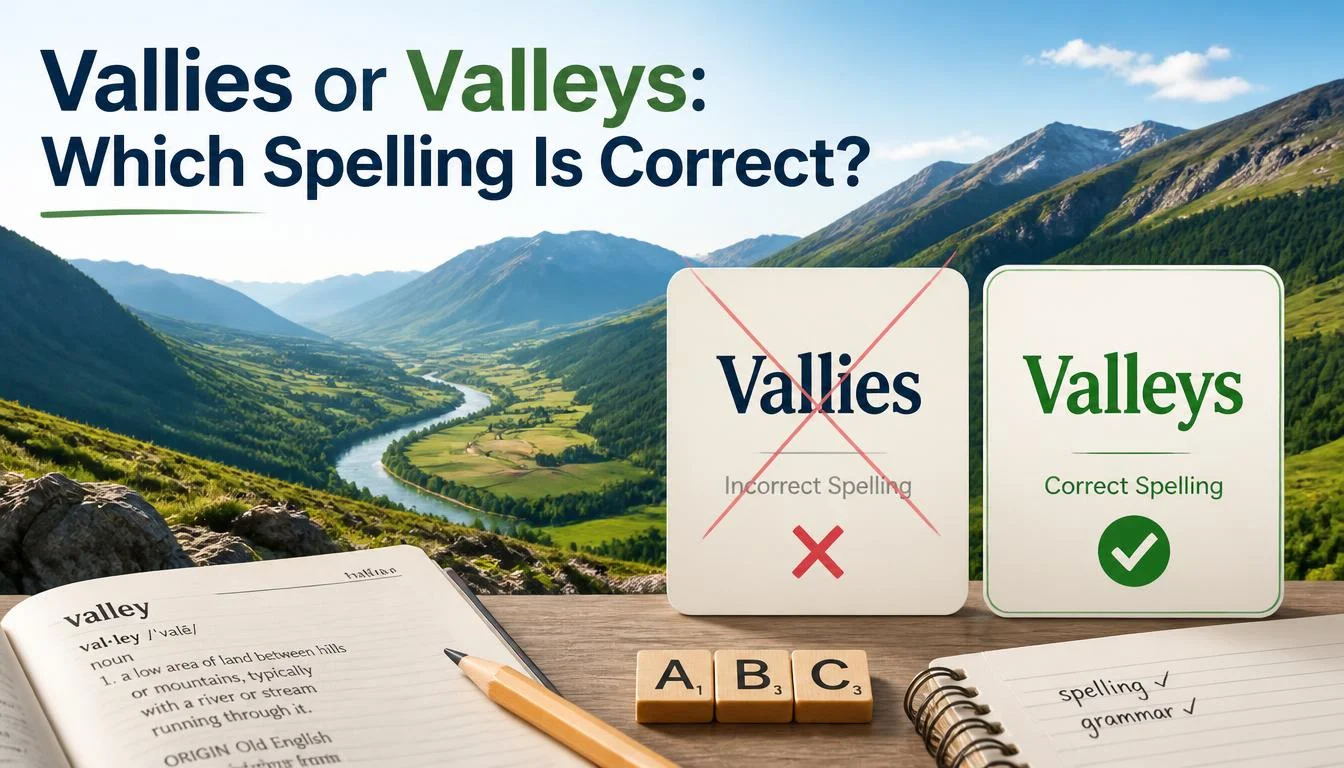
Valleys is the correct modern plural of valley. Vallies is not the standard spelling for multiple valleys, although it appears in some older English texts.
Vallies or valleys is a common spelling question, especially when writing the plural form of valley. The correct spelling is valleys, with an “e” before the final “ys.” A valley is a low area of land between hills or mountains, and its standard plural form is valleys. Although “vallies” may look reasonable at first glance, it is not the standard spelling in modern English.
Understanding this spelling becomes easier when you look at how the word valley changes in the plural. Unlike words that end in a consonant followed by -y, valley has a vowel before the y, so you simply add -s to form valleys. For example, “The valley is surrounded by mountains” becomes “The valleys are surrounded by mountains.” This guide explains the difference between vallies and valleys, shows which spelling is correct, and provides clear examples to help you use the word confidently.
Which One Is Correct?
Valleys is the standard modern English plural of valley.
Use valleys when you mean two or more valleys:
- The river flows through several valleys.
- Snow covered the mountain valleys.
- The hikers explored three beautiful valleys.
The spelling vallies is not the normal modern plural. Historical sources do contain vallies as an obsolete plural form, but contemporary writers should use valleys for ordinary English.
The difference comes from a basic spelling rule. When a noun ends in a vowel followed by y, English normally forms the plural by adding -s.
So:
- valley → valleys
- key → keys
- boy → boys
- toy → toys
- journey → journeys
However, when a noun ends in a consonant followed by y, the y usually changes to i before -es is added:
- city → cities
- baby → babies
- country → countries
- family → families
Because valley ends in -ey, not a consonant + y, it becomes valleys, not vallies.
Meaning of the Correct Word
Definition
Valleys is the plural form of valley. A valley is a relatively low area of land surrounded or bordered by higher ground, often between hills or mountains.
Valleys can form through different geological processes. Rivers, glaciers, erosion, and movements within Earth’s crust can all contribute to valley formation.
The word can describe both natural landscapes and places where people live, farm, travel, or build communities.
Explanation
The singular noun valley refers to one geographical area.
For example:
The village sits in a narrow valley.
When you refer to more than one, add -s:
Several villages sit in nearby valleys.
The spelling does not change the final y. This point causes the most confusion for English learners.
The word valley contains the ending -ey. The letter immediately before y is e, which is a vowel. Therefore, the normal plural formation simply adds s.
Usage
Valleys commonly appears in geography, travel writing, environmental discussions, history, literature, and everyday conversation.
You might see the word used with:
- mountain valleys
- river valleys
- fertile valleys
- deep valleys
- narrow valleys
- green valleys
- coastal valleys
- alpine valleys
- remote valleys
- broad valleys
It can also appear in figurative language. Writers sometimes use a valley as a symbol of difficulty, contrast, distance, or a low point.
Real-World Examples
Here are natural examples of valleys in different contexts:
Geography:
Rivers often shape valleys over long periods.
Travel:
We drove through several valleys during our mountain trip.
Agriculture:
Farmers use the fertile valleys for growing crops.
Weather:
Cold air can settle in mountain valleys overnight.
History:
Ancient settlements developed in river valleys.
Nature writing:
Mist covered the valleys before sunrise.
Everyday conversation:
The road passes through two narrow valleys.
These examples all use valleys because they refer to more than one valley.
Meaning of the Incorrect or Alternative Word
Incorrect
For ordinary modern English, vallies is incorrect when you want the plural of valley.
For example:
❌ The road crosses several vallies.
The standard version is:
✅ The road crosses several valleys.
The spelling error usually happens because writers remember the pattern found in words such as city → cities. They then apply that pattern to valley, even though the words have different endings.
Typo
In most modern writing, vallies is simply a spelling error when the writer means valleys.
You may encounter it in:
- school assignments
- online comments
- informal messages
- typed searches
- handwritten work
- documents with spelling mistakes
A spell-checker may also flag it because vallies is not the standard plural form used for geographical valleys.
Slang
There is another, unrelated use of vallies in slang. Some dictionaries record it as a plural-only slang term associated with diazepam. That meaning has nothing to do with geographical valleys.
Therefore, context matters. If you are discussing mountains, landscapes, rivers, or geography, valleys is the word you want.
Regional Variation
Vallies is not a standard British-versus-American spelling difference.
American English uses:
valleys
British English also uses:
valleys
The same spelling applies in both varieties. This means you do not need to change the word based on your audience’s English variety.
Rare but Valid Usage
Although vallies is not the correct modern plural for everyday writing, historical evidence shows that the form has existed in older English.
For example, historical literary works from the eighteenth and nineteenth centuries contain vallies as an older plural spelling of valley. Modern dictionaries and language references classify this use as obsolete.
So, the distinction is important:
- Modern standard English: valleys
- Historical English: vallies may appear
- Modern geographical writing: use valleys
If you are reading an old poem or historical document, do not automatically assume that vallies is a modern spelling mistake. The surrounding date and context can explain its appearance.
Key Differences Between the Two Words
| Feature | Vallies | Valleys |
|---|---|---|
| Modern spelling | Not standard for valley | Standard |
| Meaning in geography | Not the modern plural | Plural of valley |
| Singular form | — | valley |
| Pronunciation | Not normally used for this meaning | VALL-eez |
| Grammar | Obsolete historical plural | Standard plural noun |
| American English | Not standard | Correct |
| British English | Not standard | Correct |
| Academic writing | Avoid for modern usage | Recommended |
| Professional writing | Avoid for modern usage | Recommended |
| Historical texts | May appear | Also valid modern form |
| Recognition | May be treated as an error | Widely recognized |
| Recommended today | No | Yes |
The key difference is simple: valleys is the normal modern plural, while vallies survives mainly in historical or unrelated specialized usage.
Pronunciation Difference
In ordinary modern English, valleys is pronounced approximately:
VALL-eez
The ending sounds like -eez, similar to the plural ending in keys or cities.
The singular valley is pronounced approximately:
VALL-ee
So the change from singular to plural is mainly the addition of the -z sound at the end:
valley → valleys
The pronunciation does not change to reflect an -ies spelling.
Common Mistakes People Make
Mistake 1: Applying the Wrong Y Rule
The most common error is assuming every word ending in y changes to -ies.
That rule is incomplete.
Compare:
city → cities
with:
valley → valleys
The important detail is the letter before y.
Consonant + y:
city → cities
Vowel + y:
valley → valleys
This distinction solves most spelling questions involving final y.
Mistake 2: Writing “Vallies” Because It Looks Familiar
The spelling vallies can look natural because English contains many common -ies plurals.
For example:
- baby → babies
- lady → ladies
- party → parties
- story → stories
However, visual familiarity does not determine the plural form. The ending of the singular noun matters.
Mistake 3: Confusing Valley With Vally
Some writers also shorten the spelling incorrectly:
❌ vally
The standard singular spelling is:
✅ valley
Therefore:
valley → valleys
There is no need to remove the e.
Mistake 4: Forgetting the Double L
Another common spelling error is:
❌ valey
❌ vally
❌ vallay
The correct singular form is:
valley
It contains two l’s and ends in -ey.
Mistake 5: Assuming British English Uses “Vallies”
It does not. British English and American English both use valleys as the standard plural.
This is not a case like color/color or center/centre. There is no standard American-versus-British spelling difference here.
Correct Usage Examples
Casual Examples
These examples sound natural in everyday conversation:
We drove through several valleys on our vacation.
The mountains look beautiful from the valleys below.
There are small villages scattered across the valleys.
The road winds between two steep valleys.
We could see the valleys from the top of the hill.
Professional Examples
The word also works naturally in reports, workplace documents, and formal communication:
The project examines water availability across several mountain valleys.
The survey covered agricultural communities located in nearby valleys.
Heavy rainfall affected transportation routes through the surrounding valleys.
The report identifies flood-prone valleys along the river system.
These sentences use valleys as an ordinary plural noun.
Educational Examples
Students may encounter valleys frequently in geography and earth science:
Glaciers can carve broad U shaped valleys.
Rivers often create V-shaped valleys through erosion.
Several valleys developed between the surrounding mountain ranges.
The map shows the locations of major river valleys.
A useful classroom rule is:
Valley + s = valleys.
Literary/Metaphorical Examples
Writers can also use valleys beyond literal geography:
The travelers disappeared into the quiet valleys.
The poem moves from bright peaks into shadowed valleys.
After years of success, the character faced several emotional valleys.
In metaphorical writing, valleys can contrast with peaks. The meaning depends on context, but the spelling remains the same.
Word Origin / Etymology
The history of valley helps explain why the modern spelling looks the way it does.
English received the word through older forms related to Old French vallee, which ultimately traces back to Latin vallis, meaning “valley.” Historical English forms changed over time before the modern spelling became established.
The word has been part of English for centuries. Its history also explains why older texts can contain spelling variations that look unfamiliar to modern readers.
One such historical form is vallies. Sources record it as an obsolete plural of valley, meaning that it was used in earlier English but is no longer the normal plural form.
Modern English uses:
valley → valleys
This development reflects a broader pattern in English spelling. Older forms can survive in literature even after modern standard usage settles on a different form.
Why the Incorrect Version Became Popular
The spelling vallies makes sense if you apply a familiar English rule too broadly.
English learners often memorize examples such as:
city → cities
baby → babies
country → countries
family → families
These words end in a consonant followed by y. Their plurals change y to i and add -es.
The word valley looks similar because it also ends in y. That visual similarity can lead to:
valley → vallies
But the letter before y changes the rule.
In valley, the final letters are ey. The e is a vowel, so the plural normally takes -s:
valley → valleys
This pattern is not unique to valley. Consider:
key → keys
monkey → monkeys
donkey → donkeys
journey → journeys
chimney → chimneys
Seeing these examples together makes the rule easier to recognize.
Historical usage adds another layer to the confusion. Vallies did appear as an older plural, so someone reading historical literature might encounter the spelling and assume it remains standard today. It does not. Modern writing uses valleys.
Easy Memory Tricks
Remember “Vowel + Y = S”
The fastest rule is:
Vowel + y → add s
Since valley ends in ey, use:
valley → valleys
Compare “City” and “Valley”
Think of these two together:
city → cities
valley → valleys
Why are they different?
Because:
city = consonant + y
but:
valley = vowel + y
That single difference determines the plural spelling.
Use the “Key” Trick
The word key follows the same pattern:
key → keys
You would not normally write kies. Since valley also has a vowel before the final y, remember:
key → keys
valley → valleys
Remember the Picture
Imagine several mountain valleys. Then picture the word ending with a simple S:
🏔️ valley → 🏔️🏔️ valleys
The plural adds s. The y stays exactly where it is.
FAQs
Is “vallies” or “valleys” correct?
Valleys is the correct modern plural form of valley.
Why is it valleys instead of vallies?
Because valley ends in vowel + y, so the plural normally adds -s.
Is “vallies” a real word?
Yes, but it has historical and unrelated specialized uses. It is not the standard modern plural of valley.
What is the singular of valleys?
The singular form is valley.
One valley → two valleys
Do British and American English use “valleys”?
Yes. Both standard British and American English use valleys.
How do you pronounce valleys?
It is pronounced approximately VALL-eez.
What is the plural rule for valley?
Because the final y follows a vowel, simply add -s: valley → valleys.
Can I use “vallies” in an essay?
For modern academic writing, use valleys. Reserve vallies for historical quotations or discussions of older English.
Conclusion
When choosing between vallies or valleys, use valleys for modern English because it is the standard plural of valley.
The spelling follows the vowel-plus-y rule, so the final y stays unchanged and takes -s.Although vallies appears in some historical English sources, it is not the normal modern form for geographical valleys.Remember valley → valleys, and you will have the correct spelling every time.
Read More Articles
- Misspelled or Misspelt | Grammar, Meaning and Regional Usage In 2026
- Fiancee or Fiance | What Do These Relationship Terms Mean In 2026

Christopher Parker is a writer and blogger at GramScript.com, sharing thoughtful insights and engaging stories across a range of topics. His writing blends clarity, curiosity, and a distinctly human perspective.
1 thought on “Vallies or Valleys | How to Spell It Correctly In 2026”