Quick Answer
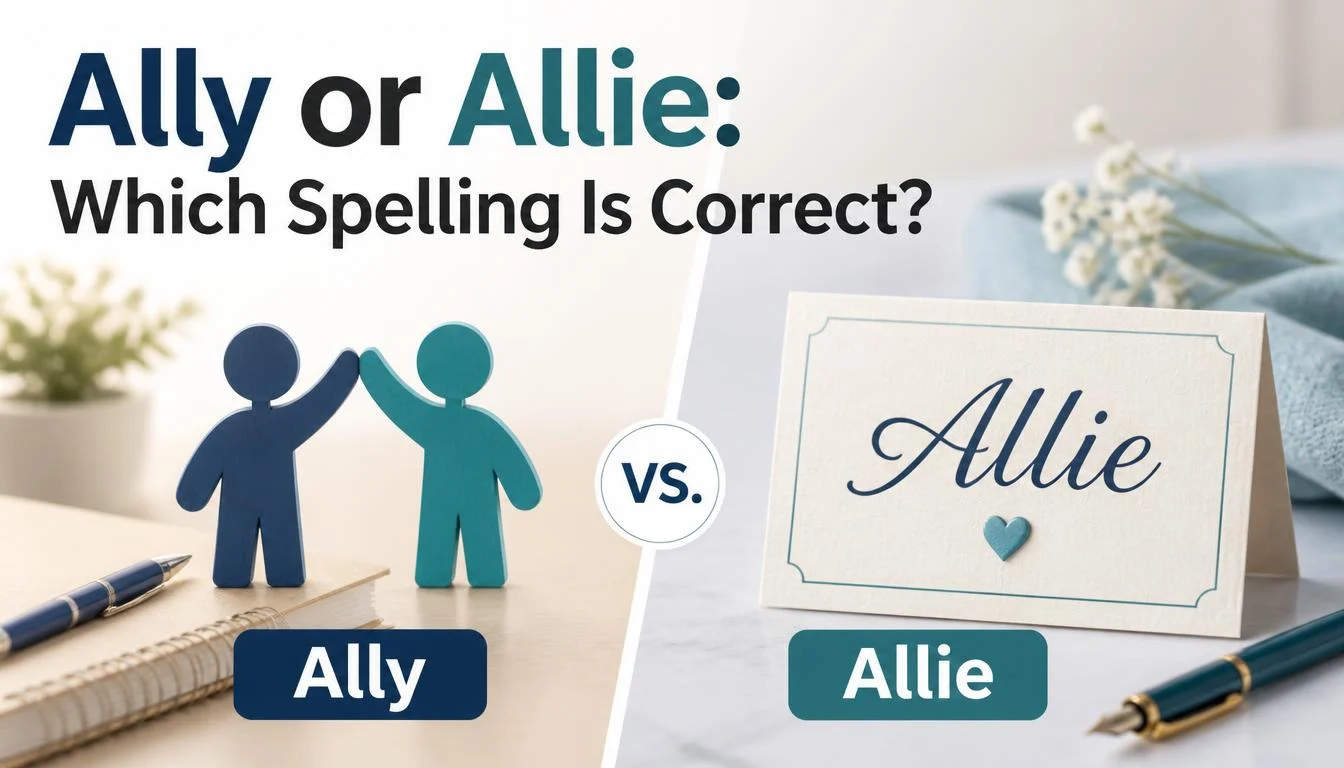
Ally is the correct English word for a friend, supporter, partner, or someone who helps another person or group.
Allie is usually a personal name or nickname, not the standard spelling of the common English word.
When you are unsure whether to write ally or allie, the confusion usually comes from how the words look and sound. However, the two forms do not have the same status in standard English. Ally is the established English word used for a person, group, or country that supports or cooperates with another. It can also refer to someone who actively supports a particular cause or community. Allie, on the other hand, is generally used as a personal name or nickname rather than the standard spelling of the common English word.
Knowing this distinction can help you avoid an easy spelling mistake in everyday writing. If you mean a supportive person, partner, or nation, ally is the correct choice. For example, you might say, “She became a strong ally during the difficult negotiations.” In this guide, we’ll explain the difference between ally and allie, look at their meanings, pronunciation, examples, and common contexts, so you can use the right form with confidence.
Which One Is Correct?
Ally is the standard English spelling when you mean a supporter, friend, partner, or cooperating group.
For example:
The two countries became close allies.
You can also use ally as a verb:
The small organization decided to ally itself with local businesses.
Allie is not the standard spelling for this common noun or verb. However, it can be completely correct when it refers to a person’s name.
For example:
Allie called me after work.
Therefore, the answer depends on what you are trying to say. Use ally for the English word and Allie when referring to a person whose name is Allie.
Meaning of the Correct Word
Definition
An ally is a person, organization, or country that supports another person or group, often because they share a goal or interest.
As a noun, ally can describe someone who provides friendship, assistance, protection, or cooperation.
It can also refer to a country that cooperates with another country, especially during a conflict or for mutual interests.
As a verb, ally means to join, connect, or cooperate with another person or group.
Explanation
The word ally has a broad meaning. It does not always describe a close personal friend.
For example, two businesses can become allies when they cooperate on a project. Two nations can become allies when they agree to support common interests. A person can also act as an ally by supporting someone who faces unfair treatment.
The central idea is support through cooperation.
The plural form is allies, not allys. This spelling changes the final y to ies.
For example:
- One ally
- Two allies
- A trusted ally
- Several international allies
The verb also changes depending on grammar:
- ally
- allies
- allied
- allying
Usage
Ally works as both a noun and a verb.
As a noun, it identifies someone or something that offers support:
Maria has always been a strong ally.
As a verb, it describes the act of joining with someone:
The two groups allied to protect the historic building.
The word often appears with phrases such as close ally, strong ally, trusted ally, political ally, strategic ally, and natural ally.
It can also appear in social and professional contexts:
He became an ally of the new employees.
Real-World Examples
Here are several examples showing how ally works naturally:
- The country gained a powerful ally during the negotiations.
- She proved to be a loyal ally when the project faced criticism.
- Several organizations became allies in the campaign.
- The two companies formed an alliance and became business allies.
- He decided to ally himself with experienced researchers.
- Good leaders often recognize the value of having trusted allies.
- The neighboring nations remained military allies for decades.
Notice that ally does not describe a person’s name in these sentences. It describes a relationship based on support or cooperation.
Meaning of the Incorrect or Alternative Word
Incorrect
Allie is incorrect when you intend to use the standard English word meaning “supporter” or “partner.”
For example:
She is my allie.
This spelling is incorrect if you mean that she is your supporter.
The correct sentence is:
She is my ally.
Likewise, this sentence is incorrect:
The two countries are allie.
The correct plural form is:
The two countries are allies.
Typo
Allie can occur as a simple spelling mistake for ally.
The mistake is understandable because English spelling often has words with endings such as -ie. People may also remember the pronunciation incorrectly and add an i before the final e.
However, standard dictionaries do not treat allie as the normal English spelling of the noun or verb ally.
If you are writing an essay, report, email, article, or formal document, use ally when you mean a supporter or cooperating partner.
Slang
Allie is not standard English slang for ally.
Some informal writing may contain creative spellings, but that does not make allie the accepted spelling of the word. Informal communication often contains deliberate misspellings, usernames, abbreviations, or playful language.
Those uses should not be confused with standard dictionary spelling.
Regional Variation
Allie is not a standard American English regional spelling of ally.
The spelling ally remains standard across major varieties of English when the word means a supporter or partner.
Pronunciation can vary slightly by accent, but the spelling does not normally change to allie.
Rare but Valid Usage
Allie can absolutely be valid when it is someone’s name.
For example:
Allie works at the library.
In that sentence, Allie is a proper noun. It is a person’s name, so the capital letter matters.
Allie can function as a given name or as a nickname for names such as Allison or Alexandra, depending on the individual.
So, calling Allie “incorrect” in every situation would be misleading. It is incorrect as the ordinary spelling of the word ally, but it can be perfectly correct as a person’s name.
Key Differences Between the Two Words
| Feature | Ally | Allie |
|---|---|---|
| Spelling | Standard English word | Usually a personal name or nickname |
| Meaning | Supporter, partner, or cooperative person/group | Usually a person’s name |
| Pronunciation | Usually “AL-eye” as a noun | Usually “AL-ee” as a name |
| Grammar | Noun and verb | Proper noun when used as a name |
| Usage | Common in everyday and formal English | Common as a given name or nickname |
| Recognition | Widely recognized as an English word | Recognized mainly as a name |
| Plural | Allies | Usually Allies when referring to people with that name |
| Example | She is a valuable ally. | Allie lives nearby. |
The most important distinction involves meaning and grammatical role.
If you are describing a supporter, use ally. If you are addressing or identifying someone named Allie, use Allie.
Pronunciation Difference
In American English, the noun ally is commonly pronounced AL-eye.
The verb ally is commonly pronounced uh-LIE.
By contrast, the personal name Allie is usually pronounced AL-ee.
This difference can help explain why some writers spell the name-like sound as Allie. The two forms can sound noticeably different depending on the speaker and context.
Grammar Difference
Ally functions as a common noun:
My brother is an ally.
It also functions as a verb:
The groups allied with one another.
Allie functions as a proper noun when it represents a person’s name:
Allie joined the meeting.
That means capitalization provides another useful clue. A common noun usually appears as ally, while a person’s name appears as Allie.
Common Mistakes People Make
One frequent mistake occurs when writers add -ie to the end of ally.
Incorrect:
He has always been an allie.
Correct:
He has always been an ally.
Another mistake involves the plural.
Incorrect:
Our organization has several allys.
Correct:
Our organization has several allies.
English changes the final y to ies when forming the plural of ally.
Writers may also confuse ally with alliance. These words are closely related, but they are not interchangeable.
An ally is the person, group, or country that supports another.
An alliance is the relationship or agreement between those parties.
For example:
Canada is an ally of the United States.
But:
The two countries formed an alliance.
Another common problem appears when people use Allie in lowercase. If it is a person’s name, capitalize it:
I spoke with Allie yesterday.
If you are using the ordinary noun, keep it lowercase:
She became an ally of the team.
Correct Usage Examples
Casual Examples
In everyday conversation, ally often describes someone who supports you.
- Thanks for being an ally when I needed help.
- Jake has become a reliable ally.
- She is more than a coworker; she is an ally.
- I know I can count on my closest allies.
- Our neighbor became an unexpected ally.
When Allie is a person’s name, the meaning changes:
- Allie is coming over tonight.
- I sent Allie a message.
- Allie helped me organize the event.
Professional Examples
Professional writing often uses ally to describe cooperation between people or organizations.
- The company found an important ally in the local business community.
- Our department needs an ally who understands the technical challenges.
- The two firms became strategic allies.
- She has earned a reputation as a dependable ally.
- The organization worked with several international allies.
The word can sound especially natural in business phrases such as strategic ally, business ally, and industry ally.
Educational Examples
Students may encounter ally in history, government, literature, and social studies.
- The nation sought another ally during the conflict.
- The smaller kingdom relied on a powerful ally.
- Several countries became allies during the war.
- The character finds an ally who supports his plan.
- The students discussed how an ally can influence a political conflict.
In academic writing, correct spelling matters because allie can look like an accidental error.
Literary/Metaphorical Examples
Writers can use ally in figurative ways.
For example:
Patience can become an ally during difficult decisions.
Here, patience is not literally a person. The writer presents it as a helpful force.
Other examples include:
- Time became her greatest ally.
- Experience can be a powerful ally.
- Silence was his unexpected ally.
- The mountain weather became an ally for the hidden travelers.
This figurative use gives ally a wider emotional and literary range.
Word Origin / Etymology
The history of ally reaches back to Latin.
The English word developed through Old French forms related to alié, meaning someone joined or connected with another. That French term traces back to the Latin verb alligare, meaning “to bind to” or “to connect.”
The underlying idea has remained remarkably consistent.
An ally is someone connected to another person or group through a shared purpose, interest, or commitment.
English eventually developed both the noun ally and the related verb ally. The related noun alliance also comes from the same family of ideas.
This history helps explain why the word is associated with connection, cooperation, and mutual support.
The modern spelling ally does not require an i before the final y. Therefore, adding an i to create allie does not reflect the normal English spelling history of the word.
Why the Incorrect Version Became Popular
The spelling Allie remains popular because it has an independent identity as a personal name.
It is often used as a given name or nickname, especially in English-speaking communities. People who know the name may naturally recognize Allie before they encounter the noun ally.
Pronunciation also contributes to the confusion. The name Allie usually sounds like AL-ee, while the noun ally is commonly pronounced AL-eye.
Visual familiarity can create another problem. English contains many common words and names ending in -ie, including Charlie, Annie, and Katie. As a result, writers may instinctively choose Allie when they are trying to spell the noun.
Digital communication can reinforce the mistake. Fast typing, autocorrect, usernames, and casual messages sometimes introduce alternative spellings. Once a spelling appears repeatedly, it can begin to look familiar even when it is not standard.
Still, familiarity does not make allie the correct noun spelling.
Easy Memory Tricks
A simple trick is to remember:
Ally = a supporter.
Think of the two l’s as two people standing together. They represent cooperation and support.
You can also remember the plural:
ally → allies
When the word means a supporter, think of ally without the final ie.
For Allie, think of a person’s name:
Allie is a person.
Ally is a supporter.
Another useful test is to replace the word with supporter.
If the sentence still makes sense, you probably need ally.
For example:
She is my supporter.
Therefore:
She is my ally.
But you cannot replace a person’s name with supporter:
Allie called me.
That sentence needs the name Allie.
FAQs
Is ally the correct spelling?
Yes. Ally is the standard English spelling for a supporter, partner, or cooperating person, group, or country.
Is Allie a word?
Allie is commonly used as a personal name or nickname. It is not the standard spelling of the noun ally.
How do you pronounce ally?
As a noun, ally is commonly pronounced AL-eye in American English. As a verb, it is commonly pronounced uh-LIE.
How do you pronounce Allie?
The name Allie is usually pronounced AL-ee.
What is the plural of ally?
The plural of ally is allies. For example, “The countries became allies.”
Can Allie be a person’s name?
Yes. Allie is a common given name and nickname, often associated with names such as Allison.
Is allie a misspelling of ally?
It can be a misspelling when someone intends to write ally. However, Allie is correct when it refers to a person’s name.
What is the difference between ally and alliance?
An ally is a person, group, or country that supports another. An alliance is the relationship or agreement connecting them.
Conclusion
When you mean a supporter, partner, or cooperating person, group, or country, ally is the correct spelling.Allie usually refers to a person’s name or nickname, so the two forms should not be treated as interchangeable.Remember that ally can work as both a noun and a verb, while Allie normally functions as a proper name.The easiest rule is simple: an ally supports you; Allie is someone’s name.
Read More Articles
- DC or Marvel | Comparing Heroes, Villains, Stories and Universes In 2026
- Cozy or Cosy | Learn the Correct Spelling In 2026

Andrew Cooper is a blogger and writer at Gramscript.com, turning everyday ideas into clear, engaging stories. His writing blends curiosity, insight and a genuinely human perspective.
2 thoughts on “Ally or Allie | Understanding the Correct Spelling and Meaning In 2026”