Quick Answer
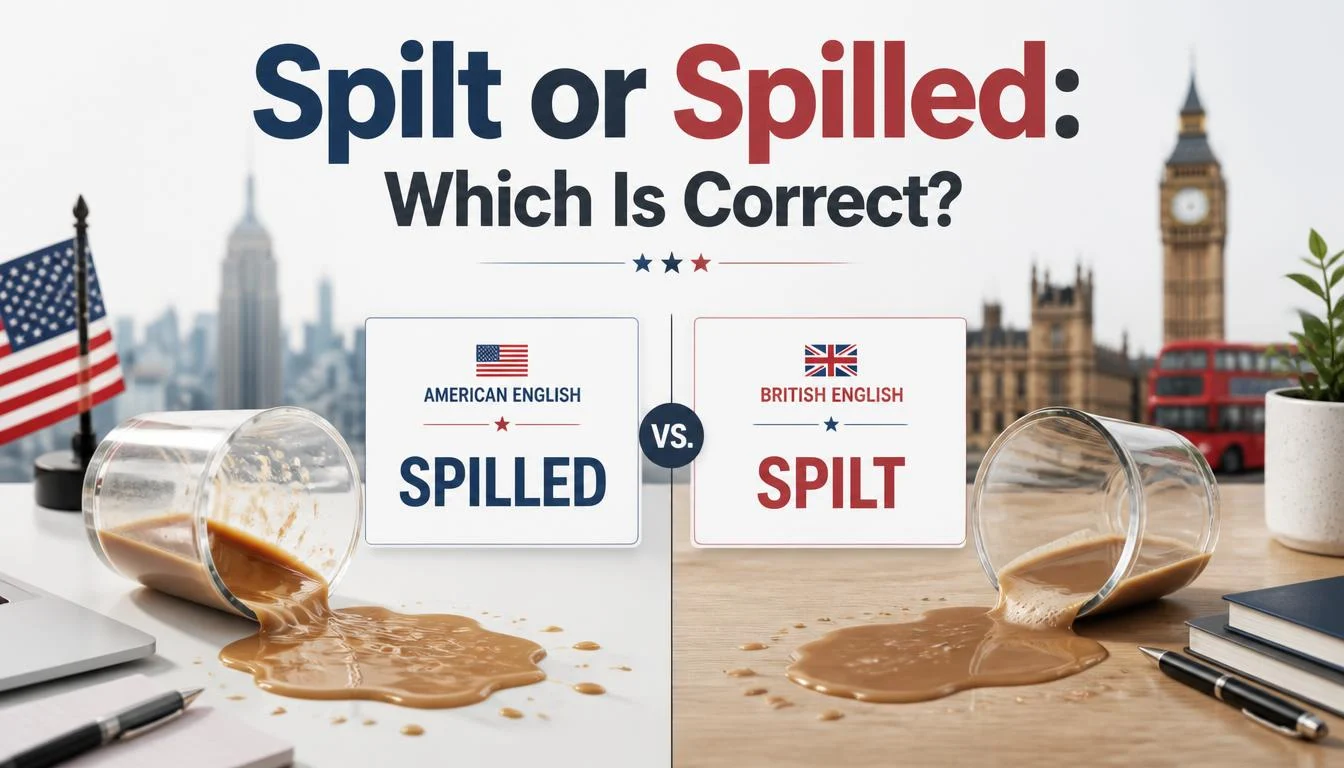
Spilled is the standard American English form, while spilt is mainly a British English variant.Both mean that something was accidentally or deliberately poured, scattered, or released.
If you have ever wondered whether spilt or spilled is the correct form, you are not alone. Both forms come from the verb spill, which means to accidentally or deliberately cause a liquid or other substance to fall or spread out. The main difference is often connected to regional English usage: spilled is more common in American English, while spilt remains widely used in British English and other varieties.
Understanding the difference between spilt and spilled can help you choose the form that fits your audience and writing style. Both can function as the past tense and past participle of spill, but their frequency varies by region and context. In this guide, we’ll look at their meanings, grammar, pronunciation, and example sentences so you can confidently decide which spelling to use.
Which One Is Correct?
Both spilled and spilt are valid English words, but they do not have the same level of use in every variety of English.
Spilled is the standard and more common form in American English. It is also widely understood and used in British English.
Spilt is a recognized alternative, particularly in British English. It often appears in phrases such as “spilt milk” and “spilt coffee.”
So, the choice depends on your variety of English:
- American English: spilled
- British English: spilled and spilt
- Formal American writing: spilled
- British informal and traditional writing: spilt is common
- Meaning: the same
If your audience expects standard American English, spilled is the safest choice.
Meaning of the Correct Word
Definition
Spilled is the simple past tense and past participle of spill.
The verb spill means to accidentally or intentionally cause a liquid, substance, or collection of things to fall, flow, or spread beyond its intended container or place.
For example:
I spilled my coffee on the table.
Here, spilled tells us that the coffee escaped from its intended location.
The word can describe liquids, loose objects, information, emotions, and even people leaving from a crowded place.
Explanation
The verb spill has several related meanings.
The most literal meaning involves a liquid:
She spilled water on the floor.
However, English speakers also use spill figuratively. Someone can spill a secret, spill the truth, or spill the details.
The same past form applies:
He spilled the secret.
In another context, spilled can describe people or objects spreading outward:
The crowd spilled into the street.
This wider meaning makes spilled a useful word in everyday and professional English.
Usage
Spilled can work as a main verb or as a past participle.
As a simple past verb:
Tom spilled the juice.
With have, has, or had, it functions as a past participle:
Tom has spilled the juice.
It can also appear in passive constructions:
The juice was spilled on the carpet.
American English generally favors spilled in all these constructions.
Real-World Examples
Here are several natural examples:
- I spilled coffee on my shirt this morning.
- She spilled water while carrying the glass.
- Someone spilled paint across the floor.
- He accidentally spilled the beans about the surprise.
- The children spilled into the backyard after school.
- The company spilled confidential information during the investigation.
- Rainwater spilled over the edge of the roof.
- She spilled her drink during dinner.
These examples show why context matters. Spilled does not always refer to liquid.
Meaning of the Incorrect or Alternative Word
Incorrect
Spilt is not actually incorrect English.
For American English readers, however, it may look less familiar because spilled is the normal American form. Calling spilt “wrong” would therefore be misleading.
If you are writing for a U.S. audience, use spilled unless you have a specific reason to preserve British wording.
Typo
Spilt is not simply a typo for spilled.
A typo would be an accidental misspelling, such as writing spileld or spiled when you intended spilled. By contrast, spilt is an established English form.
This distinction matters when proofreading. You should not automatically change every instance of spilt to spilled without considering the intended variety of English.
Slang
Spilt is not slang.
It is a standard grammatical form of spill in varieties of English that use it. Its presence does not indicate casual speech, internet language, or poor writing.
Regional Variation
The biggest difference between spilt and spilled is regional preference.
American English strongly favors spilled:
She spilled the milk.
British English allows both forms:
She spilled the milk.
She spilt the milk.
The second sentence is perfectly understandable and grammatically established in British usage.
Other English-speaking regions may also use spilt, depending on local writing conventions and exposure to British English.
Rare but Valid Usage
In American English, spilt can appear occasionally because writers encounter British books, media, quotations, or international English.
It may also survive in fixed expressions or familiar phrases. “It’s no use crying over spilt milk” is a famous example.
The phrase remains widely recognized even among American speakers, although Americans commonly say “It’s no use crying over spilled milk” in ordinary usage.
Key Differences Between the Two Words
| Feature | Spilled | Spilt |
|---|---|---|
| Spelling | Standard American form | Established alternative |
| Meaning | Past tense/past participle of spill | Past tense/past participle of spill |
| Pronunciation | “spild” | “spilt” |
| Grammar | Standard | Standard in varieties that use it |
| American usage | Very common | Less common |
| British usage | Common | Common |
| Recognition | Very widely recognized | Widely recognized |
| Main difference | Regional preference | Regional preference |
The important point is that meaning and grammar do not separate these forms. Regional convention does.
Pronunciation Difference
The two forms have slightly different pronunciations.
Spilled is pronounced roughly “spild.”
Spilt is pronounced roughly “spilt.”
The difference comes from the final consonant sound. Spilled ends with a d sound, while spilt ends with a t sound.
Neither pronunciation changes the meaning.
Grammar Difference
Both forms can function as the past tense and past participle of spill.
Compare:
She spilled the water.
She spilt the water.
Both sentences describe a completed action.
You can also use either form after have, has, or had:
He has spilled the coffee.
He has spilt the coffee.
Again, the difference is primarily regional rather than grammatical.
Common Mistakes People Make
Mistake 1: Assuming “spilt” Is Always Wrong
This is the most common misunderstanding.
Spilt is a valid form of spill, especially in British English. It should not automatically be labeled incorrect.
For American writing, however, spilled is the more natural choice.
Mistake 2: Treating “Spilt” as a Noun
Some learners may think that spilt represents a different type of word.
It does not. It is a verb form.
For example:
The milk was spilt.
Here, spilt is part of the verb phrase was spilt.
Mistake 3: Using Both Forms in the Same Style
Switching between spilled and spilt without a reason can make your writing look inconsistent.
If you are writing an American English article, choose spilled throughout.
If you are deliberately using British English, spilt may fit naturally.
Mistake 4: Thinking the Words Have Different Meanings
They do not.
Both forms can describe liquid escaping from a container:
The glass spilled over.
The glass spilt over.
They can also describe figurative actions:
She spilled the secret.
She spilt the secret.
The regional form changes, but the core meaning remains.
Mistake 5: Changing “Spilled” to “Spilt” for Variety
Writers sometimes believe repeated words should always be replaced with alternatives.
That is unnecessary here. Spilled and spilt are not interchangeable style choices in every variety of English. Your audience should guide the decision.
Correct Usage Examples
Casual Examples
Everyday conversations usually use spilled in American English.
I spilled my coffee again.
You spilled water on the counter.
The baby spilled the cereal everywhere.
I think someone spilled juice on the floor.
She spilled her drink during the movie.
These sentences sound natural in ordinary American conversation.
British speakers may use spilt in the same situations:
I spilt my coffee again.
You spilt water on the counter.
Both patterns are grammatical.
Professional Examples
Professional writing usually benefits from consistency and a clear regional standard.
The employee accidentally spilled chemicals near the storage area.
The report stated that fuel had spilled from the damaged container.
The company confirmed that confidential information had been spilled during the discussion.
In American professional writing, spilled is the expected form.
In British publications, spilt may appear instead.
Educational Examples
Teachers and textbooks may use the verb to explain both literal and figurative meanings.
The student spilled ink across the page.
The witness accidentally spilled important details.
The river spilled over its banks after heavy rain.
For learners studying American English, spilled is the form worth remembering first.
Literary/Metaphorical Examples
Writers often use spill metaphorically to create vivid descriptions.
Golden sunlight spilled through the window.
The crowd spilled into the narrow streets.
Her words spilled out before she could stop them.
Laughter spilled across the room.
In these examples, spilled describes movement or expression rather than an ordinary liquid accident.
British writers may use spilt in comparable sentences:
Golden sunlight spilt through the window.
The meaning remains clear.
Word Origin / Etymology
The verb spill has a long history in English and Germanic languages. It developed from older forms associated with causing something to fall, scatter, or flow.
English has historically developed more than one way to form the past tense and past participle of certain verbs. Spill became one of the verbs that can appear with the endings -ed and -t.
That explains the relationship between spilled and spilt.
The -ed ending is familiar across modern English because it forms the regular past tense of many verbs:
- walk → walked
- clean → cleaned
- open → opened
- spill → spilled
The -t pattern appears in several older or irregular forms:
- burn → burnt
- learn → learnt
- dream → dreamt
- spell → spelt
However, English varieties do not always treat these alternatives in the same way. American English often prefers the -ed forms, while British English retains more -t forms in certain verbs.
That historical pattern helps explain why spilt remains valid even though spilled dominates American usage.
Why the Incorrect Version Became Popular
It is more accurate to call spilt an alternative form rather than an incorrect version.
The reason spilled became especially dominant in American English relates to broader differences between American and British usage. American English often favors regular -ed forms where British English may retain older -t alternatives.
You can see a similar pattern with several verbs:
| American English | British English alternative |
|---|---|
| burned | burnt |
| learned | learnt |
| dreamed | dreamt |
| spelled | spelt |
| spilled | spilt |
These pairs are not perfectly identical in every context, and British English also uses many -ed forms. Still, the pattern helps explain why American readers usually expect spilled.
Language change also plays a role. Over time, speakers tend to favor forms that fit familiar grammatical patterns. The regular -ed ending is extremely productive in English.
As a result, spilled became the natural everyday choice for most American speakers.
Easy Memory Tricks
Think “America = -ed”
If you are writing standard American English, remember:
spill → spilled
The same pattern appears in:
spell → spelled
burn → burned
learn → learned
This does not mean the -t forms are always wrong. It simply gives you a reliable American English default.
Remember “Spilt = British Flavor”
When you see spilt, think of British English.
That does not make it incorrect. It simply tells you that the writer may be following British usage.
Use the Phrase Test
Think about the familiar expression:
It’s no use crying over spilled milk.
That version will sound natural to most American readers.
If you are writing for a British audience, you may encounter:
It’s no use crying over spilt milk.
Both versions communicate the same idea.
One Simple Rule
If you only need one rule for everyday writing, use this:
American English → spilled
British English → spilled or spilt
That rule will prevent most mistakes.
FAQs
Is “spilt” grammatically correct?
Yes. Spilt is a valid past tense and past participle of spill, especially in British English.
Is “spilled” American or British?
Spilled is standard in American English and is also widely used in British English.
Which is more common in American English, spilt or spilled?
Spilled is much more typical in American English.
Can I use “spilt” in a formal sentence?
Yes, particularly when following British English conventions. It is not slang or an incorrect spelling.
What is the past tense of “spill”?
Both spilled and spilt can serve as the past tense, depending on regional usage.
What is the past participle of “spill”?
Both spilled and spilt can function as past participles, as in “has spilled” and “has spilt.”
How do you pronounce “spilled”?
It is pronounced approximately “spild.”
How do you pronounce “spilt”?
It is pronounced approximately “spilt.”
Conclusion
When choosing between spilt or spilled, American English normally favors spilled, while British English accepts both forms.
Neither word changes the basic meaning or grammatical function of spill.Use spilled for consistent standard American writing, and recognize spilt as a valid regional alternative.The easiest rule to remember is simple: American English uses spilled; British English may use spilt.
Read More Articles
- Rock or Something | How to Use These Words Naturally In 2026
- Pilates and Or | Correct Usage Guide for English Learners In 2026

Christopher Parker is a writer and blogger at GramScript.com, sharing thoughtful insights and engaging stories across a range of topics. His writing blends clarity, curiosity, and a distinctly human perspective.