Quick Answer
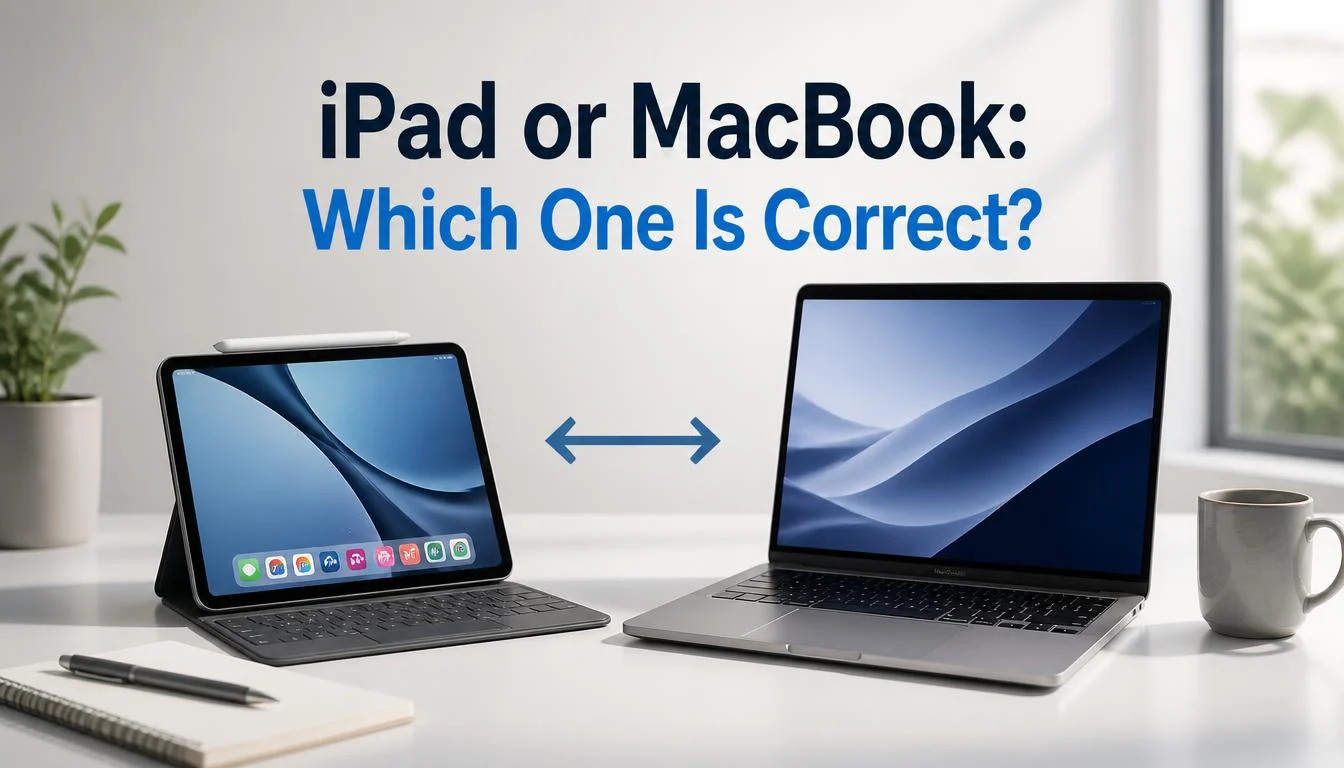
iPad and MacBook are both correct, but they name different Apple devices: an iPad is a tablet, while a MacBook is a laptop.The main writing issue is capitalization: write iPad, not “ipad,” and MacBook, not “macbook.”
Choosing between an iPad or MacBook can be difficult because both Apple devices offer powerful features, excellent displays, and a polished user experience. However, they serve different purposes. An iPad focuses on portability, touch interaction, media consumption, and flexible everyday use, while a MacBook provides a traditional laptop experience with a full desktop operating system and a keyboard-focused workflow.
The right choice depends on how you plan to use your device. Students may prioritize note-taking and portability, while professionals might need desktop applications, multitasking, or a more conventional work setup. By comparing the iPad and MacBook across performance, portability, software, accessories, battery life, and everyday productivity, you can better understand which option matches your needs and budget.
Which One Is Correct?
Both iPad and MacBook are correct.
The correct form depends on the device you mean. Use iPad when referring to Apple’s tablet line. Use MacBook when referring to Apple’s laptop line.
| Form | Correct? | What it refers to |
|---|---|---|
| iPad | Yes | Apple’s tablet |
| MacBook | Yes | Apple’s laptop |
| ipad | No in standard product-name usage | Incorrect capitalization |
| macbook | No in standard product-name usage | Incorrect capitalization |
The most important point is that iPad or MacBook is not a traditional right-versus-wrong spelling question. Both product names are established. The difference lies in what they identify.
For example:
- “I use an iPad for reading.”
- “She bought a MacBook for college.”
- “Should I choose an iPad or MacBook for my studies?”
- “My MacBook connects with my iPad.”
These sentences use both names correctly.
Meaning of the Correct Word
Definition
An iPad is a tablet computer made by Apple. It uses a touchscreen as its primary method of interaction and runs Apple’s tablet operating system.
A MacBook is a laptop computer made by Apple. It uses macOS and has a built-in physical keyboard and trackpad.
The two devices overlap in some tasks, but they are designed around different forms of computing.
Explanation
The word iPad identifies Apple’s tablet family. It is portable, touch-based, and generally lighter than a laptop. Users can browse the web, read books, watch videos, draw, take notes, communicate, and run apps on it.
The word MacBook identifies Apple’s notebook computers. A MacBook works more like a traditional desktop computer in a portable form. It supports a physical keyboard, trackpad, multiple windows, desktop applications, and broader file-management workflows.
That difference makes the phrase iPad or MacBook useful when someone is deciding which type of device fits a particular task.
An iPad may feel more natural for handwritten notes, drawing, media consumption, and touch-based activities. A MacBook may feel more natural for extensive typing, desktop productivity, software development, and workflows that depend on a traditional computer environment.
Usage
Use iPad as a proper product name when you mean Apple’s tablet.
Use MacBook as a proper product name when you mean Apple’s laptop.
Because both names function as product names, they usually retain their official capitalization in professional writing.
Correct:
I brought my iPad to class.
Correct:
My MacBook is connected to the external display.
Less appropriate in standard writing:
I brought my ipad to class.
Less appropriate:
My macbook is connected to the display.
Real-World Examples
Here are several natural examples:
- “I use my iPad to mark up PDF documents.”
- “He takes his MacBook to the office every day.”
- “She uses an iPad for digital artwork.”
- “The student wrote the report on a MacBook.”
- “I’m deciding between an iPad or MacBook for college.”
- “My iPad is useful when I want a lightweight device.”
- “The MacBook gives me a traditional laptop setup.”
Meaning of the Incorrect or Alternative Word
Incorrect
“ipad” is not the standard capitalization for Apple’s tablet name. The official-style product name uses a lowercase i followed by an uppercase P: iPad.
Similarly, “macbook” does not preserve the standard capitalization of the product name. The conventional form is MacBook, with capital M and B.
The lowercase forms may still appear in informal typing, search queries, filenames, or user-generated content. That does not make them the preferred forms in polished writing.
Typo
“ipad” and “macbook” can occur as simple typing errors.
People often type product names quickly on phones or keyboards. Automatic capitalization can also produce unexpected forms.
A typo does not create a new English word. If you are writing an article, report, email, or product description, use the established capitalization.
Slang
Neither ipad nor macbook is a separate slang word with a different meaning.
People may shorten product names in casual conversation, but the lowercase versions do not normally represent distinct slang terms.
For example, someone might casually say, “I left my Mac at home.” That does not make “Mac” another official name for every MacBook model. Context determines what the speaker means.
Regional Variation
There is no major American-versus-British spelling difference between iPad and MacBook.
English speakers in different countries generally recognize the same product names.
Other surrounding words can vary by region. For example, American English commonly uses “laptop,” while other varieties may use “notebook computer” more often. The product names themselves remain iPad and MacBook.
Rare but Valid Usage
You may encounter lowercase forms in URLs, usernames, search queries, database entries, or technical identifiers.
Those contexts may impose their own formatting rules. A web address, file name, or code identifier does not always follow normal prose capitalization.
In ordinary English writing, however, iPad and MacBook remain the preferred forms.
Key Differences Between the Two Words
The most important difference is not spelling. It is what each name represents.
| Feature | iPad | MacBook |
|---|---|---|
| Spelling | iPad | MacBook |
| Meaning | Apple tablet | Apple laptop |
| Pronunciation | eye-PAD | mak-BOOK |
| Grammar | Proper product name | Proper product name |
| Main interaction | Touchscreen | Keyboard and trackpad |
| Device category | Tablet | Laptop |
| Standard capitalization | Lowercase i, uppercase P | Uppercase M and B |
| Common use | Reading, drawing, browsing, media, notes | Writing, programming, productivity, desktop work |
| Recognition | Widely recognized product name | Widely recognized product name |
Spelling
The spelling pattern is distinctive.
iPad begins with a lowercase i and uses an uppercase P. The form is not “Ipad” or “ipad” in standard product-name writing.
MacBook begins with a capital M and contains a capital B. The standard form is not “Macbook” or “macbook.”
Meaning
An iPad refers to a tablet.
A MacBook refers to a laptop.
This difference remains important even though both devices can perform many similar tasks.
Pronunciation
iPad is commonly pronounced eye-PAD.
MacBook is commonly pronounced mak-BOOK.
The pronunciation helps distinguish the two names in conversation, especially when someone is comparing devices.
Grammar
Both names are proper nouns because they identify a specific branded product family.
- You can use them as nouns:
“My iPad is on the desk.”
“My MacBook needs charging.”
- You can also use them after prepositions:
“I wrote the notes on my iPad.”
“She finished the project on her MacBook.”
- You do not normally need quotation marks around either name.
Usage
Use iPad when the subject is Apple’s tablet.
Use MacBook when the subject is Apple’s laptop.
When comparing the two, the phrase iPad or MacBook works naturally:
“Which is better for taking notes, an iPad or MacBook?”
However, “better” depends on the task. A device that suits handwritten notes may not suit someone who spends most of the day writing code or long documents.
Recognition
Both product names have strong recognition in everyday technology writing.
That recognition makes correct capitalization especially useful. Readers can immediately identify iPad and MacBook as product names.
Common Mistakes People Make
Writing “ipad” Instead of “iPad”
This is one of the most common mistakes.
The correct form is:
“I bought an iPad.”
Not:
“I bought an ipad.”
The lowercase form may be understandable, but it does not follow the standard product-name capitalization.
Writing “macbook” Instead of “MacBook”
The same issue appears with MacBook.
Correct:
“My MacBook has a large display.”
Incorrect in standard product-name style:
“My macbook has a large display.”
Using “Ipad”
Some writers capitalize the first letter and produce Ipad.
That form is closer to the correct spelling, but it still misses the established capitalization pattern.
Write iPad, not Ipad.
Writing “Macbook”
Another common variation is Macbook.
The correct form is MacBook, with a capital B.
This internal capital is part of the product name.
Treating the Names as Synonyms
An iPad and a MacBook are not two names for the same device.
They belong to different product categories.
A person can own both and use each for different tasks.
Assuming One Is Grammatically Correct and the Other Is Not
This misunderstanding often comes from the structure of comparison searches.
The phrase iPad or MacBook may look like a spelling-choice question. It is actually a product comparison in many contexts.
Both names are correct. The question is usually which device is more suitable for a particular purpose.
Correct Usage Examples
Casual Examples
- “Should I bring my iPad or MacBook?”
- “I left my iPad in the living room.”
- “My MacBook is almost out of battery.”
- “Do you use an iPad for watching movies?”
- “I usually take my MacBook when I travel for work.”
These examples sound natural in everyday conversation.
Professional Examples
- “The presentation was prepared on a MacBook.”
- “The team uses iPads for mobile demonstrations.”
- “Please review the document on your MacBook.”
- “The iPad can be useful during client meetings.”
- “We need to decide whether an iPad or MacBook better fits this workflow.”
In professional writing, capitalization becomes particularly important because product names should look consistent throughout a document.
Educational Examples
- “Students can use an iPad to annotate digital textbooks.”
- “The teacher prepared the lesson on a MacBook.”
- “An iPad can support handwritten note-taking.”
- “A MacBook can handle longer typing assignments comfortably.”
- “The student compared an iPad and MacBook before choosing a device.”
These examples show why context matters. Both devices can support education, but their interfaces and workflows differ.
Literary/Metaphorical Examples
Product names can also appear in creative or metaphorical writing.
For example:
“The iPad felt like a digital notebook in her hands.”
“His MacBook became the workshop where every chapter took shape.”
These sentences use the product names naturally while giving the devices a figurative role.
Word Origin / Etymology
The two names have different naming structures.
iPad combines Apple’s lowercase i naming convention with the word Pad. The “pad” element suggests a flat, portable writing or computing surface, similar to a notepad or writing pad.
Apple introduced the first iPad in 2010. The name quickly became associated with the company’s tablet category.
MacBook combines Mac, Apple’s long-standing shortened form of Macintosh, with Book. The word “book” suggests a portable computer that folds like a book.
Apple introduced the MacBook name in the mid-2000s as part of its notebook computer lineup. The name therefore combines Apple’s established Mac identity with a word associated with portability.
The capitalization also reflects Apple’s branding choices. The lowercase i became strongly associated with several Apple product names, while MacBook follows the compound brand style Mac + Book.
Why the Incorrect Version Became Popular
The lowercase versions ipad and macbook became common largely because people type quickly and often ignore brand capitalization.
Search boxes, messages, comments, filenames, and informal posts frequently contain lowercase product names. Many digital interfaces also treat uppercase and lowercase letters similarly when processing searches.
Another reason is ordinary English spelling. Most common nouns do not contain unusual internal capitalization. Someone unfamiliar with Apple’s naming conventions may naturally write “ipad” or “macbook.”
Keyboard habits also play a role. People often write product names without checking the official styling. Once a lowercase form appears frequently online, it can look familiar even though it is not the preferred form in polished prose.
The important distinction is simple: frequent informal usage does not automatically make a product name’s capitalization standard.
Easy Memory Tricks
Remember the “i” in iPad
Think:
i + Pad = iPad
The i stays lowercase, while P is uppercase.
You can remember it as:
little i, big P
Remember the Two Capitals in MacBook
Think:
Mac + Book = MacBook
Both parts begin with capitals.
A useful shortcut is:
Mac meets Book
That gives you M + B = MacBook.
Remember the Device Categories
Use this quick association:
- iPad = tablet
- MacBook = laptop
If you remember the device category, choosing the correct name becomes much easier.
Remember That Both Are Correct
Do not treat the comparison as a normal spelling battle.
iPad is correct.
MacBook is correct.
The lowercase forms are simply nonstandard capitalization in ordinary prose.
FAQs
Is iPad or MacBook correct?
Both are correct. iPad names Apple’s tablet, while MacBook names Apple’s laptop.
Is “ipad” grammatically correct?
In standard product-name writing, use iPad instead. The lowercase “ipad” does not follow the established capitalization.
Is it MacBook or Macbook?
The standard form is MacBook, with a capital M and B.
How do you pronounce iPad?
iPad is commonly pronounced eye-PAD.
How do you pronounce MacBook?
MacBook is commonly pronounced mak-BOOK.
Are iPad and MacBook the same thing?
No. An iPad is a tablet, while a MacBook is a laptop.
Should iPad and MacBook be capitalized?
Yes. They are specific product names, so use iPad and MacBook in standard writing.
Which is correct in a sentence: iPad or MacBook?
Either can be correct, depending on the device you mean. For example, “I use an iPad” and “I use a MacBook” are both correct.
Conclusion
When comparing iPad or MacBook, remember that both names are correct because they identify different Apple devices.
Use iPad for the tablet and MacBook for the laptop, with their standard capitalization.Avoid forms such as “ipad,” “Ipad,” “macbook,” and “Macbook” in polished writing.The easiest rule to remember is simple: iPad is a tablet, MacBook is a laptop.
Read More Articles
- W2 or W4 | Understanding Your Tax Forms In 2026
- UTI or STD |The Key Differences You Should Know In 2026

Jessica Morgan is a blogger and writer at GramScript.com, where she turns everyday ideas into engaging, relatable stories. Her writing blends a natural voice with fresh perspectives that keep readers coming back.
2 thoughts on “iPad or MacBook | Compare Features, Performance and Flexibility In 2026”