Quick Answer
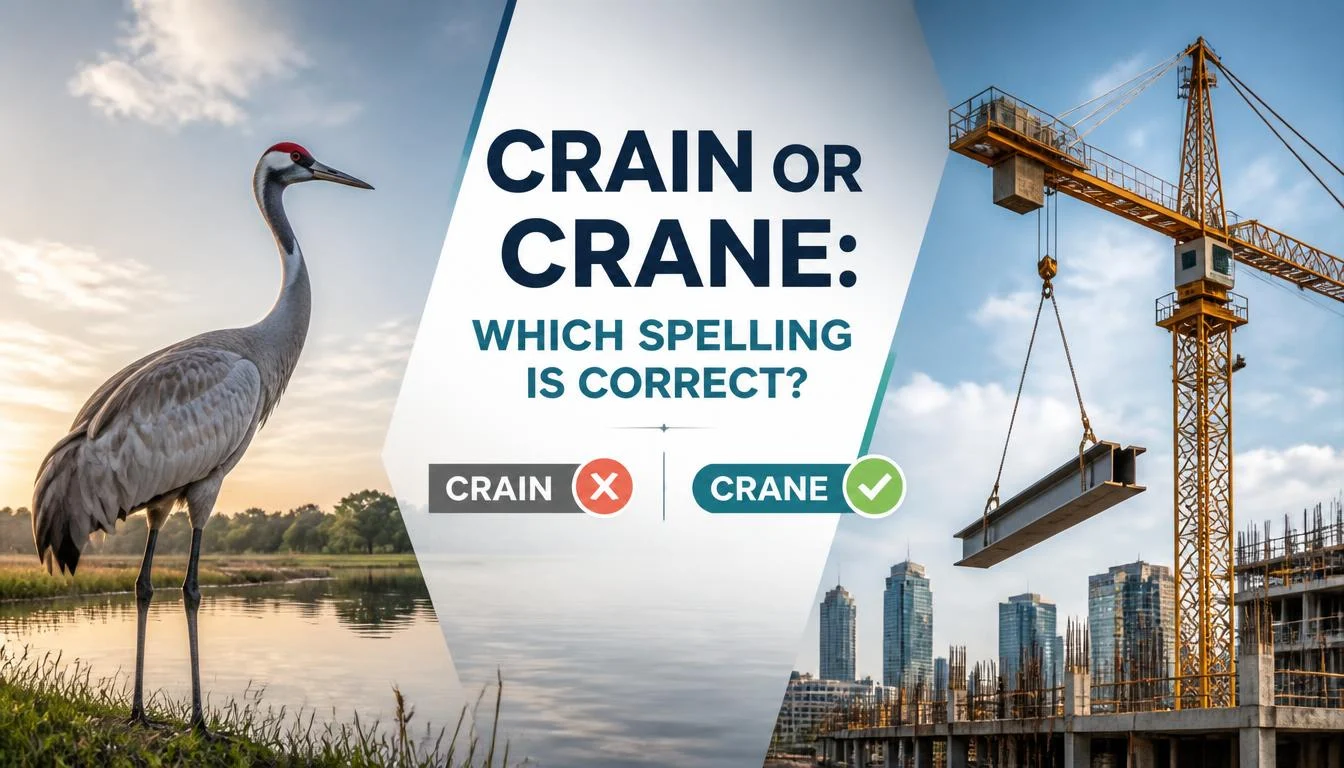
Crane is the standard English spelling for the bird, lifting machine, and verb meaning to stretch your neck.Crain is not the standard spelling for these meanings, although Crain can appear as a surname.
If you have ever wondered whether the correct spelling is crain or crane, you are not alone. These words look very similar, but they do not have the same status in standard English. Crane is the correct spelling when you mean the tall construction machine used for lifting heavy objects or the long-necked bird. Crain, on the other hand, is generally not the standard spelling of this common English word, although it can appear as a surname or proper name.
Understanding the difference between crain and crane can help you avoid a simple spelling mistake in writing. In this guide, we will explain the correct spelling, define crane in its different contexts, and show how to use it naturally in sentences. You will also see why crain sometimes appears and when it may be appropriate.
Which One Is Correct?
Crane is the correct standard English word for the common meanings discussed in this article.
It can function as a noun or a verb:
- A crane can be a large construction machine.
- A crane can be a long-legged, long-necked bird.
- To crane means to stretch or lean your neck to see something better.
Major English dictionaries list these meanings for crane. Cambridge gives the pronunciation as /kreɪn/, which can be written simply as KRAIN for learners.
The spelling crain is not the standard spelling for these common meanings. If you are writing about construction equipment, birds, or stretching your neck, choose crane.
There is one important exception. Crain can occur as a surname. In that case, it is a proper name and should remain spelled Crain.
Meaning of the Correct Word
Definition
Crane has several established meanings in English.
As a noun, it can mean:
- A machine that lifts and moves heavy objects.
- A large bird with long legs and a long neck.
As a verb, crane means to stretch or lean your neck to see something more clearly.
For example:
- The construction crane lifted the steel beam.
- We watched a crane walking through the wetland.
- She craned her neck to see over the crowd.
Cambridge and Oxford both recognize the machine, bird, and stretching-related meanings of crane.
Explanation
The word crane connects several ideas through the bird’s distinctive shape.
A crane bird has a long neck and long legs. The construction machine called a crane also has a long projecting arm. The verb to crane developed from the idea of stretching like a crane bird.
That connection makes the different meanings easier to understand.
When someone says, “He craned his neck,” they mean that he stretched his neck forward or upward to get a better view.
The word can therefore describe both a physical machine and a physical action.
Usage
Use crane when the sentence refers to standard English meanings such as:
- construction equipment
- lifting machinery
- cranes used at ports
- crane birds
- bird species such as sandhill cranes
- stretching your neck
- leaning forward to see something
The word can work as a noun or verb.
Noun:
The crane moved the heavy container.
Verb:
I had to crane my neck to see the stage.
The verb commonly appears with words such as neck, head, forward, over, or out. Oxford lists constructions such as “crane your neck” and “crane forward.”
Real-World Examples
Here are natural examples of crane in everyday English:
- The workers used a crane to lift the roof panels.
- A tall crane stood beside the unfinished building.
- We saw a sandhill crane near the lake.
- She craned her neck to see what was happening.
- The children craned forward when the parade began.
- The harbor uses several large cranes to move containers.
- He stood on his toes and craned his neck over the crowd.
- The photographer captured a beautiful crane flying across the marsh.
These examples show why context matters. The same spelling, crane, can refer to equipment, a bird, or an action.
Meaning of the Incorrect or Alternative Word
Incorrect
When you mean the common English word for a lifting machine, bird, or neck-stretching action, crain is incorrect.
For example:
The crain lifted the steel beam.
This should be:
The crane lifted the steel beam.
Likewise:
She crained her neck to see.
should be:
She craned her neck to see.
Typo
In many cases, crain is simply a spelling mistake for crane.
The error is understandable because the words sound exactly alike in standard pronunciation. Both may be pronounced like KRAIN when people encounter them visually.
The difference appears only in the spelling.
This makes crain an easy typo, especially when someone is typing quickly or spelling from memory.
Slang
Crain is not a standard slang replacement for crane.
You should not use crain in informal writing simply because the conversation is casual. Informal English still uses crane for the ordinary word.
For example:
We watched the crane move the container.
remains correct in both casual and professional English.
Regional Variation
Crain is not a standard American English or British English spelling variation of crane.
You should not treat it like pairs such as color/colour or center/centre. Those pairs reflect established spelling differences between varieties of English.
Crain does not serve that role for crane.
Rare but Valid Usage
There is an important distinction between a word and a proper name.
Crain can appear as a surname. In that context, it is not a misspelling of the common noun crane. Family names can preserve spellings that differ from ordinary dictionary words.
For example:
Dr. Crain spoke at the conference.
Here, Crain is a person’s name. Changing it to Crane would change the person’s surname.
So, the safest rule is simple: use crane for the ordinary English word, but preserve Crain when it is someone’s established name.
Key Differences Between the Two Words
| Feature | Crane | Crain |
|---|---|---|
| Spelling | Crane | Crain |
| Meaning | Bird, lifting machine, or stretching action | Mainly encountered as a surname |
| Pronunciation | KRAIN | Usually KRAIN when used as a surname |
| Grammar | Noun and verb | Proper noun when used as a surname |
| Standard common word? | Yes | No, for the meanings above |
| Usage | Everyday, technical, educational, and literary writing | Names and specific proper-name contexts |
| Recognition | Widely recognized English word | Recognized primarily as a name in this context |
| Example | The crane lifted the load. | Mr. Crain arrived early. |
The biggest difference is not pronunciation. It is meaning and spelling.
Crane belongs to standard English vocabulary. Crain, when used as a surname, belongs to the category of proper names.
That distinction is useful because a spell-checker may flag Crain in some contexts while accepting it in others. Names often do not behave like ordinary dictionary words.
Common Mistakes People Make
Writing “crain” for a construction machine
This is one of the most common spelling errors.
Incorrect:
The crain lifted the concrete block.
Correct:
The crane lifted the concrete block.
Remember that the machine is always spelled crane.
Writing “crain” for the bird
The bird is also spelled crane.
Incorrect:
We saw a beautiful crain near the wetland.
Correct:
We saw a beautiful crane near the wetland.
Common bird names can be tricky because pronunciation does not always reveal their spelling.
Writing “crained” instead of “craned”
The past tense of crane is craned, not crained.
Incorrect:
He crained his neck to see the screen.
Correct:
He craned his neck to see the screen.
The same pattern applies to the other forms:
- crane
- cranes
- craned
- craning
Oxford lists craned as the past tense and craning as the -ing form.
Assuming the pronunciation tells you the spelling
English contains many words whose pronunciation does not make their spelling obvious.
Crane is pronounced like KRAIN, so someone unfamiliar with the spelling may naturally write crain.
The sound alone cannot tell you whether the word contains ai or ay, or where the vowel pattern comes from.
Changing someone’s surname
If Crain is someone’s surname, do not automatically correct it to Crane.
For example:
Professor Crain published the study.
That sentence can be completely correct if Crain is the person’s actual surname.
The spelling of a proper name depends on the name itself, not on the spelling of a similar dictionary word.
Correct Usage Examples
Casual Examples
Here are some natural examples from everyday conversation:
- I had to crane my neck to see the screen.
- Look at that crane by the lake!
- There’s a huge crane outside the building.
- Everyone was craning to see what happened.
- I could barely see over the crowd, so I craned forward.
Notice that the spelling stays crane even when the sentence is very informal.
Professional Examples
The word crane is common in construction, shipping, engineering, and industrial contexts.
- The crane lifted the equipment onto the upper floor.
- The operator inspected the crane before starting work.
- The port uses cranes to move shipping containers.
- The damaged crane requires a complete safety inspection.
- The company purchased a mobile crane for the new project.
In these contexts, crane is a technical term, so correct spelling matters.
Educational Examples
Teachers and students may use crane when discussing vocabulary, birds, biology, or engineering.
- The crane is a large bird with long legs and a long neck.
- The class learned how cranes adapt to wetland environments.
- A construction crane can move extremely heavy materials.
- The students watched a crane lift a steel beam.
- We learned that “to crane” can mean to stretch your neck.
These examples also demonstrate how one word can have several related meanings.
Literary/Metaphorical Examples
Crane can also appear in descriptive or literary writing.
- She craned her neck toward the distant sound.
- He craned forward, hoping to catch the final words.
- The crane rose above the skyline like a giant metal arm.
- A lone crane stood quietly at the edge of the marsh.
- The crowd craned toward the doorway when the announcement began.
The verb often creates a clear physical image. It suggests curiosity, effort, or a desire to see beyond an obstruction.
Word Origin / Etymology
The history of crane is especially interesting because the modern word has connections to both the bird and the lifting machine.
The bird sense is very old. Oxford traces the noun referring to the bird to Old English and identifies it as Germanic in origin. It connects the word with related forms in languages such as Dutch and German, as well as with older Indo-European forms associated with the crane bird.
The machine sense developed later through a visual comparison with the bird. A crane machine has a long projecting arm, which resembles the long neck and shape associated with a crane bird.
The verb crane also developed from this bird-related image. Oxford explains that the verb is figurative in origin and dates to the late sixteenth century.
This explains why the same word can describe three seemingly different things:
- a bird
- a lifting machine
- stretching your neck
The meanings are connected through shape and movement.
Why the Incorrect Version Became Popular
The spelling crain probably feels natural because English spelling does not always match pronunciation perfectly.
When people hear crane, they hear one syllable that sounds like KRAIN. Someone who has never seen the word written may choose crain because the letters ai commonly represent a long “a” sound in English.
Compare familiar words such as:
- rain
- train
- brain
- chain
This pattern can make crain look plausible.
However, English also uses -ane in words such as:
- cane
- lane
- plane
- crane
So the correct spelling must be learned from standard usage rather than pronunciation alone.
Another reason for confusion is that Crain exists as a surname. Seeing the spelling in names can reinforce the impression that it might also be an ordinary English word.
The key distinction remains simple: Crain can be a proper name, while crane is the standard common word.
Easy Memory Tricks
Think of “crane” and “cane”
A simple spelling trick is to remember:
CRANE = C + RANE
It follows the same basic -ane pattern found in cane, lane, and plane.
Remember the bird
Picture a tall crane bird with its long neck stretched upward.
The word describing that bird is:
CRANE
The long neck can help you remember the long-looking spelling with -ane.
Remember the machine
Imagine a construction crane lifting a heavy beam.
Write:
crane
not:
crain
Remember the verb
Think:
Crane your neck.
That phrase is common and easy to memorize.
Once you remember crane your neck, the spelling of the verb becomes easier.
Separate names from ordinary words
If you see Crain with a capital letter, consider whether it is a person’s surname.
For example:
Mr. Crain
That is different from:
The crane lifted the load.
Capitalization and context can provide an important clue.
FAQs
Is “crane” the correct spelling?
Yes. Crane is the standard spelling for the bird, lifting machine, and verb meaning to stretch your neck.
Is “crain” a word?
Crain can occur as a surname, but it is not the standard spelling of the common English word crane.
How do you pronounce “crane”?
Crane is pronounced KRAIN, rhyming with words such as “train” and “brain.”
Is “crain” a regional spelling of “crane”?
No. Crain is not a standard American or British spelling variation of crane.
What is the past tense of “crane”?
The past tense is craned. For example: “She craned her neck to see the stage.”
What does “crane your neck” mean?
It means to stretch or lean your neck so you can see something more clearly.
Can “Crain” be a name?
Yes. Crain can be used as a surname. In that context, keep the person’s established spelling.
Is a crane a bird or a machine?
It can mean either. A crane is a long-legged bird, and it is also a machine designed to lift and move heavy objects.
Conclusion
When comparing crain or crane, choose crane for the standard English word.It can describe a bird, a lifting machine, or the action of stretching your neck to see.Crain may appear as a surname, but it is not the standard spelling for these common meanings.Remember: if you mean the bird, machine, or action, crane is the spelling to use.
Read More Articles
- iPad or MacBook | Compare Features, Performance and Flexibility In 2026
- Spilt or Spilled | Meaning, Grammar and Examples In 2026

Jessica Morgan is a blogger and writer at GramScript.com, where she turns everyday ideas into engaging, relatable stories. Her writing blends a natural voice with fresh perspectives that keep readers coming back.